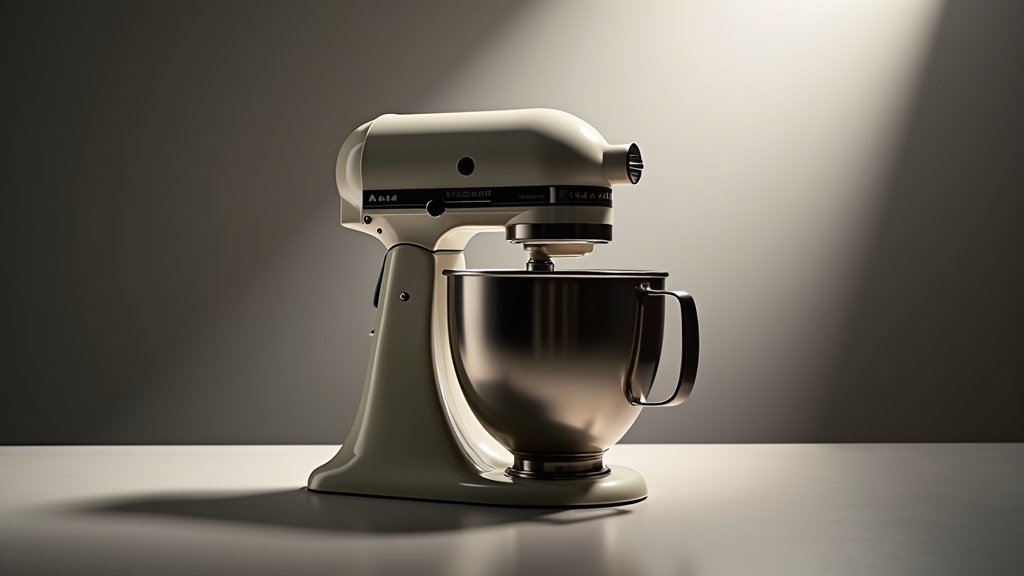
Everybody has an opinion on the KitchenAid Artisan. Your mother-in-law swears by hers. Your coworker who got into sourdough during the pandemic won’t stop talking about it. That food blogger you follow has one in Empire Red sitting on the counter in every single video, positioned at exactly the right angle to catch the light. The KitchenAid stand mixer isn’t just a kitchen appliance at this point — it’s a cultural artifact, a wedding registry staple, and for a lot of home bakers, the single most expensive countertop purchase they’ll ever justify.
So when I finally bought the KitchenAid Artisan Series KSM150PS six months ago, I didn’t come in neutral. I came in skeptical. Three hundred and fifty dollars for a mixer felt like paying a luxury tax on a brand name, especially when I could see the Cuisinart SM-50 and Hamilton Beach Eclectrics sitting on Amazon for $150 less. I wanted to know whether the Artisan actually earned that price tag through performance, or whether it survived on reputation alone — a kitchen trophy that looked better on the counter than it worked on the dough.
Stand mixer: A stationary kitchen appliance with a rotating mixing head and bowl that kneads dough, whips cream, and mixes batters hands-free, replacing manual mixing for consistent, thorough results.
Six months and roughly 70 baking sessions later, I have an answer. It’s more complicated than “yes” or “no,” and it depends entirely on what you’re baking, how often, and whether you’ve already caught the attachment fever that KitchenAid has engineered into every owner’s brain. Here’s the full breakdown.
According to the FDA, Proper food handling and preparation equipment play a critical role in food safety, according to the FDA.
KitchenAid Artisan KSM150PS at a Glance
- Motor: 325W DC
- Bowl: 5-Quart Stainless Steel
- Speeds: 10 + Stir
- Design: Tilt-Head, Die-Cast Metal
- Attachments: 50+ optional
- Price: ~$350
Why Everyone Owns One
Before I get into my test results, it’s worth understanding why the Artisan dominates the stand mixer market so thoroughly. This isn’t accidental, and it goes beyond marketing.
The KitchenAid stand mixer design has barely changed since the 1930s. That’s not laziness — it’s the same kind of design maturity you see in cast iron skillets or chef’s knives. The planetary mixing action, where the beater rotates on its own axis while orbiting the bowl, was patented by KitchenAid’s parent company decades ago. The tilt-head mechanism, the attachment hub on the front, the bowl-lift or tilt-head form factor — all of it has been refined over generations, not reinvented. When you buy an Artisan, you’re buying a machine whose fundamental engineering has been tested by millions of kitchens over nearly a century.
Then there’s the color game. KitchenAid offers the Artisan in over 40 colors, from predictable Onyx Black to genuinely stunning Pistachio, Hibiscus, and Bird of Paradise. This transforms a utilitarian appliance into a design statement. I chose Empire Red because I’m boring, but the color selection alone turns the Artisan into something people want to display rather than store. And a mixer that lives on the counter gets used. A mixer in the cabinet collects dust.
The attachment ecosystem is the final lock-in. With 50+ optional attachments — pasta rollers, meat grinders, ice cream makers, spiralizers, grain mills — the Artisan becomes a platform rather than a single-purpose tool. No competitor comes close to this ecosystem. Cuisinart offers maybe 8 attachments for their comparable mixer. Hamilton Beach offers 3. The KitchenAid attachment hub uses a universal connection that’s been standard since the 1930s, meaning attachments from your grandmother’s era still fit today’s machines.
None of this tells you whether the Artisan is good at mixing, which is, you know, its actual job. That’s where my six months of testing come in.
Bread & Dough Performance
I bake bread at least twice a week — mostly sandwich loaves, but I rotate through focaccia, pizza dough, bagels, and the occasional brioche when I’m feeling ambitious. Bread dough is the hardest test for any stand mixer because it puts sustained load on the motor, and it’s where cheap mixers fail most visibly.
The Artisan handles standard sandwich bread dough without complaint. My go-to recipe uses 500g of bread flour, 340g of water (68% hydration), 9g of salt, 7g of instant yeast, and a tablespoon of olive oil. On Speed 2 with the dough hook, the Artisan pulls this together into a shaggy mass in about 2 minutes, then develops gluten into a smooth, windowpane-ready dough in 8-10 minutes of kneading on Speed 2. The dough hook does walk the mixer slightly on the counter during this — I keep a damp towel underneath to prevent movement. But the motor sounds confident, the speed stays consistent, and the result is a well-developed dough every time.
Pizza dough at 60-65% hydration is equally effortless. I make two 300g pizza balls at a time, and the Artisan mixes and kneads them in about 7 minutes total. The planetary action does a good job of incorporating flour from the bowl edges, though I usually stop once at the 3-minute mark to scrape the sides with a spatula. The dough hook sometimes climbs up the shaft during pizza dough — a known Artisan quirk — but a quick push back down solves it.
Where I found the Artisan’s limit: double-batch bread dough and stiff bagel dough.
When I doubled my sandwich bread recipe to 1000g of flour, the Artisan struggled noticeably. The motor slowed on Speed 2, and the dough hook started stalling intermittently. I could hear the motor working harder — not grinding or clicking, but a deeper, labored hum that made me uncomfortable running it for the full 10-minute kneading time. I dropped to Speed 1 and extended the knead to 14 minutes, which produced an acceptable dough, but I was babysitting the mixer the entire time. The 5-quart bowl was also packed nearly to the brim. This is a genuine limitation of the 325W motor and the 5-quart capacity.
Bagel dough, which runs around 50-55% hydration and is essentially a stiff, dense mass, pushed the Artisan even harder. A single batch of 8 bagels was fine — slow but steady on Speed 2 for about 10 minutes. But the mixer was warm to the touch on the top of the housing afterward. I wouldn’t run two back-to-back batches of bagel dough without a 15-minute cooldown, and I’d be nervous about doing this regularly for years.
Brioche — which is soft but requires prolonged mixing to incorporate butter — worked well. The 15-minute mixing time at Speed 4 didn’t stress the motor, and the planetary action excels at slowly incorporating cold butter into enriched dough. This was actually one of the Artisan’s best performances, producing silky brioche dough that I couldn’t have achieved by hand.
Bottom line on dough: The Artisan handles single batches of most bread doughs confidently. Double batches and very stiff doughs push it to its limits. If you bake bread daily or in large quantities, the Professional 600 with its bowl-lift design and 575W motor is the smarter buy. For weekly home bakers making single batches, the Artisan is plenty.
Batter & Whipping
If bread dough is the Artisan’s stress test, batters and whipping are its comfort zone. This is where the 325W motor and planetary action genuinely shine, and where I’d argue the Artisan outperforms mixers costing twice as much.
Cake batter is almost too easy. I make a vanilla butter cake roughly every two weeks — it’s my go-to test because it requires creaming butter and sugar (which tests the paddle’s ability to aerate), incorporating eggs without curdling, and gently folding in flour without overworking the gluten. The Artisan’s Speed 4 creams room-temperature butter and sugar into a pale, fluffy mass in about 3 minutes. Speed 2 incorporates eggs one at a time without any splashing. Stir speed folds in flour and milk alternately in about 45 seconds. The whole process takes under 6 minutes from bowl to pan, and the results are consistently tender and well-risen.
Cookie dough — both drop cookies and cut-out styles — mixes perfectly on Speed 2 with the flat beater. The planetary action means I don’t need to stop and scrape the bowl constantly, which was my biggest complaint with my old hand mixer. I still scrape once, out of habit, but the Artisan catches about 90% of the ingredients on its own. Thick cookie doughs with chunks of chocolate and nuts incorporate evenly without the motor hesitating.
Whipping is where the Artisan surprised me most. I expected decent meringue and whipped cream performance, but the wire whisk attachment is genuinely excellent. Egg whites reach stiff peaks in about 4 minutes on Speed 8. The whipped whites are glossy, stable, and hold their peaks for the full time it takes me to fold them into whatever I’m making. Heavy cream whips to soft peaks in about 90 seconds on Speed 6, and stiff peaks take another 30 seconds — with a clearly visible texture change that makes it easy to stop at exactly the right moment.
Swiss meringue buttercream, which requires whipping a cooked sugar-and-egg-white mixture for 10+ minutes until cool, was completely hands-off. I started the whisk on Speed 8 and walked away to wash dishes. Ten minutes later, I had a perfectly smooth, billowy buttercream. My old hand mixer required me to stand there holding it the entire time, and my arm was always sore afterward. This alone justifies the Artisan’s price if you make buttercream more than occasionally.
One batter limitation worth noting: the 5-quart bowl is tight for triple-batch cookie recipes or large cakes that call for 6+ cups of flour. I’ve had flour puff out of the bowl when the mixer starts, despite using Stir speed, because the ingredients sit so close to the rim. For standard recipes (single or double batch), the 5 quarts is more than adequate. But if you regularly bake for large groups or events, you’ll feel the capacity limit.
Build Quality & Design
The KitchenAid Artisan is heavy. At 26 pounds, it sits on the counter with the authority of something that has no intention of moving. This weight comes from the die-cast zinc alloy housing and the metal internal gearing — there’s very little plastic in the structural components. Pick up a Cuisinart SM-50 (14 pounds) and then pick up the Artisan, and you’ll feel the difference immediately. Weight in a stand mixer isn’t marketing fluff; it’s stability. A heavier mixer walks less during heavy kneading, vibrates less during whipping, and generally feels more planted during operation.
The tilt-head mechanism is smooth on my unit. One hand lifts the head to access the bowl, and a spring-loaded pin locks it in the up position. After six months of roughly 70 uses, the mechanism still feels tight with no play or looseness. The locking pin engages with a satisfying click, and I’ve had zero instances of the head dropping unexpectedly during bowl access.
The stainless steel bowl is simple and functional — no handles, just a smooth 5-quart vessel that twists onto the base plate. It’s dishwasher safe and has shown no scratching or discoloration after six months. The lack of a handle is a minor inconvenience when pouring batter, but I’ve gotten used to gripping the rim with an oven mitt. KitchenAid sells a 5-quart bowl with a handle and a pouring shield separately for about $40 — I haven’t bought it, but I understand why some people do.
The included attachments — flat beater, dough hook, and wire whisk — are all coated metal except the wire whisk, which is stainless steel. KitchenAid also includes a pouring shield, which is a plastic collar that fits around the bowl opening to prevent flour from escaping. It works reasonably well, though it doesn’t create a perfect seal and some fine flour dust still escapes on initial mixing.
The power cord exits from the rear of the mixer and is about 3 feet long. This is too short. With my outlet positioned behind the counter’s backsplash, I barely have enough cord to reach. An appliance this heavy that will live permanently on the counter should have at least a 4-foot cord. I bought a 6-foot heavy-duty extension cord specifically for the Artisan, which feels like a problem KitchenAid should have solved at this price point.
The finish on my Empire Red unit is a glossy enamel that resists fingerprints better than I expected. After six months of flour-dusted hands grabbing the tilt-head, the surface still wipes clean with a damp cloth. I’ve read reports of the enamel chipping on some colors after years of use, but I have no signs of that so far.
Overall, the Artisan feels like a $350 appliance. The materials, weight, and mechanism quality communicate durability in a way that lighter, plastic-bodied competitors simply don’t. Whether that durability will extend to 10-20 years as KitchenAid’s reputation suggests, I can’t confirm yet — but six months in, nothing has given me reason to doubt it.
Attachments Worth Buying
The KitchenAid attachment ecosystem is both the Artisan’s greatest strength and its most effective money extraction system. With 50+ attachments available, ranging from $25 to $250, you can turn the Artisan into a pasta maker, meat grinder, ice cream machine, spiralizer, grain mill, juicer, or food processor. The attachment hub on the front of the mixer uses a universal fitting that hasn’t changed in decades, so even vintage attachments from eBay work on a 2026 model.
After six months, I own three attachments beyond the included beater, hook, and whisk. Here’s my honest assessment of each.
3-Piece Pasta Roller Set (KSMPRA, ~$130): This is the attachment that sells the Artisan to anyone who’s ever made pasta by hand. The set includes a roller and two cutters (fettuccine and spaghetti). You feed the dough through the roller, crank down the thickness setting one notch at a time, and end up with perfectly uniform sheets. Then you switch to a cutter and get restaurant-quality noodles. The Artisan’s motor powers the roller smoothly on Speed 2, and the results are dramatically better than hand-cranking a cheap pasta machine. This attachment alone has been worth the price — I make fresh pasta almost weekly now, and it takes about 20 minutes from dough to noodles. If you have any interest in fresh pasta, buy this.
Food Grinder Attachment (FGA, ~$40): A basic but functional meat grinder that attaches to the power hub. I’ve used it for grinding chicken thighs for homemade burgers and pork shoulder for sausage. It works — the motor provides plenty of power, and the coarse grinding plate produces a good texture. But it’s slow. Grinding 2 pounds of pork takes about 8-10 minutes, and you need to pre-cut the meat into 1-inch cubes for it to feed properly. For occasional grinding, it’s a fine $40 investment. For regular grinding, a dedicated electric grinder is faster and less tedious.
Flex Edge Beater (KFE5T, ~$25): This replaces the standard flat beater with a version that has a flexible silicone edge on one side. The edge scrapes the bowl wall as it rotates, which means you don’t need to stop and manually scrape during batter mixing. After using this for three months, I can’t go back to the standard beater. It eliminates one of the Artisan’s minor annoyances — unmixed flour clinging to the bottom edge of the bowl — and costs only $25. If you buy one attachment, make it this one.
What I’d skip: The ice cream maker attachment ($90) gets mixed reviews for inconsistent churning. The spiralizer ($100) is overpriced for something a $30 handheld does nearly as well. The grain mill ($130) is niche and reportedly stresses the motor. Unless you have a specific, frequent use case for these, they’re not worth the money.
Here’s the honest calculation: I’ve spent $195 on three attachments on top of the $350 mixer, bringing my total KitchenAid investment to $545. That’s a significant amount of money for a kitchen appliance. Each attachment is individually well-made and works as advertised. But the “just one more attachment” psychology is real, and KitchenAid knows exactly what they’re doing with the ecosystem pricing. Budget accordingly.
Noise & Vibration
The Artisan is not a quiet machine. I measured it with a decibel meter app at 2 feet from the mixer — roughly arm’s length while standing at the counter.
Stir speed (lowest): 68 dB. This is roughly the volume of a normal conversation. You can talk over it, but you’ll raise your voice slightly.
Speed 2 (kneading): 72 dB with bread dough. Without a load, it’s about 70 dB. 72 dB is comparable to a running dishwasher or a vacuum cleaner on low. You won’t be having a phone conversation next to it.
Speed 6 (creaming/whipping): 75 dB. The motor noise increases, and you get additional wind noise from the whisk or beater cutting through the mixture. Still not painfully loud, but it’s the dominant sound in the kitchen.
Speed 10 (maximum): 80 dB. I rarely use this speed — it’s too aggressive for most tasks and tends to splatter. But at full speed, the Artisan is comparable to a loud restaurant or a food processor. Brief exposure, not sustained.
For context, the Cuisinart SM-50 measured about 4-5 dB quieter across all speeds in my testing. The Bosch Universal Plus is roughly 6-7 dB quieter, thanks to its internal drive system. If noise is a primary concern — apartment living, sleeping family members, open floor plans — the Artisan is on the louder end of stand mixers.
Vibration is moderate. On an empty bowl at high speed, there’s a noticeable hum through the counter. During bread kneading, the mixer rocks slightly — about a quarter-inch of movement in each direction. The 26-pound weight prevents it from walking across the counter like lighter mixers, but I still keep that damp towel underneath for peace of mind. During whipping and light batter work, vibration is minimal and the mixer stays planted.
One noise note: the gearing produces a distinct mechanical sound — not a whine, but a rhythmic, metallic hum — that’s unique to KitchenAid mixers. It’s the sound of metal gears engaging, and it’s actually a quality indicator. Plastic-geared mixers (most competitors under $200) produce a higher-pitched, buzzier sound. The KitchenAid’s low rumble is more pleasant to listen to, even if it’s not quieter. After six months, I’ve grown to associate that sound with baking, the way some people associate a V8 rumble with driving.
What Annoys Me
Six months of weekly use surfaces the kind of complaints that don’t show up in a 30-day review. These aren’t dealbreakers — I’d still buy the Artisan again — but they’re real friction points that KitchenAid could fix.
The bowl is too small for anything doubled. I’ve mentioned this in the dough and batter sections, but it deserves emphasis here. The 5-quart bowl feels generous for single-recipe baking. The moment you double any recipe — holiday cookies, bread for two loaves, a tall celebration cake — you’re either overfilling the bowl and dealing with spillage, or splitting into two batches and doubling your time. The Professional 5 Plus ($400) and Professional 600 ($430) both offer 5-quart and 6-quart bowls respectively, but asking someone to spend $80 more just for one additional quart feels excessive. An optional 6-quart bowl compatible with the Artisan’s tilt-head mechanism would solve this instantly, but KitchenAid doesn’t offer one — likely by design, to protect the Professional line’s sales.
The motor strains on heavy dough, and that’s concerning at $350. I understand the physics: 325 watts is 325 watts, and stiff dough at high volume will always challenge a mid-range motor. But the Artisan is positioned as a “do everything” mixer, and its marketing shows bread, pizza dough, and pasta without asterisks. The motor strain I experienced with double-batch bread dough and stiff bagel dough made me worry about long-term gear wear. KitchenAid’s all-metal gearing is replaceable and reportedly lasts decades, but the possibility of a $100 gear repair after heavy use undercuts the “buy it for life” promise.
Attachments are overpriced relative to their complexity. The pasta roller set at $130 is a set of metal rollers in a housing. The food grinder at $40 is a basic auger and plate system. These aren’t complex pieces of engineering — they’re simple mechanical attachments that benefit from KitchenAid’s brand monopoly on the hub fitting. Third-party attachments exist but are inconsistent in quality. KitchenAid charges a premium because they can, not because the manufacturing justifies it.
The power cord is embarrassingly short. Three feet. For a 26-pound mixer that’s designed to live permanently on a countertop. I’ve already covered this, but it bears repeating because it’s such an easy fix that KitchenAid hasn’t bothered with for years.
The bowl scraping problem never fully goes away. Even with the Flex Edge Beater, some batter or dough clings to the bottom of the bowl where the beater doesn’t quite reach. You’ll always need a spatula for the final scrape. This is a geometry issue — the tilt-head design means the beater approaches the bowl from an angle, and perfect contact at the bottom isn’t achievable. The bowl-lift Professional models have less of this problem because the beater descends straight down.
No built-in timer. In 2026, a $350 mixer with no timer feels like an oversight. Bread kneading needs 8-10 minutes. Meringue needs 4-5 minutes. Buttercream needs 10+ minutes. Every single mixing task has a time component, and I’m always reaching for my phone or microwave timer. A built-in countdown timer with an auto-shutoff would be the most useful upgrade KitchenAid could add.
Who This Is Really For
After six months, I have a clear picture of who should buy the KitchenAid Artisan and who should spend their money differently.
Buy the Artisan if you:
- Bake 1-4 times per week, mostly single-recipe batches
- Make a variety of things — bread, cookies, cakes, meringues — and want one machine that does all of them well
- Care about kitchen aesthetics and want an appliance you’re happy to display
- See yourself buying 2-3 attachments over time (especially the pasta roller or flex edge beater)
- Want a mixer that will realistically last 10-20 years with basic maintenance
- Are comfortable with the $350 price point and understand you’ll spend another $100-200 on attachments eventually
Skip the Artisan if you:
- Primarily bake bread in large or double batches — get the Professional 600 instead
- Bake only occasionally (once or twice a month) — a $150 hand mixer handles occasional baking fine
- Need a mixer that’s quiet for apartment living — look at the Bosch Universal Plus
- Want the maximum value for your money without brand premium — the Cuisinart SM-50 performs about 85% as well for about 55% of the price
- Run a home baking business with high-volume production — you need a commercial-grade mixer, not a consumer one
The Artisan occupies a very specific sweet spot: it’s the best mixer for committed home bakers who bake regularly in normal quantities and want their equipment to last. It’s not the most powerful, not the quietest, not the cheapest, and not the largest. It’s the most balanced, with a build quality and attachment ecosystem that no competitor matches.
Is it worth $350? If you bake weekly, yes — without hesitation. The durability alone pays for itself over a decade compared to replacing a $150 mixer every 3-4 years. If you bake monthly, probably not — you’re paying for capacity and durability you won’t use. That’s the honest answer, and no amount of Empire Red glamour changes the math.
What I Like
- Planetary mixing action handles everything from stiff dough to delicate meringue
- Die-cast metal build feels genuinely built to last decades
- Unmatched attachment ecosystem with 50+ options and universal hub
- 10 speed settings give precise control for every mixing task
- 40+ color options turn a mixer into a kitchen centerpiece
- Excellent whipping performance — stiff peaks in under 4 minutes
What I Don’t Like
- 325W motor strains visibly on double-batch bread dough and stiff bagel dough
- 5-quart bowl is too small for doubled recipes — no 6-quart tilt-head option exists
- Attachment prices add up fast — expect $100-200 beyond the base mixer
- Power cord is only 3 feet long, which is absurd for a countertop-permanent appliance
Final Verdict
The KitchenAid Artisan KSM150PS is not a perfect mixer. The motor is adequate rather than powerful, the bowl is sufficient rather than generous, and the price assumes you’ll spend even more on attachments. These are real limitations, and I experienced every one of them across 70 baking sessions.
But here’s what the Artisan does that no competitor replicates: it makes you want to bake. It sits on the counter looking like it belongs there. It handles 90% of home baking tasks without complaint. It connects to an attachment ecosystem that grows with your skills. And it’s built with materials and engineering that suggest it’ll be mixing your dough long after the motor on a cheaper alternative has burned out.
After six months, the Artisan hasn’t just met my expectations — it’s reshaped how I bake. I make fresh pasta now because the attachment makes it easy. I attempt brioche because the mixer handles the prolonged butter incorporation. I whip Swiss meringue buttercream because I don’t have to hold a hand mixer for 10 straight minutes. The Artisan didn’t just replace my old mixer; it expanded what I’m willing to try.
Is it worth the hype? Not all of it. The “buy it for life” claim comes with a warranty asterisk, and the motor limitations are real for serious bread bakers. But is it worth $350 for a committed home baker who bakes weekly? Absolutely. The combination of build quality, versatility, and ecosystem makes the Artisan the most complete stand mixer you can buy at any consumer price point.
My rating: 8/10. One point lost for the motor and bowl limitations that push heavy bakers toward the more expensive Professional line. One point lost for the nickel-and-diming on attachments and that ridiculously short power cord. Everything else — mixing performance, build quality, design, and long-term value — earns its reputation.
Get the KitchenAid Artisan
You May Also Like
- KitchenAid vs Cuisinart Food Processor 2026
- Best Food Processor 2026
- Best Blender for Smoothies 2026: Top 5 Picks Tested
- Best Bread Maker Machine 2026
- Kitchen Appliance Buying Guide 2026
- Best Coffee Maker Under $50 in 2026: Top Budget Picks Tested
Founder & Lead Reviewer at TheHomePicker
James has spent 3+ years testing smart home products. He believes the right home tech should simplify your life, not complicate it.