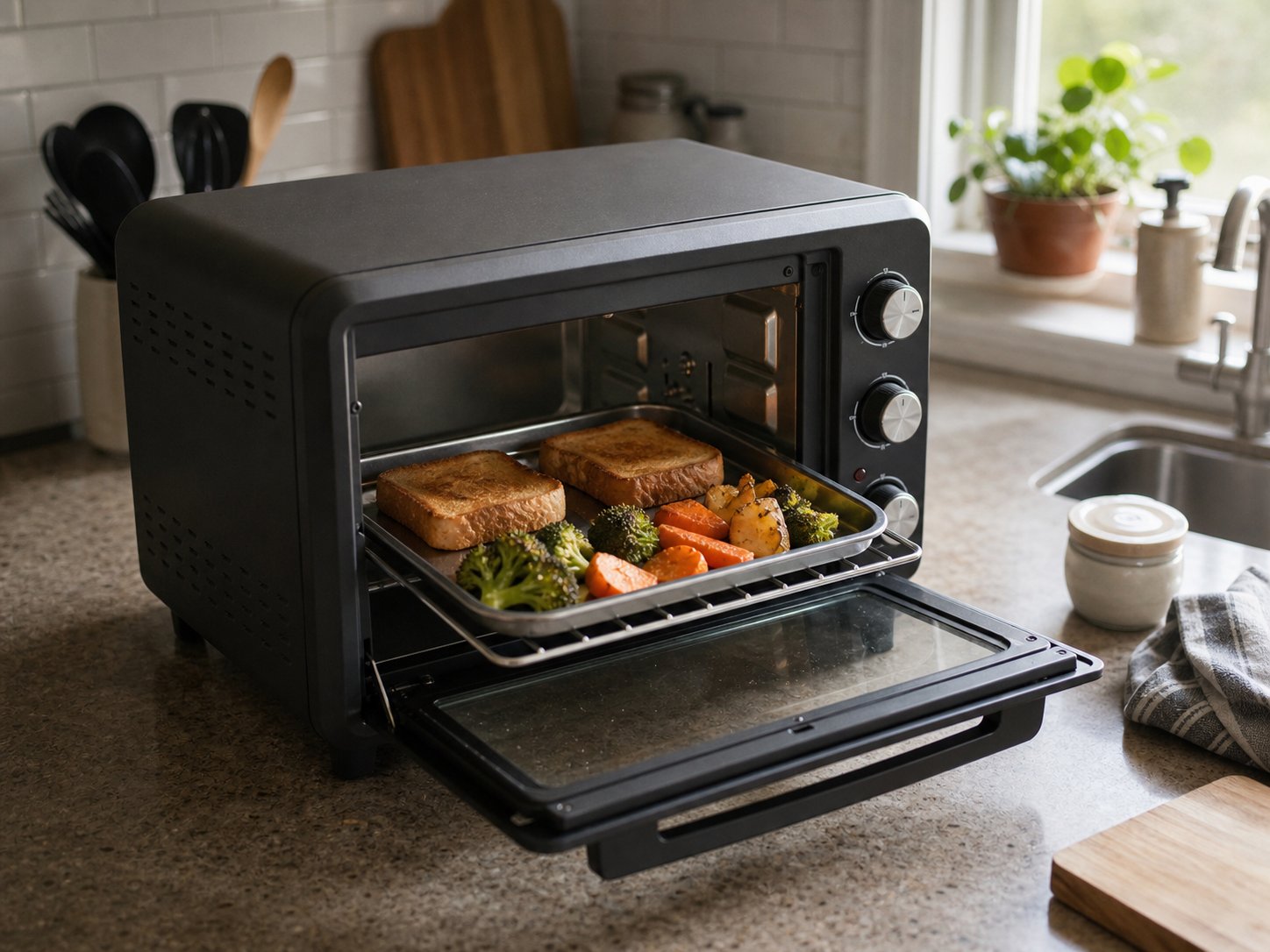
Three months ago, my kitchen counter looked like an appliance graveyard. A basket-style air fryer wedged between the coffee maker and the stand mixer. A full-size toaster oven pushed against the backsplash. A two-slot toaster that somehow always ended up on top of the microwave. Four appliances doing jobs that, in theory, one machine should handle. My wife pointed at the counter one morning and said, “Something has to go.”

At a glance – check today’s price
Check Cuisinart TOA-70 on Amazon
As an Amazon Associate, we earn from qualifying purchases.
So I started looking for a single appliance that could air fry crispy wings, toast bread evenly, bake a frozen pizza without preheating the full oven, and reheat leftovers without turning them into rubber. The Cuisinart TOA-70 Air Fryer Toaster Oven kept showing up in every search. At around $230, it promised to replace both my dedicated air fryer and my toaster oven with one unit. I ordered it, cleared the counter, and have been using it nearly every day since.
If you are deciding which countertop appliances deserve permanent space, I also keep a separate guide to the best bread maker machines for home kitchens, including when a dedicated bread machine makes more sense than another oven-style appliance.
After 90 days, I have a clear picture of what this machine does well, where it falls short, and who should actually buy one. Here is the full breakdown.
Cuisinart TOA-70 at a Glance
- Type: Air Fryer Toaster Oven
- Capacity: 0.6 cu ft (6 slices / 12″ pizza)
- Power: 1800W
- Functions: 8 total — Air Fry, Grill, Convection Bake, Bake, Convection Broil, Broil, Toast, Warm
- Timer: 60 minutes
- Dimensions: 15.5″ x 16″ x 14″ (W x D x H)
- Weight: ~21 lbs
- Price: ~$230
Setup and First Impressions
The TOA-70 arrived in a box that was bigger than I expected. At 21 pounds, this is not a small countertop appliance — it occupies a footprint of about 15.5 by 16 inches, which is roughly the size of a microwave. I measured my counter space before ordering, and I would strongly recommend you do the same. If you have less than 18 inches of depth available (you need clearance behind the unit for ventilation), this oven will hang over the edge of a standard 25-inch-deep counter.
Inside the box, Cuisinart includes the oven itself, an air fryer basket, a baking pan, a broiling rack that sits inside the baking pan, and the standard oven rack. No crumb tray is included separately — the interior bottom acts as the crumb catch area, which has implications for cleaning that I will get to later.
The control panel sits on the right side with a large dial for function selection (Air Fry, Grill, Convection Bake, Convection Broil, Warm, Toast — the Grill setting, paired with the included grill plate, is what separates the TOA-70 from the TOA-60), a temperature dial that goes from 250 to 450 degrees Fahrenheit, a toast shade selector (light to dark, seven settings), and a 60-minute timer dial with an always-on option. Everything is analog. No digital display, no presets, no smartphone app. You turn the dials and the oven starts. After three months with overly complicated smart appliances, this simplicity felt like a relief.
First thing I noticed when I turned it on: the initial burn-off smell. Cuisinart recommends running the oven empty at 400 degrees for 15 minutes before first use, and they are not kidding. The smell was strong enough that I opened two windows. It dissipated after that first run and never came back.
The oven heats up fast. From room temperature to 400 degrees took about 4 minutes in my testing, which is significantly faster than my full-size wall oven (12-15 minutes) and comparable to preheating a dedicated air fryer. That quick preheat time became one of my favorite things about the TOA-70 — for small to medium cooking tasks, it eliminates the wait that makes a full oven feel like overkill.
Air Frying Performance
This is the headline feature, so I tested it extensively. I ran frozen french fries, fresh-cut sweet potato fries, chicken wings, breaded chicken tenders, and frozen mozzarella sticks through the air fryer function over the first two weeks.
Frozen french fries: I used a standard bag of Ore-Ida Extra Crispy Fast Food Fries as my baseline test, cooking a single layer at 400 degrees for 16 minutes, shaking the basket halfway through. The results were genuinely good — golden brown exterior, soft interior, with that satisfying crunch on the first bite. They were comparable to my old Ninja air fryer basket, maybe 90% as crispy. The slight difference comes down to airflow. In a basket-style air fryer, hot air circulates tightly around a small volume of food. In the TOA-70, the larger cavity means the air has more space to move, which slightly reduces the intensity of the crisping effect. For most people, the difference would be unnoticeable. I only caught it because I ran them side by side.
Chicken wings: This was the real test. I seasoned 2 pounds of fresh wings with salt, pepper, garlic powder, and a light dusting of baking powder (the secret to crispy skin without deep frying). I cooked them at 400 degrees for 25 minutes, flipping once at the 15-minute mark. The skin rendered beautifully — thin, crackly, with no rubbery patches. The interior stayed juicy. These were legitimately restaurant-quality wings. I ran the same batch in my dedicated Ninja air fryer the following week, and the results were nearly identical. The TOA-70 produced wings that were maybe 5% less uniformly crispy on the underside where they rested against the basket, but the top and sides were excellent. At a dinner party, nobody would know the difference.
The capacity advantage: Here is where the TOA-70 actually beats a basket-style air fryer. The air fryer basket in this oven is wide and flat, which means I could spread out 2 pounds of wings in a single layer without stacking or overlapping. In my old Ninja basket, I had to cook wings in two batches because overcrowding kills crispiness. The TOA-70 did it all at once, which means dinner was ready in 25 minutes instead of 50. For a family of four, that single-batch capacity is a meaningful everyday advantage.
Sweet potato fries: Fresh-cut sweet potato fries are the Achilles heel of most air fryers because of their higher moisture and sugar content. I tossed them in a tablespoon of avocado oil, spread them in a single layer, and cooked at 390 degrees for 20 minutes with two shakes. They came out well — lightly caramelized edges, tender centers — but not as crispy as deep-fried. This is an air fryer limitation, not a TOA-70 limitation. No air fryer I have tested truly replicates deep-fried sweet potato fries. The TOA-70 did as well as any of them.
Toasting and Baking
A combo appliance needs to handle the basics, and toast is about as basic as it gets. I tested the toast function with standard white sandwich bread (Sara Lee Artesano) and thicker-cut sourdough from a local bakery.
Toast evenness: The TOA-70 can toast up to 6 slices at once, which is a nice upgrade from a 2-slot toaster if you are making breakfast for a family. I loaded 6 slices and set the shade dial to the middle position (setting 4 of 7). The results were mixed. The four center slices came out evenly golden on both sides. The two slices closest to the side walls were slightly lighter on the outer edge — maybe 15% less brown than the center. It is noticeable if you line them up for comparison, but in practice, all six slices were perfectly acceptable toast. By the second week, I had learned to put the dial one click darker when doing a full 6-slice batch, which solved the issue.
For single slices or pairs, the toasting is excellent. Even browning, consistent results, and the shade dial is well-calibrated. Setting 3 gives you light golden toast, setting 5 gives you dark and crunchy. The toast function uses top and bottom heating elements without the convection fan, which prevents the bread from drying out.
Baking performance: I baked chocolate chip cookies, a 12-inch frozen DiGiorno pizza, and a batch of roasted vegetables to test the convection bake function.
The cookies came out well — evenly browned on the bottom, slightly soft in the center, with crispy edges. I used the included baking pan, which fits perfectly on the middle rack position. One batch of 9 cookies (standard scoop size) fit comfortably. The convection fan distributes heat more evenly than a traditional toaster oven, and I could see the difference compared to the older toaster oven I replaced. No hot spots, no need to rotate the pan halfway through.
The frozen pizza test was important because the TOA-70 advertises fitting a 12-inch pizza. It does fit, but just barely. The crust edge was about half an inch from the side walls. I baked a DiGiorno Rising Crust at 400 degrees for 18 minutes (convection bake). The crust came out crispy on the bottom and the cheese melted and bubbled perfectly. This was actually better than my full-size oven typically delivers for frozen pizza, likely because the smaller cavity concentrates heat more efficiently. Pizza reheating is also excellent — 3 to 4 minutes at 350 degrees revives leftover slices with a crispy bottom that a microwave could never achieve.
Roasted vegetables: I cubed butternut squash, Brussels sprouts, and red onion, tossed them in olive oil, and roasted at 425 degrees for 30 minutes. The convection fan did its job — the vegetables developed good caramelization on the edges while staying tender inside. I stirred them once at the 15-minute mark. Results were on par with my full-size wall oven, and the TOA-70 reached temperature in a quarter of the time.
Build Quality and Design
The Cuisinart TOA-70 is built from brushed stainless steel on the exterior, and it looks like a premium appliance on the counter. After three months of daily use, the exterior still looks clean and fingerprint-resistant. The door is a single piece of tempered glass with a stainless steel handle that opens smoothly and holds its position at any angle — it does not slam down or slowly drift closed, which is a pet peeve of mine with cheaper toaster ovens.
The interior is nonstick-coated, which helps with cleaning but shows some discoloration after three months of heavy use. This is cosmetic only — the nonstick surface still functions well, and food does not stick to the walls or ceiling. The heating elements are visible at the top and bottom of the cavity, with four elements total (two top, two bottom). They are the quartz type, which heats faster and more evenly than traditional calrod elements.
The analog dials feel solid. They click into position with satisfying detents and have not loosened or become wobbly after hundreds of uses. The timer dial has a mechanical bell that dings when the time expires and automatically shuts off the oven. This is one of the underrated safety features of analog controls — there is no scenario where you forget the oven is on because a silent digital timer expired and the oven kept heating.
The feet are rubberized and keep the unit from sliding on the counter, even when pulling the door open with one hand. The power cord is about 30 inches long, which was just enough to reach my counter outlet. If your outlets are in an awkward position, you might need a short extension cord, but Cuisinart warns against using extensions with high-wattage appliances, so plan your counter placement accordingly.
One design note: the top of the oven gets hot during operation. Not dangerously hot, but warm enough that I would not recommend placing anything on top of it while cooking. Cuisinart recommends 4 inches of clearance above the unit, and after touching the top surface during a 400-degree air fry session (it was around 140 degrees by my infrared thermometer), I agree with that recommendation. If your oven sits under a cabinet, make sure there is adequate space.
Cleaning and Maintenance
This is the area where the TOA-70 shows its biggest weakness. Cleaning a toaster-oven-style air fryer is inherently more work than cleaning a basket-style air fryer, and Cuisinart has not done much to minimize that friction.
The air fryer basket is the easiest part to clean. It is nonstick-coated and dishwasher-safe. After air frying wings or fries, I soak it in warm soapy water for 10 minutes and everything wipes off easily. The baking pan and broiling rack are similarly easy to clean.
The interior cavity is the problem. Grease splatters from air frying accumulate on the ceiling and back wall of the oven. Because the heating elements are mounted to the ceiling, you cannot just wipe the top surface flat — you have to clean around and between the quartz elements, which is tedious. I use a damp cloth with a small amount of dish soap, but you have to be careful not to drip water onto the elements themselves. Cuisinart says the elements can be wiped with a damp cloth when cool, but the tight spacing between them makes thorough cleaning difficult.
The bottom of the oven collects crumbs and drips. There is no removable crumb tray — this is my single biggest complaint about the TOA-70. Virtually every toaster oven in this price range includes a slide-out crumb tray for easy cleanup. The TOA-70 does not. To clean the bottom, you tilt the oven forward and shake crumbs out, or you reach in with a cloth and wipe manually. After three months, I started lining the bottom with a piece of aluminum foil cut to size, which catches crumbs and drips and can be replaced in seconds. This works well, but I should not have to MacGyver a solution for a $230 appliance.
My cleaning routine is now: wipe the interior walls every 2 weeks, clean the air fryer basket after every use, replace the foil liner on the bottom once a week, and wipe the exterior with a damp cloth as needed. It takes about 10 minutes every two weeks for the interior deep clean, which is not terrible but is noticeably more work than popping a dishwasher-safe basket out of a standalone air fryer.
What Falls Short
After three months of daily use, here are the genuine disappointments.
No crumb tray. I mentioned this already, but it bears repeating because it is such an obvious omission. A slide-out crumb tray is a standard feature on $50 toaster ovens. Leaving it off a $230 unit is a baffling design decision. The foil-liner workaround helps, but Cuisinart should have solved this at the factory.
The 60-minute timer limit. If you want to slow-roast something for 90 minutes or do a long braise, the 60-minute maximum timer means you have to babysit the oven and reset it. There is an “always on” position on the dial, but using it means you lose the auto-shutoff safety feature. Most cooking tasks finish well within 60 minutes, but the limitation is annoying when you hit it.
No interior light. The oven cavity is dark. The only way to check on your food without opening the door is to use an external light or a flashlight. Opening the door drops the temperature, which extends cooking time and can affect results. A simple interior light bulb would cost Cuisinart maybe $2 in manufacturing and would significantly improve the user experience. Its absence at this price point is hard to justify.
Air fry results are 90%, not 100%. I keep comparing to a dedicated basket-style air fryer because that is the benchmark. The TOA-70 does a very good job air frying — good enough that I donated my standalone air fryer without regret. But if you are someone who obsesses over maximum crispiness and you only air fry, a dedicated basket unit will deliver marginally better results due to its tighter airflow design. The difference is small, maybe 5-10% in crispiness for demanding items like fresh-cut fries, but it exists.
The exterior gets hot. The sides and especially the top of the oven reach temperatures that are uncomfortable to touch during and after cooking. This is common for toaster ovens in this class, but it means you need to be mindful of placement relative to walls, cabinets, and anything heat-sensitive. Do not put your spice rack next to it.
Who Should Buy the Cuisinart TOA-70
After living with this oven for three months, I have a clear picture of who benefits most from it and who should look elsewhere.
Buy it if you want to consolidate countertop appliances. The TOA-70 genuinely replaces a toaster, a toaster oven, and a dedicated air fryer. That is three appliances replaced by one. If your counter space is limited — and whose is not — this consolidation alone justifies the price. I went from four countertop cooking appliances to two (the TOA-70 and my coffee maker), and my kitchen feels noticeably larger.
Buy it if you cook for 1 to 4 people regularly. The 0.6 cubic foot capacity handles meals for a small family without issue. Two pounds of wings, a 12-inch pizza, a sheet of cookies, or four chicken breasts all fit comfortably. If you regularly cook for more than four people, you will find yourself running multiple batches, which negates the convenience factor.
Buy it if you hate preheating your full-size oven. The 4-minute preheat time is transformative for quick weeknight meals. I use the TOA-70 for probably 70% of the cooking tasks that used to require my wall oven, and my kitchen stays cooler as a result — a meaningful benefit during summer months.
Skip it if you want the absolute best air fry results. A dedicated basket-style air fryer at $100-150 will deliver slightly crispier results. If air frying is your primary use case and you do not need the toaster oven functions, save the money and get a Ninja or Cosori basket unit.
Skip it if you need a large capacity. The 0.6 cubic foot interior is adequate for most tasks, but you cannot fit a whole chicken, a 13×9 casserole dish, or more than one rack of food at a time. If you need large-capacity countertop cooking, look at the Breville Smart Oven Air or the Cuisinart TOA-95 (the TOA-70’s bigger sibling).
Skip it if easy cleaning is a priority. The lack of a crumb tray and the difficulty of cleaning around the ceiling-mounted heating elements make the TOA-70 more maintenance-intensive than either a basket air fryer or a simpler toaster oven with a pull-out tray.
What I Like
- Replaces three countertop appliances in one unit
- Air fry results are 90%+ as good as a dedicated basket fryer
- 1800W heats to 400°F in about 4 minutes — faster than any full-size oven
- Fits a 12″ pizza and 6 slices of toast — genuinely useful capacity
- Analog controls are simple, reliable, and include auto-shutoff
- Brushed stainless steel exterior looks premium and resists fingerprints
What I Don’t Like
- No crumb tray — a baffling omission at this price point
- No interior light makes it hard to monitor food without opening the door
- 60-minute timer maximum limits long-cook recipes
- Cleaning around ceiling-mounted heating elements is tedious
Final Verdict
The Cuisinart TOA-70 is not a perfect appliance. The missing crumb tray is a genuine annoyance, the lack of an interior light is a puzzling cost-cutting decision, and the 60-minute timer cap will occasionally frustrate you. But none of those shortcomings change the fundamental value proposition: this is a well-built, 1800-watt kitchen workhorse that consolidates three appliances into one without making significant sacrifices in any category.
My air fryer is gone. My old toaster oven is gone. My two-slot toaster is gone. The TOA-70 replaced all three, and after 90 days, I have not missed any of them. The air frying is 90-95% as good as a dedicated unit. The toasting is even and consistent. The baking and roasting rival my full-size wall oven for small to medium batches. And my counter has enough space now that my wife stopped threatening to throw appliances away.
At around $230, the Cuisinart TOA-70 sits in a competitive middle ground — more capable than budget $80 toaster ovens, less expensive than the $300+ Breville Smart Oven Air. For the average household that wants a reliable do-everything countertop oven, it hits the sweet spot. Three months in, I would buy it again.
Get the Cuisinart TOA-70
Replace your toaster, toaster oven, and air fryer with one appliance.
Frequently Asked Questions
How much food can the Cuisinart TOA-70 hold?
The TOA-70 has a 0.6 cubic foot capacity that fits up to 6 slices of toast or a 12-inch pizza. The review says it’s well suited to cooking for 1 to 4 people but not recommended for large groups or for whole chickens and large casseroles.
Does the Cuisinart TOA-70 air fry as well as a dedicated air fryer?
The review rates its air frying at about 90-95% as good as a dedicated unit. It’s a strong all-in-one but not the pick if you prioritize maximum air-fry crispiness.
What are the main downsides of the Cuisinart TOA-70?
The review flags several drawbacks: there’s no removable crumb tray, which the author calls a baffling design decision, and no interior light to monitor food. The 60-minute timer limit restricts longer cooking, the ceiling-mounted heating elements are hard to clean around, and the exterior surfaces get uncomfortably hot during use.
Who is the Cuisinart TOA-70 best for?
It’s best for households with limited counter space who want to consolidate a toaster, toaster oven, and air fryer into one appliance. The review also favors it for people cooking for 1 to 4 people who value fast preheat, since it reaches 400°F in about 4 minutes.
You May Also Like
- Best Air Fryer Toaster Oven Combo 2026: Top 5 Picks Tested
- Breville vs Cuisinart Toaster Oven 2026
- Best Toaster Oven Under $100
- Air Fryer vs Toaster Oven vs Microwave 2026
- Ninja Air Fryer Max XL Review 2026
- Kitchen Appliance Buying Guide 2026
Founder & Editor-in-Chief at TheHomePicker
James has spent 3+ years testing smart home products. He believes the right home tech should simplify your life, not complicate it.
Disclosure: This post contains affiliate links. If you purchase through our links, we may earn a small commission at no extra cost to you. Learn more. As an Amazon Associate, we earn from qualifying purchases.