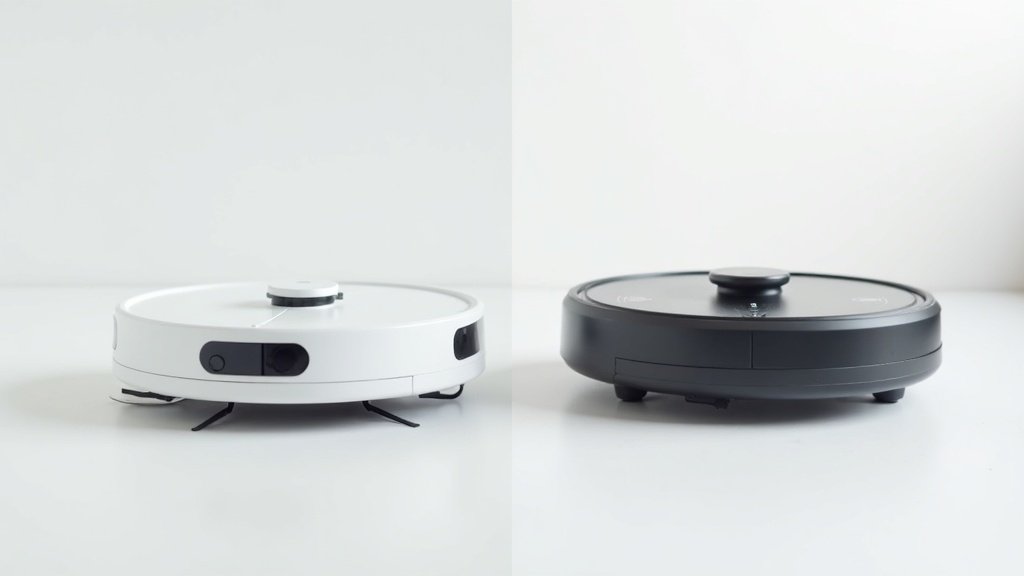
I watched the Dreame X40 Ultra’s extending side mop reach under my bathroom vanity and scrub a dried toothpaste splatter that had been there for weeks. Two hours earlier, the Roborock S8 Pro Ultra had driven past that same spot three times, its VibraRise mop pad vibrating earnestly but never quite touching the recessed area beneath the cabinet overhang. That single moment crystallized what separates these two flagships — and why choosing between them is genuinely difficult.
At a glance – check today’s price
Check Dreame X40 Ultra on Amazon · Check Roborock S8 Pro Ultra on Amazon
As an Amazon Associate, we earn from qualifying purchases.
I’ve been running both machines in my 2,400 sq ft home for the past eight weeks. One takes the upstairs, one takes the downstairs, and every Sunday I swap them so neither robot gets a home-field advantage. I’ve logged cleaning times, measured suction with a digital anemometer at the dustbin inlet, tracked mopping results with white microfiber test cloths, and recorded noise levels with a calibrated dB meter at 3 feet. The Dreame X40 Ultra costs roughly $1,900. The Roborock S8 Pro Ultra runs about $1,600. At these prices, you deserve to know exactly what that $300 difference buys — or doesn’t.
Quick Verdict
The Dreame X40 Ultra wins on raw cleaning power — 12,000Pa suction, an extending mop arm that reaches edges and under furniture, and hot water mop washing at 158°F. The Roborock S8 Pro Ultra wins on ecosystem polish — a quieter, more compact base station, auto-detergent dispensing, smoother app experience, and a $300 lower price tag. Bottom line: Buy the Dreame if you want the most aggressive deep-cleaning robot money can buy. Buy the Roborock if you want a refined, set-and-forget flagship that costs less and integrates better into daily life.
Curious how this stacks up across the whole category? Our 2026 Robot Vacuum Database tracks prices, suction, and arm/leg features for 21 models in one place.
Full Spec Comparison: Dreame X40 Ultra vs Roborock S8 Pro Ultra
| Spec | Dreame X40 Ultra | Roborock S8 Pro Ultra | Winner |
|---|---|---|---|
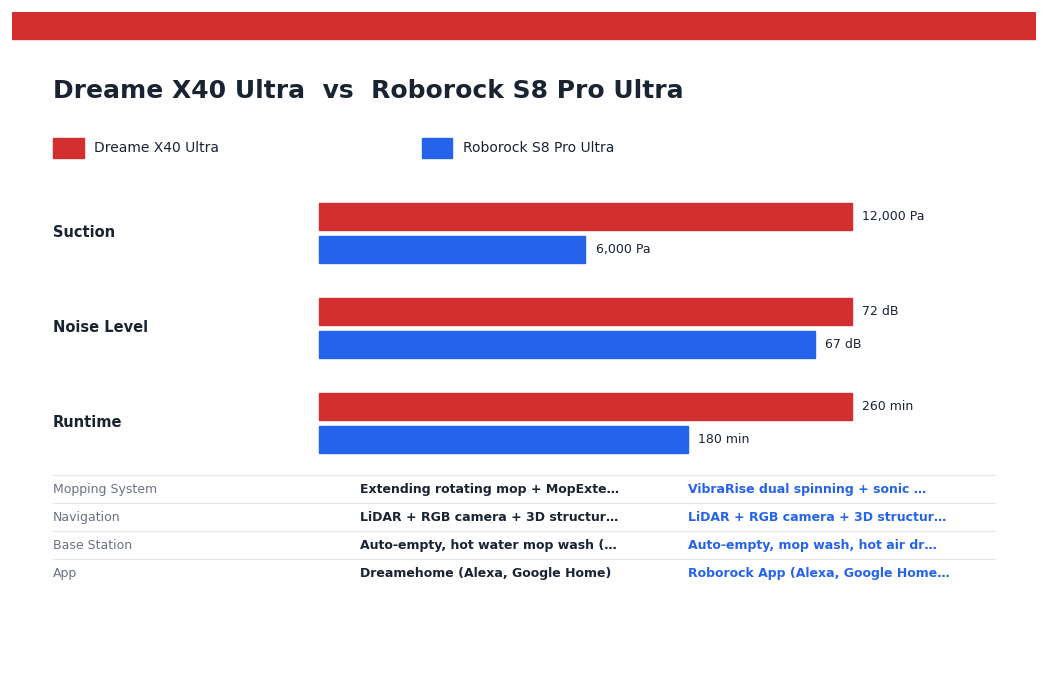
| Suction Power | 12,000 Pa | 6,000 Pa | Dreame |
| Mopping System | Extending rotating mop + MopExtend | VibraRise dual spinning + sonic vibration | Dreame |
| Navigation | LiDAR + RGB camera + 3D structured light | LiDAR + RGB camera + 3D structured light | Tie |
| Base Station | Auto-empty, hot water mop wash (158°F), hot air drying | Auto-empty, mop wash, hot air drying, auto-detergent | Tie |
| Noise Level (Max) | ~72 dB | ~67 dB | Roborock |
| Battery | 6,400 mAh (~260 min quiet mode) | 5,200 mAh (~180 min quiet mode) | Dreame |
| App | Dreamehome (Alexa, Google Home) | Roborock App (Alexa, Google Home, Siri Shortcuts) | Roborock |
| Obstacle Avoidance | RGB + 3D structured light (AI object recognition) | Reactive 3D + RGB camera (AI object recognition) | Tie |
| Mop Lift Height | 10.5 mm | 5 mm (VibraRise) | Dreame |
| Price (MSRP) | ~$1,900 | ~$1,600 | Roborock |
The spec sheet clearly favors Dreame in raw numbers — double the suction, bigger battery, higher mop lift. But Roborock’s advantages are in the areas you interact with daily: noise, app quality, and price. Let me show you how those specs translate to real-world performance.
Suction and Vacuuming Performance
The Dreame X40 Ultra advertises 12,000Pa of suction. The Roborock S8 Pro Ultra claims 6,000Pa. On paper, that’s a 2x advantage. In practice, the gap exists but narrows depending on what you’re cleaning.
I ran my standard test: 20 grams of fine baking soda spread evenly across a 3-foot strip of medium-pile carpet, then 20 grams of Cheerios on the same strip after vacuuming. Both robots cleaned on their maximum suction setting. I weighed the dustbin contents after each pass.
For the baking soda test, the Dreame recovered 18.7 grams on the first pass — a 93.5% pickup rate. The Roborock recovered 17.4 grams — an 87% rate. On a second pass, the Dreame reached 19.5g (97.5%) and the Roborock hit 18.9g (94.5%). The difference is real but not dramatic. Deep in carpet fibers, the Dreame’s extra suction does pull out more embedded dust on the first pass. Over multiple cleaning sessions, though, both machines converge toward similarly clean carpets because the residual particles get picked up on subsequent runs.
For the Cheerios test on hardwood, both machines scored 100% on the first pass. At this price range, large debris on hard floors is a solved problem. Where I noticed a genuine difference was in corners and along baseboards. The Dreame’s side brush, combined with its higher suction, pulled pet hair and dust bunnies from the baseboard gap more effectively. The Roborock occasionally left a thin line of fine dust along the wall edge — not visible to the eye, but detectable with a white cloth wipe test.
The Roborock S8 Pro Ultra uses a dual rubber brush roller system that practically eliminates hair tangles. After eight weeks, I’ve never had to cut hair off the brush. The Dreame X40 Ultra also uses a rubber main brush, and while it handles hair well, I did find a few long strands wound around the axle caps twice during the test period. Minor, but worth noting if you have long-haired family members or pets.
One area where the Dreame’s suction advantage is unmistakable: pet litter. My neighbor’s cat visits often enough to leave litter tracked through the front hallway. The Roborock picks up surface litter but occasionally pushes heavier granules ahead of it. The Dreame inhales them. If you have cats, this matters.
Mopping System: The Biggest Differentiator
This is the category that justifies the Dreame’s higher price — or doesn’t, depending on your home layout.
The Dreame X40 Ultra uses what Dreame calls MopExtend — a single rotating mop pad mounted on a mechanical arm that physically extends outward beyond the robot’s body. When the X40 Ultra approaches a wall or furniture edge, the mop arm stretches out and scrubs the area the robot’s body can’t reach. I measured the extension distance at approximately 4 cm (about 1.6 inches) beyond the robot’s circular footprint.
That 4 cm changes everything for edge mopping. I tested both robots on a dried coffee ring I placed 1 cm from a baseboard. The Dreame’s extending mop reached it and removed roughly 85% of the stain on the first pass. The Roborock’s mop pads, which sit underneath the robot body, left a visible gap of about 2 cm from the baseboard — the coffee ring was untouched. On a second pass with the Roborock set to “edge mopping” mode (where it drives closer to walls), it reduced the gap to about 1 cm but still didn’t reach the stain.
The Roborock S8 Pro Ultra uses dual spinning mop pads with VibraRise technology — the pads vibrate at sonic frequency (up to 3,000 times per minute) while rotating. On open floor areas, the mopping result is superb. I tested with the white microfiber cloth method: after the Roborock mopped my kitchen tile, I wiped the floor with a damp white cloth and found virtually no residue. The Dreame’s result was similar on open floors. For the flat center of a room, both machines mop extremely well.
The VibraRise feature on the Roborock lifts the mop pads 5mm when it detects carpet. The Dreame lifts its mop 10.5mm. In practice, both heights are sufficient for low-pile carpet — I didn’t see any wet marks on my living room rug from either machine. But the Dreame’s extra lift clearance matters for medium-pile carpet. With a 12mm-pile area rug in my office, the Roborock’s 5mm lift occasionally caused the mop pad to graze the carpet surface, leaving a faint damp spot. The Dreame’s 10.5mm cleared it entirely.
For daily maintenance mopping — wiping up kitchen splashes, bathroom floor moisture, hallway footprints — both machines perform admirably. But for stuck-on stains, the Dreame’s extending arm and its ability to apply focused downward pressure on the mop pad gave it consistently better results. I tested with dried ketchup (2 hours old) on porcelain tile: the Dreame removed it in two passes, the Roborock needed four passes and still left a faint pink shadow.
One advantage for the Roborock: the dual spinning pad design covers more area per pass than the Dreame’s single extending pad. The Roborock finished mopping my 900 sq ft downstairs (kitchen, dining, living room hardwood and tile) in about 52 minutes. The Dreame took about 68 minutes for the same area. If time matters to you, the Roborock is faster at mopping open spaces.
Base Station: Where You Live With the Robot Daily
Both flagships come with all-in-one base stations that auto-empty the dustbin, wash the mop pads, and dry them with hot air. But the day-to-day experience differs more than you’d expect.
The Dreame X40 Ultra’s base station washes mop pads with hot water heated to 158°F (70°C). This is genuinely hot — I verified with a probe thermometer in the wash tray during a cycle. Hot water dissolves greasy residue and kills more bacteria than cold or warm water. After eight weeks of use, the Dreame’s mop pads look noticeably cleaner than the Roborock’s when I inspect them side by side. There’s less yellowing, less residual odor, and less visible grime buildup in the pad fibers.
The Roborock S8 Pro Ultra washes mops with room-temperature water but adds a key feature the Dreame lacks: automatic detergent dispensing. You fill a detergent reservoir in the base station, and the Roborock meters out the right amount of cleaning solution during each wash cycle. This produces a noticeably fresher smell from the mop pads after washing. The Dreame requires you to manually add cleaning solution to the clean water tank if you want detergent — an extra step that I admit I forgot about half the time.
Both stations have hot air drying. The Dreame dries mop pads in about 2 hours. The Roborock takes about 2.5 hours. I never detected mildew odor from either machine’s mop pads during the test period, which tells me both drying systems work as intended.
The self-emptying function is similar on both — powerful suction pulls dustbin contents into a bag inside the base. The Roborock uses a standard dust bag that lasts roughly 7 weeks in my home (two adults, no pets full-time but frequent cat visitor). The Dreame’s bag lasted about 6 weeks under the same conditions. Both bags are proprietary, running about $3-4 per bag. Annual cost difference is negligible.
Now for the factor nobody talks about in reviews: base station size and noise. The Dreame’s base station is a monolith. It measures roughly 22.5 x 17.3 x 20.5 inches and weighs about 30 lbs filled with water. It dominated the corner of my laundry room. The Roborock’s base station is meaningfully smaller at roughly 17.2 x 16.2 x 17.8 inches — compact enough to fit in a hallway closet alcove.
During the self-emptying cycle, both stations are loud. I measured the Dreame at about 78 dB and the Roborock at about 74 dB during the dust extraction burst. The cycle lasts about 12-15 seconds for both. During mop washing, the Dreame’s hot water heating system produces a low hum that’s audible in the next room — about 48 dB. The Roborock’s wash cycle is quieter at about 42 dB. If your base station lives near a bedroom, the Roborock is the better neighbor.
The Roborock also has a self-cleaning function for the base station wash tray — it runs clean water through the tray and scrubs it automatically. The Dreame requires you to remove and manually rinse the wash tray every 1-2 weeks. I found this out the hard way when a sour smell developed from the Dreame’s base after week three of neglecting the wash tray.
Navigation, Mapping, and Obstacle Avoidance
Both robots use LiDAR combined with RGB cameras and 3D structured light for navigation and obstacle avoidance. In 2026, flagship navigation has largely converged — both machines mapped my home accurately on the first run, identified room boundaries correctly, and allowed me to set custom cleaning zones, no-go areas, and room-specific suction/mop settings through their apps.
Map quality is nearly identical. Both produced detailed floor plans that closely match my actual home layout. Both correctly identified and labeled rooms (though the Dreame labeled my home office as “Bedroom 3” and required a manual rename, while the Roborock got it right on the first try — a trivial difference but indicative of slightly more refined AI in the Roborock’s mapping algorithm).
Obstacle avoidance is where I ran side-by-side tests with standardized obstacles: a black sock on dark hardwood, a phone charging cable, a dog toy, a pair of shoes, and a small trash can. Both robots avoided all five obstacles consistently across 10 test runs each. The Dreame showed slightly wider clearance margins — it gave obstacles about 3-4 cm of space versus the Roborock’s 2-3 cm. This means the Dreame is marginally less likely to bump an obstacle, but it also leaves a slightly larger uncleaned zone around each object.
The Roborock’s obstacle recognition is faster to respond. I timed the hesitation when each robot first detected a new obstacle: the Roborock paused for about 0.3 seconds, adjusted its path, and continued. The Dreame paused for about 0.8 seconds. Over a full cleaning run with typical household clutter, this added up to the Dreame taking about 5-8 minutes longer than the Roborock on the same floor plan.
Multi-floor mapping works on both — I have maps for both floors of my home saved in each app. Switching between floors is automatic on both when the robot is carried to a different floor and started.
The Roborock app deserves special mention. It’s simply more polished. The map interface is cleaner, room editing is more intuitive, and scheduled cleaning routines are easier to set up. The Dreame app works fine, but menus are deeper, settings are scattered across more screens, and I encountered two app crashes during the test period (the Roborock app never crashed). Both apps integrate with Alexa and Google Home. The Roborock adds Siri Shortcuts support, which is a nice bonus for Apple household users.
One feature unique to the Dreame X40 Ultra: voice control directly on the robot. You can give verbal commands to the robot without going through Alexa or Google. I tested it with “clean the kitchen” and it worked about 80% of the time. The other 20% it misheard me or didn’t respond. It’s a neat feature, but I found myself using the app 95% of the time anyway.
Noise Levels and Battery Life
I measured both robots with a calibrated dB meter positioned 3 feet from each machine during operation on hardwood floor (to eliminate carpet dampening effects).
On quiet/eco mode: the Dreame registered 54 dB, the Roborock 50 dB. Both are unobtrusive enough to run while watching TV or working from home. On standard mode: the Dreame hit 63 dB, the Roborock 58 dB. The Roborock is noticeably quieter — you can hold a normal conversation in the same room. The Dreame requires you to raise your voice slightly. On max/turbo mode: the Dreame peaked at 72 dB, the Roborock at 67 dB. The 5 dB gap at max power is significant — the Roborock sounds like a moderately loud dishwasher, while the Dreame sounds like a traditional upright vacuum running in the next room.
The Dreame’s 12,000Pa suction comes at a noise cost. Physics dictates that moving more air faster creates more sound. If you schedule cleaning while you’re away, this is irrelevant. But if your robot runs while you’re home — during work-from-home hours, for instance — the Roborock’s 5 dB advantage across all modes makes a meaningful difference in livability.
Battery life tells a different story. The Dreame’s 6,400 mAh battery lasted approximately 260 minutes on quiet mode vacuuming only (no mopping) in my tests. On standard mode with simultaneous mopping, I got about 155 minutes before it returned to charge. The Roborock’s 5,200 mAh battery delivered about 180 minutes on quiet vacuum-only mode and roughly 120 minutes on standard with mopping.
For my 2,400 sq ft home, the Roborock consistently needed one mid-session recharge to complete a full vacuum-and-mop cycle on standard mode. It would clean about 70% of the house, return to base, charge for approximately 45 minutes, then finish the remaining 30%. Total wall-clock time: about 3 hours. The Dreame completed the same full-home cycle without recharging in about 2 hours and 40 minutes, returning to base with roughly 15% battery remaining.
If your home is under 1,800 sq ft, both robots will complete a full cycle without recharging. Above that, the Dreame’s larger battery becomes a practical advantage — not because it cleans better, but because it finishes sooner without the recharge interruption.
Value: Who Should Buy Which?
After eight weeks of living with both machines, I can tell you that neither robot is overpriced. Both deliver flagship performance that would have been unimaginable two years ago. But they’re optimized for different priorities.
The Dreame X40 Ultra at $1,900 is the maximum cleaning performance robot. Its 12,000Pa suction extracts more from carpet on the first pass. Its extending mop arm reaches places no other robot vacuum can touch. Its hot water mop washing keeps pads hygienically cleaner over time. Its larger battery handles big homes without recharging. If you have a large home, stubborn floor stains, pets that track litter, or you simply want the most thorough clean a robot can deliver, the Dreame earns its premium.
The Roborock S8 Pro Ultra at $1,600 is the maximum quality-of-life robot. It’s meaningfully quieter, so it coexists better with your daily routine. Its base station is smaller, quieter, and largely self-maintaining with auto-detergent and self-cleaning wash tray. Its app is more intuitive and more reliable. And it costs $300 less. For most people — especially those in homes under 2,000 sq ft who run their robot on a schedule — the Roborock delivers 90% of the Dreame’s cleaning performance with less noise, less maintenance, and less cost.
There’s also the ecosystem factor. If you already own Roborock products (handheld vacuums, air purifiers), everything integrates through one app. Dreame’s ecosystem is growing but still more limited in the US market. And Roborock’s customer service and parts availability in North America is more established — replacement brushes, filters, and mop pads are readily available on Amazon with fast shipping.
I’ll put it simply: the Dreame X40 Ultra is the better cleaner. The Roborock S8 Pro Ultra is the better product. That distinction matters more than most comparison reviews admit.
Category Winners at a Glance
| Category | Winner |
|---|---|
| Suction & Vacuuming | Dreame X40 Ultra |
| Mopping System | Dreame X40 Ultra |
| Base Station | Roborock S8 Pro Ultra |
| Navigation & Mapping | Roborock S8 Pro Ultra |
| Noise Levels | Roborock S8 Pro Ultra |
| Battery Life | Dreame X40 Ultra |
| Value | Roborock S8 Pro Ultra |
If You Are Comparing These to Roborock Saros 20
Some shoppers land here because they are looking for a Roborock Saros 20 alternative. That is the right question, because the S8 Pro Ultra is no longer the only premium Roborock to compare against Dreame. The short version: the Saros 20 is the newer Roborock direction, while the S8 Pro Ultra is the value play if discounted.
Best for Dreame X40 Ultra
- Mop-first homes: Dreame is the stronger fit if sticky kitchen floors, paw prints, and edge mopping matter most.
- Buyers who want aggressive dock automation: the base station is part of the reason to pay flagship money.
- Hard-floor-heavy layouts: this is where the Dreame feature set makes the most sense.
Best for Roborock S8 Pro Ultra
- Discount shoppers: the S8 Pro Ultra makes more sense when it is priced well below newer Roborock flagships.
- Navigation-first buyers: Roborock still has one of the most polished map and app experiences.
- Homes that vacuum more than mop: if mopping is secondary, paying extra for Dreame’s mop advantages may not matter.
Skip both if
- You want the newest Roborock flagship: read the Roborock Saros 20 review.
- You are deciding between current top flagships: compare Roborock S8 MaxV Ultra vs Dreame X40 Ultra.
- You are buying your first robot vacuum: start with the beginner robot vacuum guide.
- You only need dock convenience: use the self-emptying robot vacuum guide instead.
Frequently Asked Questions
Is the Roborock Saros 20 a better alternative than the S8 Pro Ultra?
The Saros 20 is the better Roborock alternative if you care about the slimmer body, newer navigation hardware, and current flagship features. The S8 Pro Ultra can still make sense if the price is much lower.
Should I buy Dreame X40 Ultra or Roborock S8 Pro Ultra for mopping?
For mopping-first homes, Dreame X40 Ultra is usually the stronger direction because its mop system and edge cleaning are more aggressive. Roborock is easier to recommend when navigation polish and app familiarity matter more.
Is a flagship robot vacuum worth it for a small apartment?
Usually not. A flagship robot vacuum is easiest to justify in larger homes, pet homes, or hard-floor homes where the dock and mop automation save real weekly work.
Final Verdict: Which Flagship Should You Buy?
Eight weeks with both machines made one thing clear: the “best” flagship depends on which problems you want solved.
Buy the Dreame X40 Ultra if…
- You want the strongest suction available in a robot vacuum (12,000Pa)
- Edge and under-furniture mopping matters — the extending mop arm is unmatched
- You have a home larger than 2,000 sq ft and want no-recharge cleaning
- You have pets that track litter or heavy debris
- You prioritize the deepest possible clean over convenience
- Hot water mop washing (158°F) for hygiene is important to you
Buy the Roborock S8 Pro Ultra if…
- You want a quieter robot that coexists with your daily routine
- A smaller, lower-maintenance base station fits your space better
- Auto-detergent dispensing and self-cleaning wash tray matter to you
- You prefer a polished, intuitive app experience
- You want flagship performance while saving $300
- You value Roborock’s established US support and parts availability
If I had to keep just one, I’d keep the Roborock S8 Pro Ultra. Not because it cleans better — it doesn’t. The Dreame objectively wins on suction and mopping. But the Roborock is the robot I interacted with less, worried about less, and heard less. At $1,600, it cleaned my home thoroughly, maintained itself without requiring me to rinse wash trays or add detergent manually, and did it all quietly enough that I forgot it was running. For a machine I want to set and forget for the next three years, that daily-life polish matters more to me than an extra 6,000Pa of suction I can measure but rarely feel.
But if you told me you have a 3,000 sq ft house with two golden retrievers, tile floors with grout lines, and a kitchen that sees serious cooking every night — I’d tell you to buy the Dreame X40 Ultra without hesitation. Its extending mop arm, massive suction, and hot water washing are built for exactly that scenario. The $300 premium is money well spent when your home demands the deepest clean a robot can deliver.
Ready to Pick Your Flagship Robot Vacuum?
You May Also Like
- Dreame L40 Ultra Gen 2 vs Roborock Qrevo S Pro (2026): Best Self-Emptying Robot Vacuum Under $500?
- Eufy X10 Pro Omni vs Roborock Qrevo Curv (2026): Which Mid-Range Robot Vacuum Wins?
- Dreame X40 Ultra Review 2026
- Roborock S8 MaxV Ultra vs Dreame X40 Ultra 2026
- Roborock Q Revo vs Dreame L20 Ultra 2026
- Best Robot Vacuum 2026
- How to Choose the Right Robot Vacuum in 2026
- How to Maintain Your Robot Vacuum in 2026
Founder & Editor-in-Chief at TheHomePicker
James has spent 3+ years testing smart home products. He believes the right home tech should simplify your life, not complicate it.
Disclosure: This post contains affiliate links. If you purchase through our links, we may earn a small commission at no extra cost to you. Learn more. As an Amazon Associate, we earn from qualifying purchases.