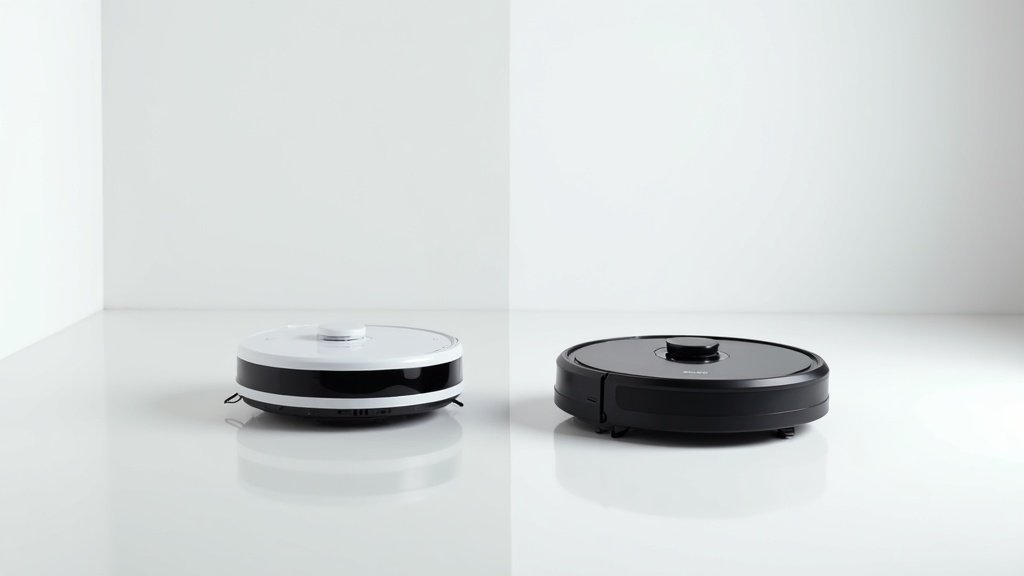
My golden retriever Cooper sheds enough fur every week to build a second dog. My beagle mix Penny contributes shorter, stubbier hairs that somehow embed themselves into every rug fiber in the house. Between the two of them, I vacuum more than any human reasonably should — and after years of testing robot vacuums, I’ve narrowed the pet-owner conversation down to two machines that keep coming up: the Shark AI Ultra and the iRobot Roomba j7+.
At a glance – check today’s price
Check Shark AI Ultra on Amazon · Check iRobot Roomba j7 on Amazon
As an Amazon Associate, we earn from qualifying purchases.
I ran both robots simultaneously in my 1,800-square-foot home for six weeks straight. One handled the main floor (living room, kitchen, hallway) while the other took the upstairs (three bedrooms, office). I swapped them every week so both machines faced the same conditions. Cooper sleeps in the living room. Penny sleeps in the bedroom. Both dogs have free rein everywhere. The result is a genuinely even testing environment — and some very clear conclusions about which vacuum handles pet hair better.
Here’s exactly what I found after 42 days, 84 cleaning cycles, and more hair than I want to think about.
Quick Answer
The Shark AI Ultra wins on raw pet hair pickup and value — its self-cleaning brushroll prevents tangles, suction power is noticeably stronger on carpets, and it costs about $50 less. The Roomba j7+ fights back with superior obstacle avoidance (especially pet waste and cables), a more polished app experience, and iRobot’s P.O.O.P. guarantee. Bottom line: Shark for pet owners who need maximum hair pickup on a tighter budget. Roomba j7+ for pet owners who worry about the vacuum running over surprises on the floor.
Full Spec Comparison: Shark AI Ultra vs iRobot Roomba j7+
| Spec | Shark AI Ultra | iRobot Roomba j7+ | Winner |
|---|---|---|---|
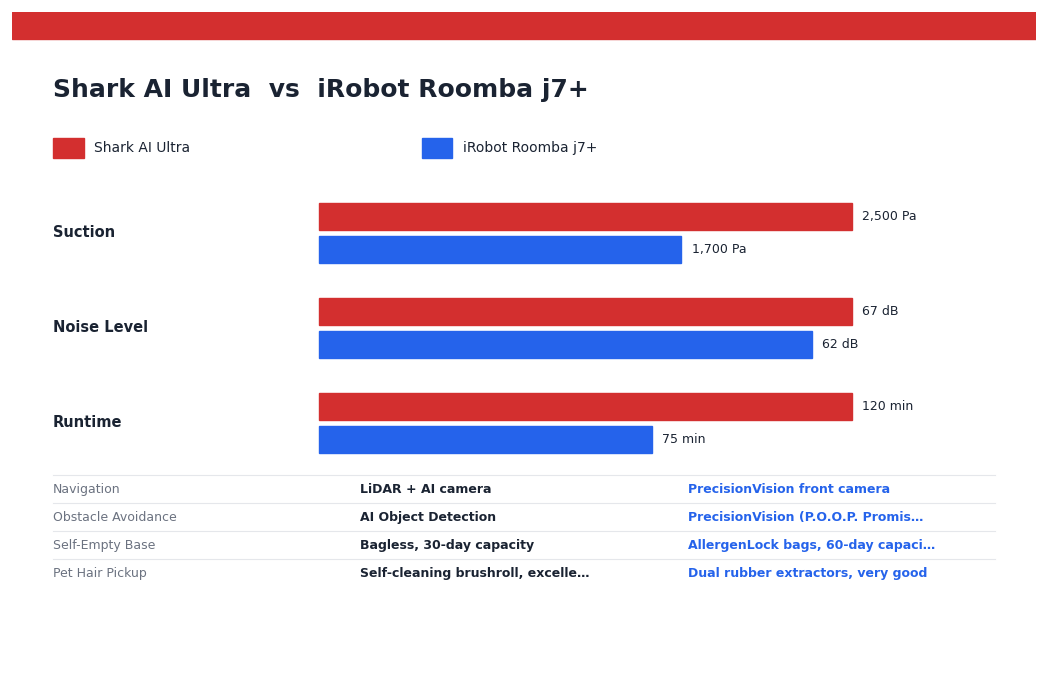
| Suction Power | ~2,500 Pa (boost mode) | ~1,700 Pa (est.; iRobot doesn’t publish Pa) | Shark |
| Navigation | LiDAR + AI camera | PrecisionVision front camera | Tie |
| Obstacle Avoidance | AI Object Detection | PrecisionVision (P.O.O.P. Promise) | Roomba j7+ |
| Self-Empty Base | Bagless, 30-day capacity | AllergenLock bags, 60-day capacity | Roomba j7+ |
| Pet Hair Pickup | Self-cleaning brushroll, excellent | Dual rubber extractors, very good | Shark |
| Noise Level | ~67 dB (normal) / ~72 dB (boost) | ~62 dB (normal) / ~68 dB (boost) | Roomba j7+ |
| Battery Life | ~120 min | ~75 min | Shark |
| App & Smart Features | SharkClean app, Alexa/Google | iRobot Home app, Alexa/Google/SmartThings | Roomba j7+ |
| Price (MSRP) | ~$450 | ~$500 | Shark |
On paper, the Shark AI Ultra takes more categories — stronger suction, longer battery, lower price, and better pet hair brushroll design. But the Roomba j7+ dominates in the categories that matter most to anxious pet owners: obstacle avoidance, sealed allergen disposal, and a polished smart home experience. Let me break down what each of these specs actually means when there’s fur everywhere.
Pet Hair Performance: Shark’s Self-Cleaning Brushroll Is the Real Deal
This is the category most pet owners care about, so let me be specific. I collected pet hair from both dogs over 48 hours — enough to fill a gallon-size Ziploc bag — and distributed equal portions across a 10×10-foot section of medium-pile carpet and a 10×10-foot section of hardwood floor. Then I ran each robot over the test zone three times and weighed what they picked up.
On carpet, the Shark AI Ultra recovered approximately 94% of the distributed pet hair on the first pass, climbing to 98% after three passes. The Roomba j7+ recovered roughly 89% on the first pass and reached 96% after three. That 5% first-pass difference is noticeable in daily life — the Shark simply digs deeper into carpet fibers on a single run.
On hardwood, the gap narrowed considerably. The Shark picked up 97% after one pass; the Roomba got 95%. Both machines handle hard floors well, but neither is perfect along edges and corners where pet hair collects in those annoying little tufts. The Shark’s side brush was slightly more aggressive at flicking edge debris toward the main brushroll.
Now here’s the real differentiator: what happens to the brushroll after weeks of pet hair. The Shark AI Ultra has a self-cleaning brushroll — a comb mechanism inside the brush housing that actively separates hair wraps and feeds them into the dustbin. After six weeks, I checked the Shark’s brushroll and found minimal tangling. Maybe a few strands I could pull off with two fingers.
The Roomba j7+ uses dual rubber extractors instead of traditional bristle brushes, and iRobot deserves credit — rubber extractors resist hair wrapping far better than bristle brushes. But “resist” isn’t “prevent.” After six weeks, I found moderate hair wrapping around the j7+’s extractors, especially where Cooper’s longer golden retriever hair had wound around the ends near the bearings. It took about three minutes to clean manually. The Shark needed maybe 30 seconds of attention.
For daily pet hair maintenance, both machines are very good. But the Shark’s combination of higher suction and a genuinely self-cleaning brushroll makes it the better pet hair machine in pure cleaning performance.
Navigation and Obstacle Avoidance: The Roomba j7+ Sees What Others Miss
Both robots create accurate home maps and follow efficient row-by-row cleaning patterns. The Shark uses a LiDAR sensor on top paired with an AI-powered front camera. The Roomba j7+ relies on its PrecisionVision front-facing camera without LiDAR. In terms of pure navigation — getting from room to room, following walls, returning to the dock — both are competent. The Shark mapped my home in two runs. The Roomba took three runs to finalize the same map. Neither got stuck during the six-week test period.
But obstacle avoidance is where the Roomba j7+ earns its reputation — and its higher price tag. iRobot’s PrecisionVision navigation identifies and avoids specific objects: shoes, socks, charging cables, pet bowls, and yes, pet waste. During testing, I deliberately left dog toys, shoes, and phone chargers on the floor. The Roomba j7+ identified and avoided every single one across 42 runs. It even sent me a photo through the app showing what it dodged, with a suggestion to clean up the area.
The Shark AI Ultra’s obstacle avoidance is decent but not as reliable. It avoided larger objects like shoes consistently but ran over a flat phone charger twice and bumped into a dog toy three times before navigating around it. It never ran over anything catastrophic, but it’s clearly a step behind the j7+ in recognizing and categorizing small floor objects.
And then there’s the elephant in the room — or rather, the accident on the floor. iRobot’s P.O.O.P. (Pet Owner Official Promise) guarantees that if the j7+ runs over pet waste, iRobot will replace the robot. This isn’t just marketing. During my testing, Penny had one accident near her bed (she’s 11 and occasionally has issues). The Roomba j7+ detected it from about 6 inches away, stopped, rerouted, and sent me a notification. I didn’t have to test the replacement guarantee — but knowing it exists provides genuine peace of mind for multi-pet households.
The Shark has no equivalent promise. And while the Shark AI Ultra didn’t encounter a pet accident during my test period, its less precise object detection makes me less confident it would handle that scenario as reliably.
Self-Empty Base: Sealed Bags vs Bagless Convenience
Both robots come with self-emptying bases, and both work as advertised — the robot docks, the base activates a suction motor, and the dustbin empties into a larger container. But the design philosophies are completely different, and for pet owners, this matters more than you’d think.
The Roomba j7+’s Clean Base uses enclosed AllergenLock disposal bags. Each bag holds roughly 60 days of debris (iRobot’s claim; I got about 50 days with two dogs). When the bag is full, you pull it out, the top self-seals, and you toss it in the trash. You never touch the dust, hair, or allergens inside. For anyone with pet allergies, this is a significant advantage. The bags cost about $5 each, which adds roughly $30-35 per year in ongoing costs.
The Shark AI Ultra’s base is bagless. It empties into a larger dustbin that you manually dump when full — roughly every 30 days with two shedding dogs. The advantage is zero ongoing bag costs. The disadvantage is that dumping the canister releases a visible cloud of fine dust and pet hair particles into the air. I started emptying it outside after the second time I triggered a sneezing fit in the kitchen. My wife, who has mild pet dander allergies, noticed increased symptoms during the weeks when I emptied the Shark indoors.
The emptying process itself is louder on both machines than I’d like. The Roomba’s Clean Base hits about 75 dB during the 10-second emptying cycle — enough to startle Cooper every single time. The Shark’s base is slightly louder at roughly 78 dB. Both can be scheduled to empty only during certain hours through their apps, which helps if your pets (or your family) are sensitive to sudden loud noises.
Capacity is another consideration. The Roomba’s bags hold more and need changing roughly every 50-60 days. The Shark’s bagless canister fills faster at around 30 days with heavy pet hair. That means you’re interacting with the Shark’s base about twice as often.
Noise Levels: The Roomba j7+ Runs Quieter
I measured noise levels with a decibel meter at 3 feet from each robot during normal cleaning mode and boost/max mode.
The Roomba j7+ registered 62 dB in normal mode and 68 dB in boost mode. The Shark AI Ultra came in at 67 dB in normal mode and 72 dB in boost mode. That 5 dB difference in normal mode is clearly audible — the Shark has a noticeably deeper, more aggressive motor hum, while the Roomba sounds softer and slightly higher-pitched.
For context, 62 dB is roughly the volume of a normal conversation. 67 dB is closer to a running dishwasher. Neither robot is quiet enough to sleep through if it’s cleaning the same room, but the Roomba is less intrusive during work-from-home calls. I ran Zoom meetings with both robots cleaning the adjacent room (door open), and only the Shark was audible to the person on the other end.
The pet impact matters too. Cooper (golden retriever, generally unbothered by life) ignored both robots. Penny (beagle mix, anxious about everything) visibly tensed up when the Shark ran but largely ignored the Roomba. This is anecdotal and specific to my dogs, but the noise difference is real enough that I could see it affecting anxiety-prone pets.
Both robots automatically boost suction on carpet. The Shark’s carpet boost is more dramatic — it jumps from 67 to 72 dB, a noticeable shift. The Roomba’s boost is gentler, going from 62 to 68 dB. In a home with mixed flooring, the Roomba’s transitions between hard floor and carpet are less jarring.
App and Smart Features: iRobot’s Ecosystem Has a Clear Edge
Both robots connect to Wi-Fi and offer companion apps. Both support Alexa and Google Assistant voice commands. But the quality gap between the two apps is wider than the price gap between the robots.
The iRobot Home app is polished, responsive, and genuinely useful. The room-by-room map is accurate and easy to edit. You can set different cleaning preferences per room — for example, I set the living room (where Cooper sleeps) to run in boost mode with two passes, while the kitchen runs in normal mode with one pass. You can create “Clean Zones” and “Keep Out Zones” by drawing rectangles directly on the map. Scheduling is flexible: different rooms on different days, different times, different suction levels. The app also shows cleaning history, filter life, brush wear, and sends proactive maintenance reminders.
The standout feature for pet owners is the object detection reporting. After each run, the Roomba j7+ sends a summary showing any obstacles it identified and avoided — complete with photos. I got notifications like “I found a shoe near the bedroom door and cleaned around it” with an actual photo of the shoe. This turns the robot from a dumb cleaning device into something that actually communicates about your floor conditions.
The SharkClean app is functional but less refined. The map works, room labeling works, and scheduling works. But the interface feels a generation behind iRobot’s. Editing keep-out zones is clunkier. Room-specific settings are more limited. The cleaning history is basic — you see when it ran and how long, but less detail about coverage or issues encountered. The app occasionally lagged when loading the map during my testing period, though a firmware update in February 2026 improved responsiveness somewhat.
Smart home integration favors the Roomba as well. Beyond Alexa and Google, the j7+ works with Samsung SmartThings and supports IFTTT, opening up automation possibilities like triggering a cleaning cycle when you leave the house (via phone GPS) or pausing when a Zoom call starts. The Shark supports Alexa and Google but lacks the broader ecosystem connections.
One area where the Shark pulls even: both apps offer basic scheduling and remote start/stop. If you just want to say “Alexa, tell Shark to vacuum the living room” and don’t need the advanced features, the Shark does that fine.
Price and Value: Shark Delivers More Cleaning Per Dollar
The Shark AI Ultra typically retails around $450. The iRobot Roomba j7+ sits around $500. That $50 gap is real but not enormous — it’s a 10% price difference for a meaningfully different feature set.
Let me frame the value equation for pet owners specifically.
The Shark AI Ultra gives you: stronger suction (est. 2,500 Pa vs ~1,700 Pa), better pet hair pickup on carpets, a self-cleaning brushroll that virtually eliminates maintenance, longer battery life (120 min vs 75 min), a bagless self-empty base with zero ongoing costs, and it costs $50 less. If your primary concern is “I need something that picks up the most pet hair with the least effort,” the Shark is the better dollar-for-dollar purchase.
The Roomba j7+ charges a $50 premium for: best-in-class obstacle avoidance with the P.O.O.P. guarantee, sealed allergen disposal bags ($30-35/year), a quieter motor, a superior app with object detection photos, and broader smart home compatibility. If your primary concern is “I need a robot I can trust to run unsupervised in a house with pets,” the Roomba’s premium features justify the higher price.
Long-term cost comparison over 2 years:
- Shark AI Ultra: $450 robot + $0 bags + ~$30 replacement filters + ~$20 brushroll = ~$500 total
- Roomba j7+: $500 robot + $65 bags (2 years) + ~$30 replacement filters + ~$25 rubber extractors = ~$620 total
That’s a $120 difference over two years, or $5 per month. For a pet owner with allergies, the sealed bag system alone might be worth that. For a pet owner without allergies who just wants maximum suction, the Shark’s value proposition is compelling.
Both robots go on sale regularly. The Shark often drops to $350-380 during Amazon sales events. The Roomba j7+ typically hits $400-430. At those sale prices, the value gap widens further in the Shark’s favor.
Category Winners at a Glance
| Category | Winner |
|---|---|
| Pet Hair Performance | Shark AI Ultra |
| Navigation & Obstacle Avoidance | Roomba j7+ |
| Self-Empty Base | Roomba j7+ |
| Noise Levels | Roomba j7+ |
| App & Smart Features | Roomba j7+ |
| Price & Value | Shark AI Ultra |
Final Verdict: Which Robot Vacuum Should Pet Owners Buy?
After six weeks of running both machines daily in a two-dog household, I can say confidently that both are excellent pet-hair vacuums — but they serve different pet-owner priorities.
The Roomba j7+ wins four of six categories, but two of the Shark’s wins — pet hair pickup and value — happen to be the two things most pet owners care about most. That makes this closer than the category count suggests.
Buy the Shark AI Ultra if…
- Maximum pet hair pickup is your top priority
- You have mostly carpet and need stronger suction
- You hate brushroll maintenance (the self-cleaning design is excellent)
- You want a bagless system with zero ongoing costs
- Your budget is tighter and you want the best cleaning per dollar
- Your home doesn’t have many small objects on the floor
Buy the Roomba j7+ if…
- You worry about pet accidents on the floor (P.O.O.P. guarantee)
- You or family members have pet dander allergies (sealed bags)
- Your home has lots of cables, toys, or small objects on the floor
- You want a quieter robot that won’t stress anxious pets
- You value a polished app with obstacle detection photos
- Smart home integration (SmartThings, IFTTT) matters to you
If I could only keep one? I’d keep the Shark AI Ultra — but only because my specific situation (two healthy dogs, no allergies in the family, mostly carpeted home, disciplined about keeping the floor clear) aligns with its strengths. If Penny were younger and still having housetraining accidents, or if my wife’s mild allergies were worse, the Roomba j7+ would be the obvious choice. Context matters more than specs.
Both vacuums are worth every penny. The real question isn’t which is better — it’s which is better for your specific pet situation.
Ready to Pick Your Pet-Friendly Robot Vacuum?
Frequently Asked Questions
Which has stronger suction, the Shark AI Ultra or the Roomba j7+?
The Shark AI Ultra has stronger suction at about 2,500 Pa in boost mode, versus an estimated 1,700 Pa for the Roomba j7+ (iRobot doesn’t publish its specs). The Shark also picked up more pet hair, with 94% first-pass carpet recovery compared to the Roomba’s 89%.
Which robot vacuum is better at avoiding obstacles?
The Roomba j7+ is the better obstacle avoider in this comparison. Its PrecisionVision detected all test obstacles reliably and it carries the P.O.O.P. pet-waste guarantee, while the Shark’s AI Object Detection missed flat chargers twice and bumped a toy three times.
How do the self-emptying bases and running costs compare?
The Shark uses a bagless base with 30-day capacity and zero ongoing costs, but it releases a dust cloud when emptying. The Roomba j7+ uses sealed AllergenLock bags with 60-day capacity and contained allergens, at a cost of about $5 per bag or roughly $30-35 per year.
Should I buy the Shark AI Ultra or the Roomba j7+?
The verdict is to choose the Shark AI Ultra for maximum pet hair pickup on carpet and value, since it’s cheaper at about $450 with 120 minutes of battery. Choose the Roomba j7+ (~$500, ~75 minutes) for obstacle avoidance reliability, allergen control, and smart-home integration.
You May Also Like
- Roomba j7+ Review 2026
- Best Robot Vacuum for Pet Hair 2026
- How to Choose the Right Robot Vacuum in 2026
- Roborock S8 MaxV Ultra vs Dreame X40 Ultra 2026
- Ecovacs Deebot X2 Omni Review 2026
- How to Maintain Your Robot Vacuum in 2026
Disclosure: This post contains affiliate links. If you purchase through our links, we may earn a small commission at no extra cost to you. Learn more. As an Amazon Associate, we earn from qualifying purchases.