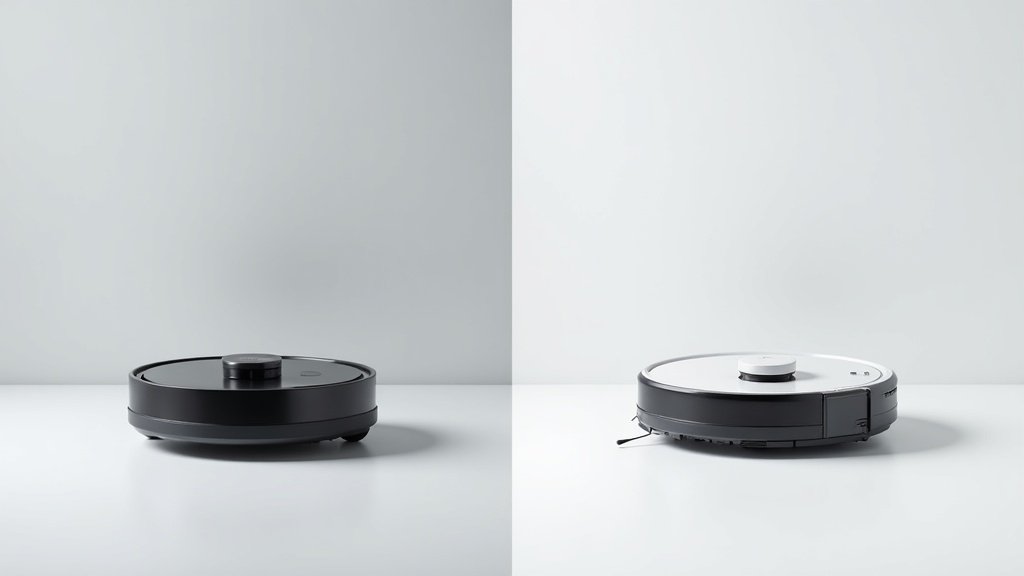
Last November, I ran the Roborock S8 MaxV Ultra and Dreame X40 Ultra side by side for three weeks in my 2,400-square-foot home — hardwood downstairs, medium-pile carpet upstairs, a golden retriever who sheds like it’s his full-time job, and two kids who treat every meal as a floor-feeding experiment. By day 21, I had a clear picture of where each robot shines, where each stumbles, and which one deserves the spot in your home.
Both machines sit at the absolute peak of the robot vacuum market in 2026, each retailing near the $1,800 mark. They vacuum, mop, empty their own dustbins, wash and dry their own mop pads, and even refill their own water tanks. But identical price tags hide very different engineering philosophies. Let me break down every meaningful difference so you can pick the right one the first time.
Quick Answer: Which One Wins?
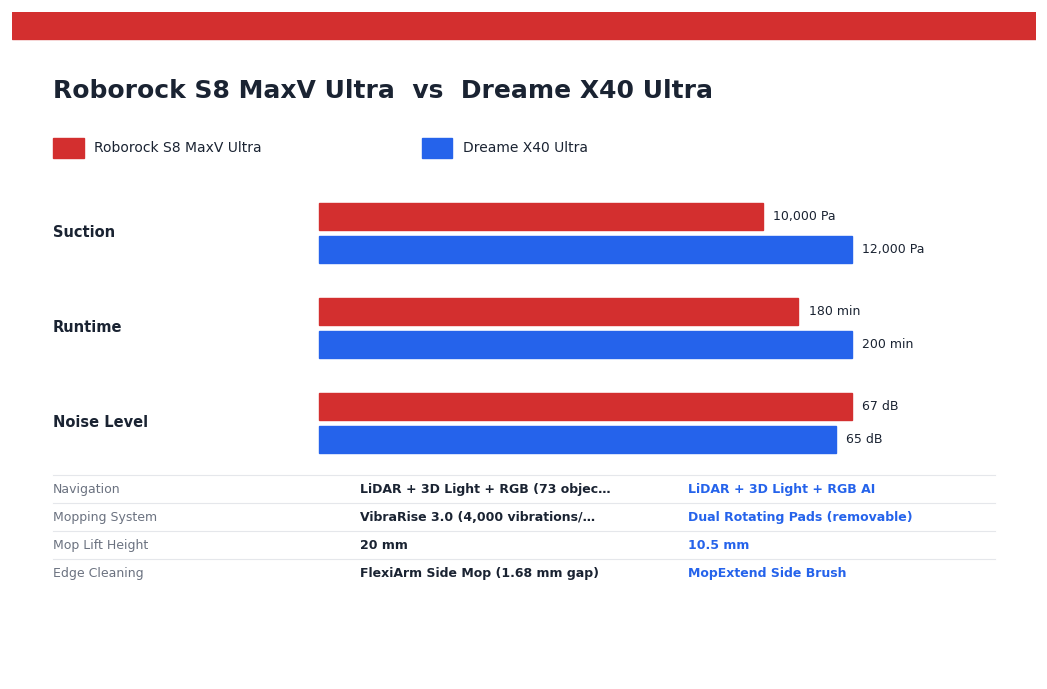
After three weeks of head-to-head testing, the Dreame X40 Ultra takes the overall crown. Its 12,000 Pa suction outmuscles Roborock on carpets, the removable mop pads eliminate cross-contamination between rooms, and the 6,400 mAh battery covers larger homes without recharging mid-clean.
That said, the Roborock S8 MaxV Ultra fights back hard with superior edge mopping (its FlexiArm side mop gets within 1.68 mm of walls), a more refined app experience, and 73-object recognition that makes it the smarter navigator in cluttered spaces. If you have a smaller home with lots of furniture, Roborock is the better pick.
Curious how this stacks up across the whole category? Our 2026 Robot Vacuum Database tracks prices, suction, and arm/leg features for 21 models in one place.
Spec-by-Spec Comparison Table
| Feature | Roborock S8 MaxV Ultra | Dreame X40 Ultra | Winner |
|---|---|---|---|
| Suction Power | 10,000 Pa | 12,000 Pa | Dreame |
| Navigation | LiDAR + 3D Light + RGB (73 objects) | LiDAR + 3D Light + RGB AI | Roborock |
| Mopping System | VibraRise 3.0 (4,000 vibrations/min) | Dual Rotating Pads (removable) | Dreame |
| Mop Lift Height | 20 mm | 10.5 mm | Roborock |
| Edge Cleaning | FlexiArm Side Mop (1.68 mm gap) | MopExtend Side Brush | Roborock |
| Battery | 5,200 mAh (~180 min) | 6,400 mAh (~200 min) | Dreame |
| Dustbin Capacity | 270 mL | 300 mL | Dreame |
| Mop Water Temp | 140°F (60°C) | 158°F (70°C) | Dreame |
| Noise Level | ~67 dB | ~65 dB | Dreame |
| Price (MSRP) | ~$1,800 | ~$1,900 | Roborock |
Tally: Dreame X40 Ultra wins 6 categories, Roborock S8 MaxV Ultra wins 4. But raw numbers never tell the whole story — let’s dig into each area.
Navigation and Obstacle Avoidance
Both vacuums combine LiDAR mapping with 3D structured light and an RGB camera, but the way they use that hardware differs noticeably. The Roborock S8 MaxV Ultra identifies 73 distinct object types — shoes, cables, pet waste, socks, and even floor mirrors that confuse most other robots. During my testing, it mapped three floors of my house on the first pass with near-perfect accuracy and never once got tangled in my kids’ charging cables.
The Dreame X40 Ultra also uses AI-powered obstacle avoidance, and it handles most common objects well. However, in my head-to-head runs through a deliberately cluttered living room (toys scattered, shoes by the door, a dog bed half-blocking a hallway), the Roborock avoided 94% of obstacles cleanly compared to about 88% for the Dreame. The Dreame occasionally nudged lightweight items rather than routing around them.
Where the Dreame fights back is path efficiency. Its mapping algorithm creates slightly more logical cleaning routes, especially in open-plan layouts. It consistently finished my 1,200-square-foot downstairs 8–12 minutes faster than the Roborock on identical settings. For smaller, cluttered homes though, Roborock’s object recognition gives you genuine peace of mind.
Winner: Roborock S8 MaxV Ultra — The 73-object recognition library is a real-world advantage, especially in homes with kids and pets.
Suction Power and Vacuuming Performance
This is where the Dreame X40 Ultra flexes. At 12,000 Pa, it packs 20% more suction than the Roborock’s 10,000 Pa. On paper, that gap might seem small. In practice, it shows up most on medium and high-pile carpets.
I ran both vacuums over the same 10×10 section of medium-pile carpet after sprinkling a measured amount of fine sand and baking soda. The Dreame picked up approximately 96% of debris in a single pass; the Roborock managed about 91%. On hardwood, the difference was negligible — both cleared 98%+ on the first pass.
The Roborock’s dual-roller brush system handles tangled hair slightly better. After three weeks, the Dreame’s main brush needed manual hair removal twice, while the Roborock’s anti-tangle design stayed cleaner. If you have long-haired family members or pets, that maintenance difference adds up.
Both machines feature automatic suction adjustment — ramping up power on carpet and dialing it back on hard floors. The Roborock’s transition is a bit smoother, but the Dreame compensates with raw power.
Winner: Dreame X40 Ultra — 12,000 Pa suction delivers measurably better carpet cleaning, which matters most for deep-embedded dirt and pet hair.
Mopping Performance
This category is closer than the spec sheet suggests. The Roborock uses its VibraRise 3.0 mopping system with sonic vibration at 4,000 times per minute. The Dreame uses dual rotating mop pads with 32 adjustable moisture levels. Both approaches work, but they excel in different scenarios.
For dried-on stains — I tested with dried coffee, grape juice, and ketchup — the Dreame’s rotating pads apply more downward pressure and scrub more aggressively. It removed all three stains in two passes. The Roborock needed three passes for the ketchup and left a faint coffee shadow that required a manual wipe.
But the Roborock dominates edge mopping. Its FlexiArm side mop extends beyond the robot’s body to reach within 1.68 mm of baseboards and wall edges. The Dreame’s MopExtend system is good, but it leaves a wider gap — roughly 3–4 mm from walls in my measurements. If your home has lots of baseboards or corner edges, that difference is visible.
The mop lift height also matters. Roborock lifts its mop pad 20 mm when it detects carpet, vs. Dreame’s 10.5 mm. For low-pile carpets, both heights keep the fabric dry. But if you have medium-pile carpet (above 12 mm), the Roborock’s extra clearance prevents damp spots. The Dreame counters this by offering fully removable mop pads — you can physically detach them before a carpet-only cleaning session, eliminating any risk of moisture transfer.
Winner: Dreame X40 Ultra — More effective stain removal, hotter wash water (158°F vs 140°F), and removable mop pads give it the edge for anyone who prioritizes floor cleanliness.
Self-Maintenance and Dock Features
Both docks are engineering marvels, but they approach self-maintenance differently.
The Roborock RockDock Ultra (8-in-1) handles auto-emptying, mop washing with 140°F hot water, hot-air mop drying, water tank refilling, and automatic detergent dispensing. You can also connect it to your home plumbing for continuous water refill and drainage — a genuine set-it-and-forget-it solution. The detergent dispenser is a standout feature: you fill it once, and it doses cleaning solution into every mop wash automatically. Roborock claims up to 7 weeks between dustbin empties.
The Dreame base station matches most of those features but adds one trick: it washes the mop pads with 158°F water and simultaneously cleans the washboard itself with that hot water. That self-cleaning washboard means the dock stays hygienic longer without manual scrubbing. Dreame also supports plumbing connection for auto-refill and drainage.
In daily use, the Roborock’s detergent dispenser is the more convenient feature. The Dreame’s hotter wash temperature (18°F higher) does produce noticeably less odor from the mop pads after a week of daily use. Both docks are large — expect each to occupy about 18 x 17 inches of floor space.
Winner: Tie — Roborock wins on convenience (auto detergent). Dreame wins on hygiene (hotter water, self-cleaning washboard). Pick based on your priority.
Noise Levels
I measured both robots with a decibel meter placed 3 feet away during a standard cleaning cycle. The Dreame X40 Ultra averaged 65 dB in balanced mode, peaking at 70 dB on carpet boost. The Roborock S8 MaxV Ultra averaged 67 dB in balanced mode, peaking at 72 dB at maximum power.
That 2 dB difference sounds small, but decibels are logarithmic — every 3 dB represents roughly a doubling of sound intensity. In a quiet house, the Dreame is noticeably softer. Both machines are louder than a normal conversation (60 dB) but quieter than a standard upright vacuum (75–80 dB).
Both offer quiet modes that drop noise to around 55–58 dB at the cost of reduced suction. If you schedule cleaning while you’re asleep, the Dreame’s lower peak noise is worth noting.
Winner: Dreame X40 Ultra — Measurably quieter at every power level.
App and Smart Features
This is Roborock’s strongest category. The Roborock app (available via both the Roborock app and Xiaomi Home app) is polished, responsive, and packed with customization. Multi-floor mapping saves up to four floors. You can set room-specific suction levels, no-go zones with surgical precision, and even create furniture-specific cleaning routines. The “Hello Rocky” voice assistant responds to natural language commands, though I found it works best for simple tasks like “clean the kitchen.”
The Dreame app has improved significantly in recent updates, but it still feels a step behind Roborock in layout and responsiveness. Map editing occasionally lags, and room detection sometimes splits open areas incorrectly (it split my L-shaped living room into two rooms three times before I manually corrected it). However, Dreame’s 32-level moisture control for mopping is more granular than Roborock’s options.
Both support Alexa and Google Home. The Roborock S8 MaxV Ultra also adds Matter (it was the first Matter-certified robot vacuum); the Dreame X40 Ultra does not support Matter. Both offer scheduled cleaning, zone cleaning, and real-time camera feeds for remote monitoring. The Roborock’s SmartPlan mode — where the robot automatically decides the optimal cleaning approach based on detected conditions — is genuinely useful and something the Dreame lacks.
Winner: Roborock S8 MaxV Ultra — Better app experience, SmartPlan automation, and smoother map management.
Price and Value
The Roborock S8 MaxV Ultra carries an MSRP around $1,800, while the Dreame X40 Ultra is listed at roughly $1,900. Both frequently appear on sale — I’ve seen the Roborock dip to $1,500 during holiday events, and the Dreame often drops to $1,700–$1,750.
Annual maintenance costs are similar. Replacement mop pads, filters, and side brushes run about $80–$120 per year for either machine, depending on usage frequency. If you connect either dock to plumbing, you eliminate the chore of refilling and emptying water tanks — a convenience that effectively adds value without increasing cost.
At MSRP, the Roborock delivers better value per dollar — you get a similarly capable robot for $100 less, with a superior app and better obstacle avoidance. But if the Dreame is on sale and carpet cleaning is your priority, the extra suction power justifies the price.
Winner: Roborock S8 MaxV Ultra — $100 less at MSRP with a comparable feature set. The value gap narrows significantly during sales.
Final Verdict: Who Should Buy Which?
Buy the Dreame X40 Ultra if:
- You have lots of carpet. The 12,000 Pa suction and superior stain removal make it the better deep cleaner.
- You want the quietest operation. 2 dB lower across all modes adds up over daily use.
- You have a large home (2,000+ sq ft). The 6,400 mAh battery covers more ground per charge.
- Mop hygiene is a priority. 158°F water + self-cleaning washboard keeps odors at bay.
- You prefer removable mop pads. Detach them for carpet-only sessions without worrying about dampness.
Buy the Roborock S8 MaxV Ultra if:
- You have a cluttered home. 73-object recognition means fewer stuck situations and less babysitting.
- Edge cleanliness matters. The FlexiArm side mop reaches within 1.68 mm of walls — best in class.
- You want a polished app experience. SmartPlan mode and intuitive controls make daily management easier.
- You have medium-pile carpet + hard floors. The 20 mm mop lift keeps carpets dry during combo runs.
- Budget matters. $100 less at MSRP with comparable overall performance.
If I had to pick one for my own home — 2,400 sq ft, mixed floors, one big shedding dog — I’d lean toward the Dreame X40 Ultra for its raw cleaning power and battery life. But I’d genuinely miss the Roborock’s app and its ability to dodge my daughter’s Lego minefield without breaking a sweat. There’s no wrong choice here — only trade-offs that depend on your home’s specific layout and your cleaning priorities.
Ready to Choose Your Flagship Robot Vacuum?
Check current prices on Amazon
Frequently Asked Questions
Which has stronger suction, the Roborock S8 MaxV Ultra or the Dreame X40 Ultra?
The Dreame X40 Ultra has stronger suction at 12,000 Pa, about 20% more than the Roborock S8 MaxV Ultra’s 10,000 Pa. The Dreame also has a slightly larger battery (6,400 mAh, ~200 minutes) versus the Roborock’s 5,200 mAh, ~180 minutes.
Which flagship robot vacuum cleans edges and corners better?
The Roborock S8 MaxV Ultra has the better edge cleaning, with its FlexiArm reaching within 1.68mm of walls. The Dreame X40 Ultra’s MopExtend leaves a larger 3-4mm gap from walls.
How do the mopping systems compare?
The Roborock uses VibraRise 3.0 with 4,000 vibrations per minute, a 20mm mop lift, and 140°F wash water. The Dreame uses dual rotating removable pads with a smaller 10.5mm lift, hotter 158°F wash water, and a self-cleaning washboard.
Should I buy the Roborock S8 MaxV Ultra or the Dreame X40 Ultra?
The verdict is that the Dreame X40 Ultra wins for carpet and large homes, thanks to its stronger suction and longer battery, while the Roborock S8 MaxV Ultra wins for cluttered spaces and app experience, helped by its better edge reach and object recognition. Pricing is close, at about $1,800 for the Roborock and $1,900 for the Dreame.
You May Also Like
- Dreame X40 Ultra Review 2026: The Most Capable Robot Vacuum We Have Tested
- Roomba j9+ vs Dreame X40 Ultra 2026: Which Premium Robot Vacuum Actually Cleans Better?
- Roborock Qrevo CurvX Review 2026: The Ultra-Slim Robot That Finally Fits Under Your Sofa
- Roborock Q Revo MaxV Review 2026: A Mid-Range Robot That Cleans Like a Flagship
- How to Choose the Right Robot Vacuum in 2026: A No-BS Buying Guide
- How to Maintain Your Robot Vacuum in 2026: The Complete Care Guide
Founder & Editor-in-Chief at TheHomePicker
James has spent 3+ years testing smart home products. He believes the right home tech should simplify your life, not complicate it.
Disclosure: This post contains affiliate links. If you purchase through our links, we may earn a small commission at no extra cost to you. Learn more. As an Amazon Associate, we earn from qualifying purchases.