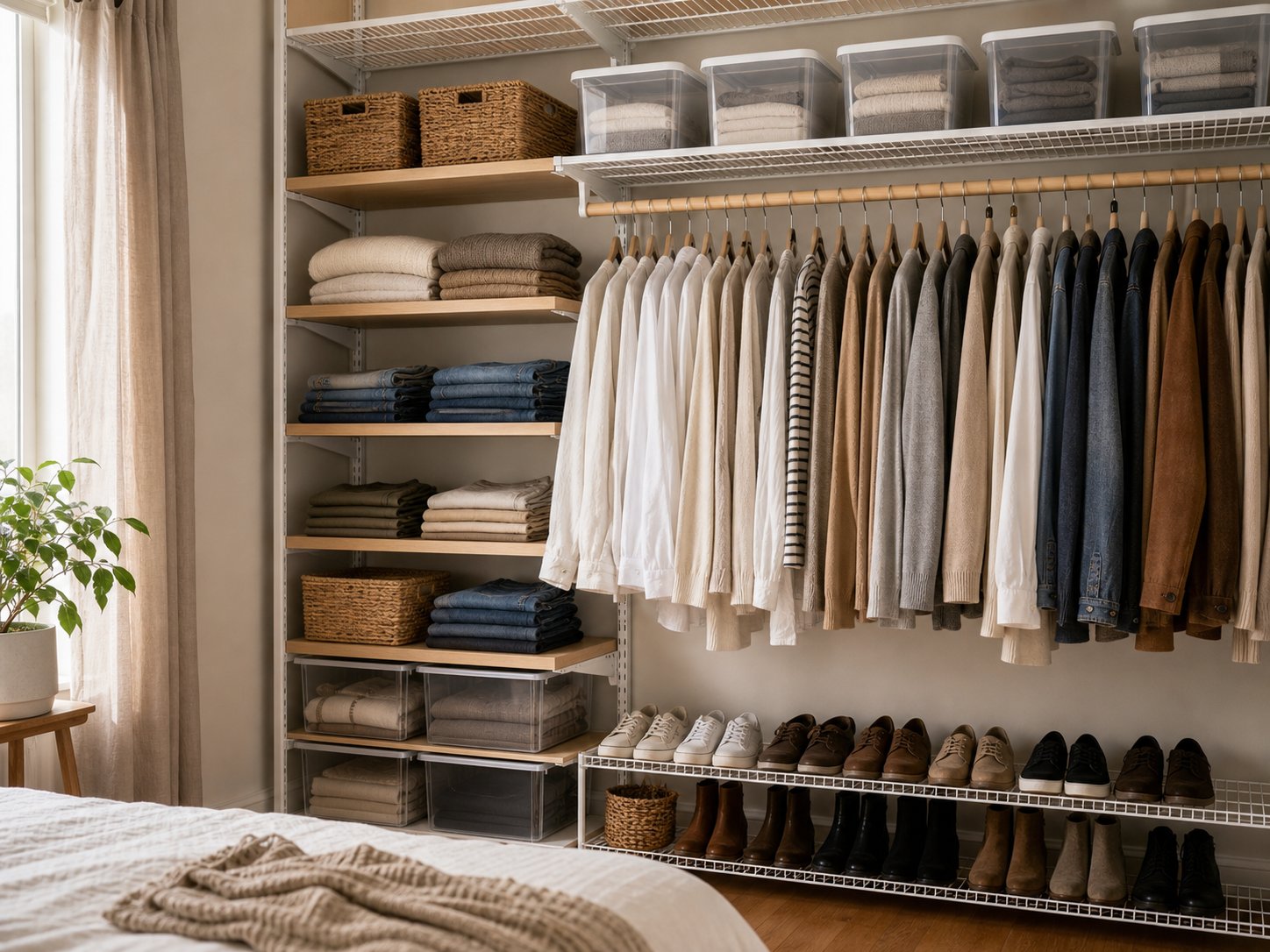
My neighbor Sarah spent $3,200 on a California Closets installation last spring. Floor-to-ceiling walnut veneer, soft-close drawers, built-in LED strip lighting — the whole nine yards. She posts photos of it on Instagram regularly. It looks phenomenal.
At a glance – check today’s price
Check Top Closet Organization Systems on Amazon
As an Amazon Associate, we earn from qualifying purchases.
Meanwhile, my buddy Ryan organized his nearly identical walk-in closet with two ClosetMaid wire kits from Home Depot. Total cost: $147, including the anchors he had to buy separately because his walls are old plaster. He finished the install during a single football game on a Sunday afternoon. His closet holds roughly the same number of clothes, shoes, and accessories as Sarah’s.
When you choose a closet system, do not forget the odd-shaped items that never sit neatly on shelves. Hats are one of those categories, so I made a separate guide to wall, door, and closet hat organizers.
Both of them are happy with the result. Neither of them is wrong. But the process of getting there — the research, the measuring, the agonizing over options — is where most people lose weeks of their life and hundreds of dollars they did not need to spend.
I have helped over a dozen friends and family members organize their closets in the past four years. Rentals, condos, suburban colonials, one converted garage that should not have been a closet but somehow was. Every single project started with the same question: what kind of system should I get? And every single time, the answer depended on three things that most buying guides skip right past — how long you plan to stay, how much you genuinely want to spend, and whether you own or rent.
This guide covers the actual differences between wire shelving, freestanding wood or laminate systems, and custom built-ins. Not brochure differences — real ones. I will walk through measuring your space (the right way, with a checklist), planning a layout that makes sense for how you actually dress, and five specific systems under $300 that I would recommend to anyone who asked me tomorrow.
Key Takeaways
- Wire shelving ($50–200) is the best value for renters and budget-conscious homeowners. It installs in under two hours and comes out cleanly when you move.
- Freestanding wood/laminate ($150–600) splits the difference — looks better than wire, moves with you, and requires no wall anchoring in most cases.
- Custom built-ins ($1,000–5,000+) maximize every inch and add resale value, but only make sense if you own the home and plan to stay at least 3–5 years.
- Measuring wrong is the #1 reason closet systems get returned. Always measure width at three heights, depth at the narrowest point, and account for door swing clearance.
- The “double hang” layout (two rods stacked vertically for short items) can nearly double your hanging capacity without spending an extra dollar.
The 3 Types of Closet Systems (And Who Each One Is For)
Walk into any Home Depot, Lowe’s, or Container Store and you will find closet organization products that fall into one of three categories. The marketing language varies — “modular,” “customizable,” “designer” — but structurally, every residential closet system is either wire-based, freestanding furniture, or permanently mounted custom cabinetry. Each approach carries distinct trade-offs in cost, appearance, portability, and how much of your weekend it will consume.
Here is the honest breakdown, starting with the cheapest option and working up.
Wire Shelving: The Budget Champion ($50–200)
Wire shelving systems — the kind made by ClosetMaid, Rubbermaid, and a handful of lesser-known brands — have been the default closet upgrade in American homes since the 1980s. They are the Toyota Corolla of closet organization: unglamorous, reliable, and shockingly effective for the price.
A basic wire closet kit that covers a 5-to-8-foot span typically costs between $50 and $120. That gets you one or two ventilated shelves, a hanging rod, mounting hardware, and sometimes a shoe rack attachment. Step up to the $150–200 range and you get expandable configurations with multiple shelf tiers, double-hang sections, and corner units.
Why Wire Works
Price per linear foot is unbeatable. You can organize a standard 6-foot reach-in closet for under $80. Try doing that with any other system — it is not possible.
Installation is genuinely DIY-friendly. If you own a drill, a level, and a stud finder, you can install a wire system in 90 minutes to 2 hours. The hardware mounts directly into wall studs (or uses drywall anchors for lighter loads). No cutting required on most adjustable kits — the shelves telescope to fit your width.
Ventilation is a real advantage that people overlook. Wire shelves allow air to circulate around your clothes, which matters more than you think if you live in a humid climate or your closet lacks ventilation. Musty closets happen because stagnant air gets trapped between solid shelves and walls. Wire fixes that.
Expansion is straightforward. Need another shelf in six months? Buy a $15 shelf kit and add it. ClosetMaid’s SuperSlide and ShelfTrack lines are designed for exactly this — you can reconfigure your entire closet without buying a new system.
Where Wire Falls Short
It looks like what it costs. There is no way around this. Wire shelving screams “rental apartment” and “first post-college closet.” If aesthetics matter to you — and for many people, they legitimately do — wire will always feel like a compromise.
Small items fall through or get stuck. Belts, scarves, socks, jewelry — anything narrow or small will slip through the wire grid gaps. You will end up buying shelf liners (another $10–15) or plastic bins to compensate, which partially negates the airflow advantage.
Hangers slide to one end. This is the most common complaint from wire shelf users and it is completely valid. Standard hangers on a wire shelf rod will drift toward whichever end is slightly lower. You can fix this with rubber bumpers or velvet hangers, but it is an annoyance that should not exist at any price point.
Weight limits are lower. Most wire shelves support 40–60 pounds per linear foot. That is fine for shirts and pants, but if you plan to store heavy items like boots, stacked sweaters, or storage bins on the shelves, you will hear creaking. Wall-mounted wire shelves that pull out of drywall anchors are a rite of passage for anyone who has overloaded one.
Best for: Renters, budget-limited homeowners, temporary living situations, utility closets, and anyone who values function over form. If you are in an apartment and your lease ends in 18 months, wire is the only rational choice.
Freestanding Wood/Laminate: The Middle Ground ($150–600)
Freestanding closet organizers sit on the floor and typically do not require any wall mounting. Think of them as furniture you place inside your closet — tower units with shelves and drawers, standalone garment racks with integrated storage, or modular cube systems you stack and arrange.
The price range here is wide because the category spans everything from a $130 SONGMICS fabric-and-steel organizer to a $600 John Louis Home solid wood tower kit. The laminate options (think IKEA KALLAX style or ClosetMaid SuiteSymphony) land in the sweet spot between $180 and $350.
Why Freestanding Makes Sense
It moves with you. This is the single biggest advantage over custom installations. When you relocate, you disassemble the unit, box it up, and set it up again in your next closet. For homeowners who might sell in 3–5 years or renters who do not want to lose their deposit, this flexibility is worth real money.
It looks significantly better than wire. Even a basic laminate tower adds visual weight and perceived quality to a closet. Flat, solid shelves hold folded items neatly without the wire-grid marks. Drawers hide underwear and socks. Doors can conceal clutter. For anyone who opens their closet and wants to feel a small dopamine hit instead of mild despair, freestanding wood or laminate delivers.
No wall damage means no deposit risk. Most freestanding systems sit under their own weight. Some taller units include a wall-tip restraint strap (one screw, small hole, easy to patch), but the core structure does not require drilling into studs.
Modular configurations let you start small. Buy a tower unit now for $200. Add a drawer module in three months for $80. Add a second tower next year. This incremental approach is psychologically easier than dropping $500 at once, and it lets you adjust as your wardrobe changes.
Where Freestanding Gets Tricky
Floor footprint reduces usable space. A freestanding tower is typically 16–24 inches deep and 24–48 inches wide. In a standard reach-in closet that is only 24 inches deep, that tower eats most of your floor space. Walk-in closets absorb freestanding units much better — if you have a narrow reach-in, wire mounted to the wall preserves more floor area.
Dimension mismatches are common. Freestanding units come in fixed sizes. Your closet does not. A 48-inch tower in a 50-inch niche leaves an awkward 2-inch gap on each side. A 72-inch tall unit in a closet with an 80-inch ceiling wastes 8 inches of vertical space. You will almost always have dead zones that a custom system would eliminate.
Stability can be an issue without wall anchoring. Loaded tower units are heavy, but a top-heavy one (heavy coats hanging above, empty bottom shelves) can tip forward when you pull a hanger aggressively. The anti-tip strap exists for a reason — use it, even if it means one small screw hole in the wall.
Best for: Homeowners who want a polished look without permanent installation, renters with walk-in closets, anyone who values portability, and people who want to build their system gradually over time.
Custom Built-In: The Dream ($1,000–5,000+)
Custom closet systems are permanently installed into your space — bolted to walls, cut to exact dimensions, and designed around your specific wardrobe. The range here is enormous because “custom” can mean anything from a $1,000 IKEA PAX configuration you measure and assemble yourself to a $5,000+ California Closets or Inspired Closets professional design with soft-close everything and integrated lighting.
The Elfa system from The Container Store sits in an interesting middle zone — it is wall-mounted and highly configurable (so it feels custom), but uses standardized components (so it is more affordable than true bespoke cabinetry). An Elfa closet typically runs $800–2,500 depending on size and components.
Why Custom Is Worth It (When It Is)
Every single inch gets used. A custom system designed for your specific closet dimensions eliminates the dead zones that plague freestanding systems. That awkward 11-inch gap next to the door frame? It becomes a pull-out scarf organizer. The 14-inch space above your top shelf? It becomes a seasonal storage shelf with a lip to prevent avalanches.
Home value increases measurably. Real estate agents consistently cite organized closets as a top-10 feature that buyers notice during walkthroughs. The National Association of Home Builders found that 85% of buyers considered closet organization a desirable feature. A well-done custom closet in a master bedroom can return 50–80% of its cost at resale — better than most bathroom renovations.
Longevity is dramatically better. Professionally installed custom closets use thicker materials (typically 3/4-inch melamine or plywood vs. 5/8-inch in flat-pack), better hardware (soft-close European hinges vs. basic pivot hinges), and are anchored directly into studs. They last 15–25 years with minimal maintenance. A $200 laminate tower starts sagging in 3–5 years under real-world loads.
Daily experience improves. This sounds intangible, but it is not. Opening a custom closet where everything has a designated spot — where you can see all your shirts at eye level, your shoes are individually visible, and your accessories are in velvet-lined drawers — genuinely makes getting dressed faster and less stressful. I have heard multiple friends describe it as a quality-of-life upgrade they did not expect.
Where Custom Hurts
The price is real. A mid-range custom closet for a standard walk-in (6×8 feet) runs $2,500–4,000 installed. A full master suite closet with islands, mirrors, and premium finishes can exceed $10,000. That is not play money. You need to be confident you will live in the home long enough to recoup the investment or simply enjoy it enough to justify the cost.
It stays when you leave. Built-in closet systems are considered fixtures. When you sell your house, the closet stays. You cannot take your $4,000 California Closets system to your next home any more than you can take the kitchen cabinets. This is fine if you are in your forever home. It is a painful loss if you relocate unexpectedly after two years.
Professional installation adds cost and scheduling friction. Most custom closet companies require an in-home consultation (free, but takes 60–90 minutes), followed by a design phase (1–2 weeks), manufacturing (2–4 weeks), and installation day (4–8 hours). From first call to finished closet, expect 4–8 weeks. IKEA PAX and Elfa are faster because you buy off the shelf, but installation is still a full-day project.
Modifications after installation are expensive. Want to move a shelf six inches higher? On a wire system, you unscrew two brackets and relocate in five minutes. On a custom system, you might be drilling new holes into melamine and patching old ones — or calling the installer back at $150/hour. Custom means commitment.
Best for: Homeowners who plan to stay at least 5 years, anyone selling a home and wanting to maximize appeal, people with complex wardrobes (lots of long dresses, shoe collections, accessories), and anyone for whom the daily experience of a beautifully organized closet genuinely matters enough to justify the cost.
The Measurement Guide: Get This Right or Return Everything
More closet systems get returned because of bad measurements than any other reason. Not defective products, not wrong color choices — wrong dimensions. The closet was 62 inches wide and they bought the 64-inch kit. The closet was 23 inches deep and the unit needed 24. These are preventable mistakes that cost you a trip to the store and two hours of your life.
Here is how to measure your closet correctly, in the order that matters.
Width (Measure Three Times)
Measure the interior width of your closet at three heights: floor level, waist level (36 inches up), and near the ceiling. Older homes especially have walls that are not plumb — a closet that is 63 inches wide at the floor might be 61.5 inches wide at the top. Your system needs to fit the narrowest measurement.
Depth (Measure at the Narrowest Point)
Measure from the back wall to the inside edge of the door frame (not the door itself — the frame). Standard reach-in closets are 24 inches deep, but I have seen them range from 20 to 28 inches. If your closet has baseboard molding on the back wall, measure to the front face of the baseboard — that is your usable depth.
Height (Floor to Ceiling and Floor to Shelf Rod)
Measure floor to ceiling for the total available vertical space. Then measure from the floor to the existing shelf rod (if there is one) to know what you are replacing. Standard closet rods sit at 66–72 inches. If you plan a double-hang section, the lower rod should be at 40–42 inches and the upper rod at 80–84 inches.
Door Swing Clearance
Open your closet door fully. Measure how far it swings into the closet interior. A standard hinged door swings 18–22 inches inward. Any system component (tower, drawer face, pull-out basket) within that swing arc will get hit every time you open the door. Sliding or bifold doors do not have this issue, but they reduce your accessible opening width.
Lighting and Electrical
Note the location of any ceiling light fixture, light switch, or electrical outlet inside the closet. Tall tower units can block light fixtures and cast shadows over half your wardrobe. If your closet has a pull-chain light, mark its position — you do not want a shelf unit blocking access to it.
Measurement Checklist (Print This)
- ☐ Width at floor level: _____ inches
- ☐ Width at waist level (36″): _____ inches
- ☐ Width at ceiling level: _____ inches
- ☐ Depth (back wall to door frame): _____ inches
- ☐ Height (floor to ceiling): _____ inches
- ☐ Current rod height from floor: _____ inches
- ☐ Door swing clearance: _____ inches
- ☐ Door type: Hinged / Sliding / Bifold / None
- ☐ Light fixture location noted: Yes / No
- ☐ Electrical outlet inside closet: Yes / No
- ☐ Baseboard molding depth: _____ inches
How to Plan Your Layout: Zones, Rods, and the Double-Hang Trick
A good closet layout divides your space into four functional zones. The exact proportions depend on your wardrobe, but here is a starting framework that works for most adults.
Zone 1: Hanging (60–70% of Your Space)
Most American wardrobes are hanging-dominant. Shirts, blouses, jackets, pants on hangers, dresses — these all need rod space. Divide your hanging into two sub-categories:
Double hang (short items): Install two rods stacked vertically — one at 40 inches from the floor, one at 82 inches. This is where shirts, folded pants, blouses, and jackets go. A 4-foot section of double hang holds roughly the same number of garments as an 8-foot section of single hang. This is the single most space-efficient upgrade you can make to any closet, and it costs nothing if you already have the rod hardware.
Long hang (tall items): Keep one section with a single rod at 68–72 inches for dresses, long coats, robes, and full-length garments. Most people need less long-hang space than they think — unless you wear dresses or suits daily, a 2-foot long-hang section is usually enough.
Recommended ratio: 70% double hang, 30% long hang for most wardrobes. Adjust based on your actual garment mix.
Zone 2: Folded Storage (15–20% of Your Space)
Shelves for folded sweaters, jeans, t-shirts, and workout clothes. The ideal shelf spacing for folded clothing is 10–12 inches. Going taller than 14 inches leads to unstable stacks that topple when you pull from the bottom.
Shelves vs. drawers vs. baskets: Shelves are cheapest and most visible — you can see what you have at a glance. Drawers hide contents but keep things neater (especially underwear, socks, and intimates — nobody needs those on display). Baskets split the difference — semi-visible, good airflow, easy to pull out and sort through.
General rule: use shelves for items you grab daily (jeans, t-shirts), drawers for items you want hidden (undergarments, accessories), and baskets for seasonal items you rotate in and out.
Zone 3: Shoes (10–15% of Your Space)
The average American owns 12–15 pairs of shoes. Where you store them depends on your closet type:
Floor-level shoe racks: The simplest option. A slanted wire rack below your hanging section holds 9–12 pairs in a 3-foot span. Downsides: bending over constantly, dust accumulation, and shoes getting kicked around.
Shoe shelves at waist height: More ergonomic, but uses premium shelf space that could hold folded clothes. Worth it if you have a large shoe collection and a walk-in closet with room to spare.
Over-the-door shoe organizers: Do not overlook these. A $15 over-the-door pocket organizer holds 24 pairs of shoes and uses zero closet interior space. The fabric pocket versions work better than the rigid plastic ones — shoes flex into the pockets instead of popping out.
Zone 4: Accessories (5–10% of Your Space)
Belts, ties, scarves, jewelry, watches, sunglasses, hats. These small items create disproportionate clutter when they do not have a designated home. Options:
- Hook strips or peg boards on the inside of the closet door for belts and necklaces
- Velvet-lined drawer inserts for jewelry and watches ($15–25 on Amazon)
- Shelf dividers for purses and clutches (acrylic dividers, $12 for a pack of 6)
- Dedicated tie/belt pull-out racks if your system supports them (custom systems usually include these)
DIY vs Professional Installation: When to Call Someone
The honest answer: most wire and freestanding systems are genuine DIY projects. Most custom built-in systems are not, unless you have intermediate woodworking skills and are comfortable cutting melamine with a track saw.
You Can DIY (Save $200–500)
- Wire shelf kits: These are designed for DIY. ClosetMaid literally includes a paper template you tape to the wall, mark your holes, and drill. A cordless drill, a level, and a stud finder are the only tools you need. Budget 90 minutes to 2 hours for a standard 6-foot reach-in.
- Freestanding units: If you have assembled IKEA furniture, you can assemble a freestanding closet organizer. Most use cam-lock and dowel construction with an Allen wrench. Budget 2–4 hours depending on the number of components.
- IKEA PAX (with caveats): PAX is technically DIY, but it pushes the boundary. The frames are heavy (80+ pounds for a full-height unit), the wall anchoring is critical for safety, and leveling the units on an uneven floor requires shimming. Two people minimum. Budget a full day for a typical walk-in PAX configuration.
Hire a Professional (Spend $200–800 for Installation)
- Custom melamine or plywood systems: These require precise cuts, wall mounting into studs at specific load points, and leveling that accounts for floor slope. A bad installation shows immediately — doors that do not close, shelves that sag, gaps between units and walls.
- California Closets, Inspired Closets, EasyClosets: These companies include professional installation in their pricing. The installer typically completes the job in 4–8 hours. You do not need to arrange your own installer.
- Elfa from The Container Store: TCS offers professional installation for a fee (typically $200–400 depending on complexity). You can also DIY Elfa, but the wall-mounted track system requires precise leveling across a long span — if the top track is even 1/8 inch off level, every hanging standard below it will be visibly crooked.
Cost Comparison
| Approach | Product Cost | Install Cost | Total | Time |
|---|---|---|---|---|
| Wire (DIY) | $50–200 | $0 | $50–200 | 1.5–2 hours |
| Freestanding (DIY) | $150–600 | $0 | $150–600 | 2–4 hours |
| IKEA PAX (DIY) | $600–1,800 | $0 | $600–1,800 | 6–10 hours |
| Elfa (Professional) | $800–2,500 | $200–400 | $1,000–2,900 | 4–6 hours |
| California Closets | $2,000–5,000+ | Included | $2,000–5,000+ | 4–8 hours |
5 Best Closet Systems Under $300 (Our Picks)
If your budget is under $300, these five systems cover the full spectrum from bare-bones wire to premium freestanding. Every one of them is available on Amazon with free shipping for Prime members.
1. ClosetMaid SuperSlide 5-to-8-Foot Closet Organizer Kit (~$80)
The SuperSlide is ClosetMaid’s most popular product for a reason. The adjustable design fits closets between 5 and 8 feet wide without cutting. You get a ventilated shelf, a hanging rod, and all mounting hardware. The “SuperSlide” feature is a smooth rod surface that prevents hanger marks and reduces sliding — a genuine improvement over older wire shelf designs where hangers drifted constantly.
This is the system I recommend to anyone on a tight budget or anyone organizing a rental apartment. You can install it in 90 minutes, it holds up to 600 pounds when properly mounted into studs, and it will come out cleanly when you move with just a few small holes to patch.
2. SONGMICS Portable Closet Organizer with Cover (~$130)
The SONGMICS is a steel-frame freestanding wardrobe with fabric cover, hanging rods, and multiple shelves. It is ideal for rooms without a built-in closet — spare bedrooms, studio apartments, basements, or any space where you need a closet but the architecture did not provide one.
Assembly takes about 2 hours. The fabric cover keeps dust off your clothes and gives the whole thing a cleaner look than an exposed garment rack. The steel frame supports up to 250 pounds of total load. It is not going to win any design awards, but for $130 you get a functional closet where one did not exist before.
3. ClosetMaid SuiteSymphony Starter Tower Kit (~$200)
SuiteSymphony is ClosetMaid’s laminate line, and the starter tower kit is the entry point. You get a 25-inch wide tower with adjustable shelves, and you can add drawers, doors, and additional shelf modules separately. The laminate finish (available in white, espresso, and natural gray) looks significantly more polished than wire.
What makes SuiteSymphony appealing is the expandability. Start with the $200 tower, and over time add the corner unit ($80), the drawer kit ($60), or a second tower. Within a year you can build out a full walk-in closet for under $500 total, spending incrementally instead of all at once.
4. IKEA BOAXEL Wire Shelving System (~$150)
BOAXEL is IKEA’s wall-mounted wire shelving system, and it occupies an interesting niche between basic wire kits and premium custom systems. The components are sold separately — wall uprights, shelves, clothes rails, baskets — so you configure exactly what you need. A typical 5-foot reach-in setup with two shelves, a clothes rail, and a basket runs about $140–160.
The key advantage over ClosetMaid wire is the Scandinavian design DNA. BOAXEL looks intentional, not like an afterthought. The white powder-coated steel has a modern, clean aesthetic that works in bedrooms, laundry rooms, and even visible pantries. The mounting system is also more robust — the wall uprights distribute load across multiple anchor points instead of individual shelf brackets.
Downside: you need an IKEA nearby or you pay $49+ for delivery. Component pricing also adds up faster than you expect — that $150 baseline can creep to $250 if you add baskets and extra shelves.
5. John Louis Home Woodcrest Closet Tower (~$250)
If you want real wood in your closet without going custom, John Louis Home is the brand to look at. The Woodcrest tower is made from solid wood (red mahogany finish or espresso), stands 72 inches tall, and includes five adjustable shelves plus a top shelf. It looks like it cost three times what it did.
This is a freestanding tower that requires no wall mounting (though an anti-tip strap is included and should be used). The construction quality is noticeably better than laminate alternatives — thicker panels, dovetail-style joints, and a finish that resists scratching. It is heavier to assemble (get a partner) and the wood expands slightly in humid conditions, but in terms of aesthetics-per-dollar in the under-$300 range, nothing touches it.
5 Common Closet Organization Mistakes (And How to Avoid Them)
After helping friends with over a dozen closet projects, these are the mistakes I see repeated most often — and they are all preventable.
1. Not Measuring Before Buying
This sounds obvious, and yet I have personally watched three different people order closet systems based on eyeball estimates. “It looks like about five feet wide.” It was 4 feet 7 inches. The system did not fit. Measure. With a tape measure. Write the numbers down. Refer to the checklist above.
2. Ignoring Shoe Storage Entirely
People plan for hanging clothes and folded clothes, then dump 20 pairs of shoes on the closet floor in a pile. Shoes on a bare floor migrate, get stepped on, and collect dust bunnies that would horrify you. Budget at least 10% of your closet real estate for a proper shoe solution — rack, shelf, or over-door organizer.
3. Forgetting About Lighting
A beautifully organized closet is useless if you cannot see what is in it. Most closets have a single overhead bulb (often a 60-watt incandescent) that casts shadows over at least half the interior. LED puck lights ($15 for a 3-pack, battery powered, stick-on) inside dark corners and under shelves make a dramatic difference. This is a $15 fix that makes a $200 closet system feel like a $500 one.
4. Not Rotating Seasonally
If you live anywhere with distinct seasons, half your wardrobe is irrelevant for six months of the year. Winter coats in July and tank tops in January are consuming premium closet real estate they do not deserve. A seasonal rotation — moving off-season clothes to under-bed storage, vacuum bags, or a secondary closet — can free up 30–50% of your primary closet space instantly.
5. Ignoring Door Swing
A standard hinged closet door swings 18–22 inches inward. If you place a freestanding tower or a pull-out basket within that arc, the door hits it every single time. I have seen dented laminate panels, cracked basket frames, and one case where the door handle punched a hole in a fabric wardrobe on day one. Measure your door swing. Mark it on the floor with painter’s tape. Design around it.
The Seasonal Rotation Strategy: 50% More Space Without Buying Anything
This is the single most impactful closet organization technique that costs zero dollars, and almost nobody does it consistently.
The concept is simple: your closet should only contain clothes for the current season plus transitional pieces. Everything else goes into storage — vacuum-sealed bags under the bed, clear bins on a high shelf, or a secondary closet in another room.
How to Set Up a Rotation
Step 1: Pull everything out of your closet. Yes, everything. Pile it on the bed. This is uncomfortable but necessary.
Step 2: Sort into four piles — keep for this season, store for next season, donate (have not worn in 12+ months), and trash (stained, torn, stretched out).
Step 3: Vacuum-seal the off-season pile. A $25 pack of vacuum storage bags on Amazon compresses bulky winter coats and sweaters down to about 25% of their original volume. Slide them under your bed or on a high closet shelf.
Step 4: Put only the current-season clothes back in the closet. Arrange them by category (shirts, pants, jackets) and then by color within each category. This takes 20 minutes and makes finding specific items dramatically faster.
Step 5: Set a calendar reminder to rotate at the beginning of each season change (roughly March and October for most of the US). The whole process takes about an hour twice a year.
People who do this consistently report that their closet feels twice as large, they wear a wider variety of their clothing (because everything is visible instead of buried), and they get dressed faster in the morning. It is free, it takes two hours per year, and it works with any closet system — wire, freestanding, or custom.
Wire vs Freestanding vs Custom: Full Comparison
| Feature | Wire | Freestanding | Custom Built-In |
|---|---|---|---|
| Price Range | $50–200 | $150–600 | $1,000–5,000+ |
| DIY Difficulty | Easy | Medium | Hard |
| Appearance | Basic | Good | Premium |
| Portability | High | Medium | None |
| Customization | Low | Medium | Total |
| ROI (Home Value) | None | Low | High |
| Best For | Rentals, budget | Flexible homeowners | Forever home |
| Install Time | 1.5–2 hours | 2–4 hours | 4–8 hours |
| Durability | 5–10 years | 3–7 years | 15–25 years |
| Renter-Friendly | Yes (small holes) | Yes (no holes) | No |
Quick-Reference: What to Buy at Every Budget
| Budget | Recommended System | Setup |
|---|---|---|
| Under $100 | ClosetMaid SuperSlide wire kit | DIY, 2 hours |
| $100–300 | Freestanding tower (SONGMICS, SuiteSymphony, or BOAXEL) | DIY, 3–4 hours |
| $300–600 | Premium freestanding (John Louis Home, expanded SuiteSymphony) | DIY or handyman |
| $600–1,500 | IKEA PAX or Elfa system | DIY (full day) or professional |
| $1,500+ | California Closets or local custom builder | Professional installation |
Best Value Pick
ClosetMaid SuiteSymphony Starter Kit
The best balance of price, appearance, and expandability for most homeowners.
Browse Closet Systems on Amazon →
As an Amazon Associate, we earn from qualifying purchases.
Frequently Asked Questions
What are the main types of closet organization systems?
There are three: wire shelving (the budget champion, about $50–200), freestanding wood or laminate units (the middle ground, about $150–600), and custom built-ins (the dream, roughly $1,000–5,000+). Wire is cheapest and easiest to install, freestanding balances looks and cost, and custom maximizes every inch but is a real investment.
How much does a closet organization system cost?
Anywhere from about $50–200 for wire shelving to $150–600 for freestanding units, up to $1,000–5,000+ for custom built-ins. Most people get excellent results in the $300 range without going custom.
How do I measure my closet before buying a system?
Measure the width, depth, and height of the space precisely before ordering anything — bad measurements are the number-one reason people end up returning systems. Also note the door swing and any baseboards or trim that eat into usable space.
What is the double-hang trick?
Installing two rods, one above the other, in part of the closet roughly doubles the hanging capacity for shorter items like shirts and folded pants. It’s the single biggest space win in most reach-in closets.
Should I install a closet system myself or hire a professional?
Wire and freestanding systems are DIY-friendly with basic tools. Call a professional for custom built-ins, heavy wall-mounted systems, or any time you’re not confident anchoring securely into studs — a poorly anchored system can pull out of the wall under load.
How can I get more closet space without buying anything?
Use seasonal rotation: store off-season clothing elsewhere and keep only the current season in the closet. It can free up around 50% of your space at no cost.
You May Also Like
- Best Closet Organizer System 2026
- Best Shoe Organizer for Closet 2026
- Best Laundry Room Organizer 2026
- Best Bathroom Storage Solutions 2026
- Best Garage Storage Solutions 2026
- Home Organization Buying Guide 2026
Disclosure: This post contains affiliate links. If you purchase through our links, we may earn a small commission at no extra cost to you. Learn more. As an Amazon Associate, we earn from qualifying purchases.
Small-space setup: if the space you’re organizing is a dorm, don’t forget the appliances — our dorm-legal appliance guide covers what fits your one outlet (and what your RA will confiscate).