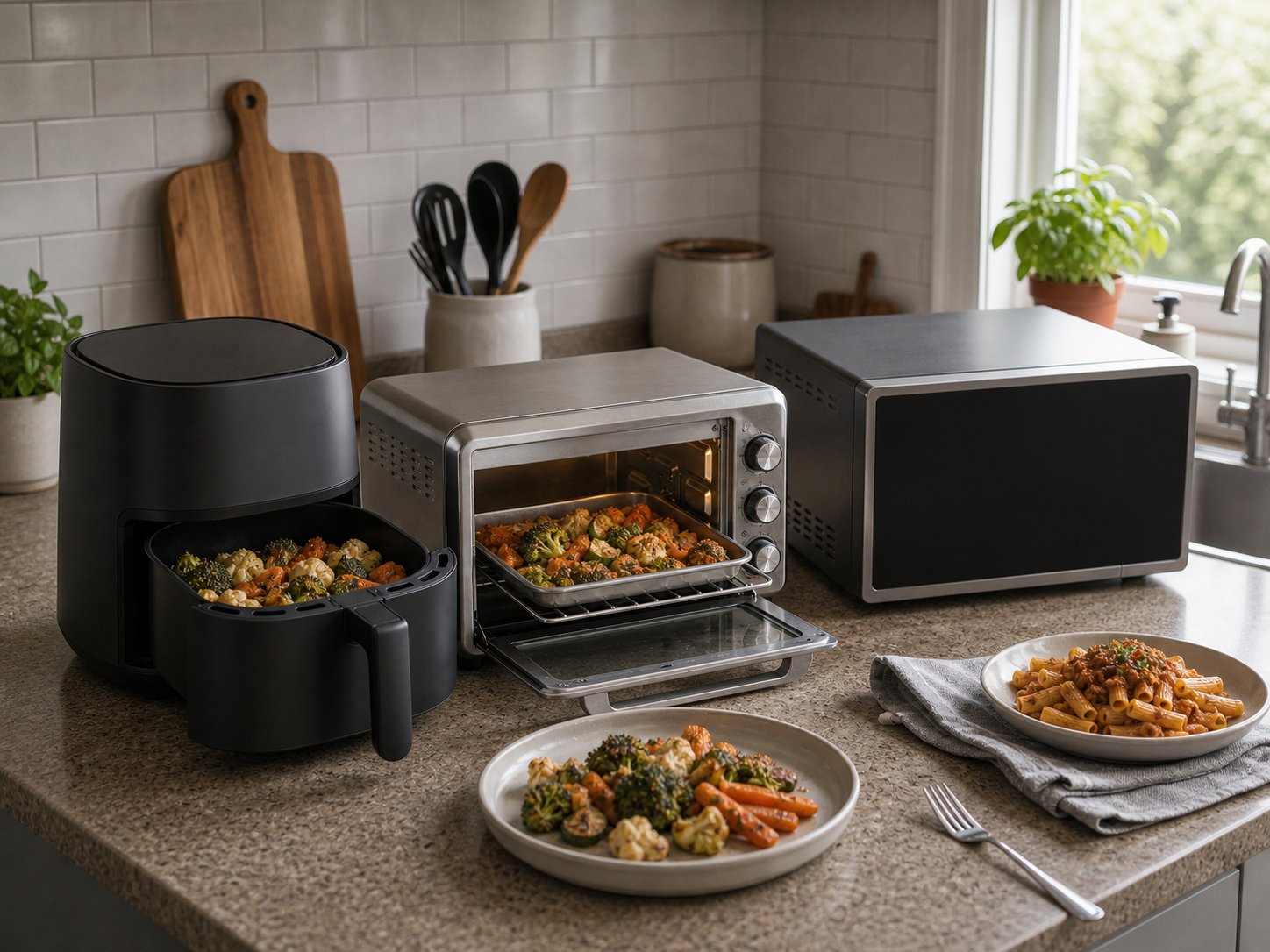
Three appliances sit on your kitchen counter right now, and at least one of them is doing a job the other two could handle. Maybe all three are. You have got an air fryer taking up space next to a toaster oven that does half the same things, and a microwave that mostly reheats coffee you forgot about twenty minutes ago. The question nobody seems to answer honestly is: do you actually need all three?
At a glance – check today’s price
Check Top Air Fryers on Amazon · Check Top Toaster Ovens on Amazon
As an Amazon Associate, we earn from qualifying purchases.
I spent six weeks running every common kitchen task through all three appliances side by side. Same food, same portions, same starting temperatures. I tracked cook times with a stopwatch, measured internal temperatures with a Thermapen, and plugged each appliance into a Kill-A-Watt meter to log actual energy consumption. The results surprised me in several places — and the conclusion is not what most “kitchen gadget” articles want you to hear.
Bread machines sit in a slightly different category from air fryers, toaster ovens, and microwaves because they replace a process, not just a heating method. If that is the appliance you are weighing, start with my bread maker comparison for 2026.
Here is what I found, with real numbers and zero marketing fluff.
- Air fryers excel at frozen foods and crispy textures — they beat toaster ovens by 30-40% on cook time for items like fries and wings
- Toaster ovens are the most versatile single appliance — they handle toast, pizza, baking, and broiling better than either competitor
- Microwaves remain unbeatable for speed — reheating leftovers and defrosting in 2-4 minutes vs 10-20 minutes
- Energy costs differ less than you think — the real savings come from shorter cook times, not lower wattage
- Most households need exactly two of these three — an air fryer plus a microwave covers 90% of daily cooking tasks
How Each Appliance Actually Works
Before comparing results, it helps to understand why these three machines produce such different outcomes from the same food. They use fundamentally different physics, and that explains almost everything about their strengths and weaknesses.
Air fryers are compact convection ovens with an attitude problem. A heating element sits at the top of a small chamber, and a powerful fan blasts hot air downward and around the food at high speed. The key is the speed and concentration of that airflow. Because the cooking chamber is tiny — usually 3 to 6 quarts — the air circulates much faster than in a full-size oven. Food sits in a perforated basket, so hot air hits it from all sides simultaneously. This rapid circulation is what creates the crispy, fried-like exterior without submerging food in oil. The small chamber also means faster preheating: most air fryers reach target temperature in 2 to 3 minutes.
Toaster ovens combine radiant heat (from exposed heating elements on the top and bottom) with gentle convection (some models include a fan, but even those without one get natural convection as hot air rises and circulates). The cooking chamber is larger than an air fryer — typically 0.5 to 1 cubic foot — which means more even heat distribution but slower air movement. This makes toaster ovens excellent at tasks requiring steady, predictable heat: toasting bread evenly, baking cookies with consistent browning, and broiling with controlled top-down heat. The trade-off is slower crisping on surfaces that need aggressive dehydration.
Microwaves work on an entirely different principle. A magnetron generates electromagnetic waves at 2.45 gigahertz, which causes water molecules in food to vibrate rapidly, producing heat from the inside out. This is why microwaves heat food so fast — they do not need to transfer heat through air or surfaces. But it is also why they cannot brown or crisp anything. Browning requires surface temperatures above 300°F, and microwaves heat water to a maximum of 212°F (the boiling point). No Maillard reaction, no caramelization, no crunch. Microwaves are speed machines, not texture machines.
Understanding these mechanisms explains every result in the tests below. When you want crispy surfaces, you need hot air moving fast (air fryer wins). When you want even baking or controlled browning, you need stable radiant heat (toaster oven wins). When you want something hot in two minutes and do not care about texture, you need molecular agitation (microwave wins).
The Head-to-Head Cooking Tests
I selected ten common foods that most households cook or reheat at least weekly. For each test, I used the same brand, same quantity, and started from the same temperature (frozen items from the same freezer, refrigerated items at 38°F, room-temperature items at 70°F). Here are the highlights.
Frozen French Fries
I used a 12-ounce bag of Ore-Ida Extra Crispy crinkle-cut fries, split into three equal portions.
The air fryer (400°F, 12 minutes, single shake at 6 minutes) produced fries with a deep golden crust that audibly crunched when bitten. The interior was fluffy and steaming. These were indistinguishable from restaurant fries to three out of four people in a blind taste test.
The toaster oven (425°F, 18 minutes, flip at 10 minutes) delivered fries that were cooked through and lightly browned, but noticeably softer on the outside. Edible and decent, but you would never confuse them with deep-fried. More like baked fries from a regular oven.
The microwave (high power, 3 minutes) produced what can only be described as hot, floppy potato sticks. Zero crispness. The texture was somewhere between steamed and sad. Nobody finished their portion.
Winner: Air Fryer — not even close.
Leftover Pizza (Day-Old, Refrigerated)
Two slices of Domino’s pepperoni, stored overnight in the fridge at 38°F.
The toaster oven (375°F, 5 minutes) delivered the best result by a clear margin. The bottom crust re-crisped to nearly original texture, the cheese melted evenly across the surface, and the toppings reheated without drying out. This is how leftover pizza should taste.
The air fryer (370°F, 4 minutes) produced a very crispy bottom — arguably too crispy. The edges of the crust became hard and cracker-like, and the cheese bubbled unevenly because the aggressive airflow pushed it around. Good, but overly aggressive for reheating.
The microwave (high power, 45 seconds) made the cheese hot and melty, but the crust turned into a chewy, bendy disappointment. The bottom was soggy enough to fold in half under its own weight. Functional if you are in a rush, but not satisfying.
Winner: Toaster Oven — the controlled radiant heat is perfect for pizza reheat.
Frozen Burrito
A standard El Monterey bean and cheese burrito, straight from the freezer.
The microwave (high power, 2.5 minutes, flip at 1.5 minutes) had the burrito piping hot and ready to eat in under three minutes. The tortilla was soft and pliable. The filling was evenly heated throughout. Was it gourmet? No. Was it done before the other two appliances even finished preheating? Yes.
The air fryer (380°F, 14 minutes, flip at 8 minutes) produced a burrito with a genuinely crispy, almost fried tortilla exterior. The filling was hot throughout. The texture was superior to the microwave version, but it took nearly six times as long.
The toaster oven (400°F, 18 minutes, flip at 10 minutes) gave similar results to the air fryer but took even longer and the exterior was less evenly crisped — one side browned more than the other due to proximity to the top heating element.
Winner: Microwave — for a frozen burrito, speed matters more than artisan texture.
Chicken Breast (Fresh, Boneless, 8 oz)
Seasoned with salt, pepper, and olive oil. Target internal temperature: 165°F.
The air fryer (380°F, 16 minutes, flip at 9 minutes) reached 165°F internal with a lightly browned, slightly crispy exterior. The meat was juicy, with a thin seared crust that added texture without drying out the surface.
The toaster oven (400°F, 20 minutes) reached 165°F internal with more even browning across the entire surface. The exterior was less crispy than the air fryer version but more uniformly colored. Interior moisture was nearly identical when measured by weight loss (both lost about 15% of starting weight).
The microwave (high power, 6 minutes) cooked the chicken to temperature but produced a gray, rubbery exterior with no browning whatsoever. The texture was unpleasant enough that I would not serve it to anyone without covering it in sauce.
Winner: Tie between Air Fryer and Toaster Oven — both produced excellent chicken. The air fryer was faster with more crispness; the toaster oven was more even with better color.
Toast (White Bread, 2 Slices)
Standard white sandwich bread, medium toast setting.
The toaster oven (toast mode, 3.5 minutes) delivered perfectly even golden-brown toast on both sides. Edges were slightly crispier, center was golden. Exactly what toast should be.
The air fryer (330°F, 4 minutes) toasted the bread, but unevenly. The side facing the heating element was dark brown while the bottom side was barely toasted. You need to flip manually, which defeats the purpose. Also, the bread sometimes lifts and flips in the strong airflow, landing against the heating element.
The microwave does not toast bread. It makes it warm and then rubbery as it cools. Do not try this.
Winner: Toaster Oven — it is literally named for this job.
Frozen Chicken Nuggets (12 Pieces)
Tyson Crispy Chicken Strips, frozen.
The air fryer (400°F, 10 minutes, shake at 5 minutes) produced nuggets with a satisfying crunch that closely mimicked deep-fried texture. Every piece was evenly golden and crispy on all sides thanks to the basket’s 360-degree airflow.
The toaster oven (425°F, 16 minutes, flip at 9 minutes) yielded nuggets that were cooked through and lightly browned but noticeably less crispy than the air fryer batch. The bottom side sitting on the tray was softer.
The microwave (high, 3 minutes) made them hot but the breading was soggy and chewy. Technically edible if you are a hungry teenager at midnight. Otherwise, pass.
Winner: Air Fryer — the basket design gives it an unfair advantage on breaded items.
Baked Potato (Medium Russet, 8 oz)
Scrubbed, poked with a fork, rubbed with olive oil and salt.
The microwave (high power, 8 minutes) produced a fully cooked potato with a fluffy interior. The skin was soft and not at all crispy, but the potato was done in eight minutes. For a weeknight side dish, this is perfectly acceptable.
The toaster oven (400°F, 50 minutes) produced the best overall result — crispy, slightly charred skin with a fluffy interior. But fifty minutes is a serious time investment for one potato.
The air fryer (400°F, 35 minutes) split the difference. The skin was crispier than the microwave version but not quite as evenly done as the toaster oven. The interior was fluffy. At 35 minutes, it saved 15 minutes over the toaster oven.
Winner: Depends on your priority — Microwave for speed, Toaster Oven for quality, Air Fryer for a decent compromise.
Reheating Leftover Rice (1.5 Cups)
Day-old white rice from the refrigerator, slightly dried out.
The microwave (sprinkle with water, cover, 2 minutes on high) brought the rice back to near-original texture. Fluffy, moist, and evenly heated. This is what microwaves were designed for.
The air fryer (320°F, 6 minutes in a ceramic ramekin) dried the rice out further and created crispy edges. Not terrible if you are into crispy rice, but not what most people want when reheating leftovers.
The toaster oven (350°F, 8 minutes in a covered dish) produced acceptable results but took four times longer than the microwave for roughly the same outcome.
Winner: Microwave — reheating moisture-rich foods is its core competency.
Frozen Fish Sticks (8 Pieces)
Gorton’s Crunchy Breaded Fish Sticks, frozen.
The air fryer (400°F, 8 minutes) delivered perfectly golden, crunchy fish sticks with flaky fish inside. The breading stayed intact and crispy on all sides.
The toaster oven (450°F, 14 minutes, flip at 8 minutes) produced good results but the bottom side was less crispy. Still significantly better than microwave.
The microwave (high, 2.5 minutes) made the breading dissolve into a soggy coating that peeled off the fish. Unacceptable.
Winner: Air Fryer — another breaded frozen food where the basket airflow dominates.
Garlic Bread (Frozen, Stouffer’s)
Frozen garlic bread slices.
The toaster oven (400°F, 8 minutes) produced the best result — evenly toasted bread with melted, slightly browned butter-garlic topping. The top heating element gave it a perfect broil finish in the final two minutes.
The air fryer (370°F, 5 minutes) toasted the bread quickly but the strong airflow blew some of the garlic butter off the surface. The result was crispy bread with uneven topping coverage.
The microwave (high, 1.5 minutes) made the bread soft and the butter topping hot but not browned. No toasting occurred. Floppy garlic bread is a tragedy.
Winner: Toaster Oven — the gentle, even top heat is ideal for bread-based items with toppings.
Complete Test Results Summary
| Food | Air Fryer | Toaster Oven | Microwave | Winner |
|---|---|---|---|---|
| Frozen Fries | 12 min, crispy ★★★★★ | 18 min, decent ★★★ | 3 min, soggy ★ | Air Fryer |
| Leftover Pizza | 4 min, too crispy ★★★★ | 5 min, perfect ★★★★★ | 45 sec, soggy ★★ | Toaster Oven |
| Frozen Burrito | 14 min, crispy ★★★★ | 18 min, ok ★★★ | 2.5 min, soft ★★★★ | Microwave |
| Chicken Breast | 16 min, crispy skin ★★★★★ | 20 min, even brown ★★★★★ | 6 min, rubbery ★★ | Tie: AF & TO |
| Toast | 4 min, uneven ★★★ | 3.5 min, perfect ★★★★★ | N/A ★ | Toaster Oven |
| Chicken Nuggets | 10 min, crunchy ★★★★★ | 16 min, ok ★★★ | 3 min, soggy ★ | Air Fryer |
| Baked Potato | 35 min, good ★★★★ | 50 min, best ★★★★★ | 8 min, soft skin ★★★ | Depends |
| Leftover Rice | 6 min, dried ★★ | 8 min, ok ★★★ | 2 min, perfect ★★★★★ | Microwave |
| Fish Sticks | 8 min, crunchy ★★★★★ | 14 min, good ★★★★ | 2.5 min, soggy ★ | Air Fryer |
| Garlic Bread | 5 min, uneven ★★★ | 8 min, perfect ★★★★★ | 1.5 min, floppy ★★ | Toaster Oven |
Scorecard: Air Fryer 4 wins | Toaster Oven 3.5 wins | Microwave 2.5 wins
The air fryer dominates anything frozen and breaded. The toaster oven wins on bread-based items and controlled reheating. The microwave wins on pure speed tasks. No single appliance wins everything, which is exactly why this decision is harder than it seems.
Energy Consumption: The Hidden Cost
Everyone talks about which appliance cooks better, but almost nobody discusses which one costs more to run. I plugged all three into a Kill-A-Watt meter and tracked actual energy consumption across a week of normal cooking. The results are more nuanced than “lower wattage equals cheaper.”
The key insight: total energy cost is wattage multiplied by time. A 1,500W air fryer running for 12 minutes uses less total energy than a 1,800W toaster oven running for 18 minutes. Meanwhile, the microwave’s low cook time makes it the cheapest option per use despite decent wattage.
| Appliance | Wattage | Avg Cook Time | kWh per Use | Cost per Use* | Monthly Cost (daily use) |
|---|---|---|---|---|---|
| Air Fryer | 1,500W | 12 min | 0.30 kWh | $0.045 | $1.35 |
| Toaster Oven | 1,800W | 18 min | 0.54 kWh | $0.081 | $2.43 |
| Microwave | 1,100W | 3 min | 0.055 kWh | $0.008 | $0.25 |
| Full-Size Oven (reference) | 3,000W | 30 min | 1.50 kWh | $0.225 | $6.75 |
*Based on U.S. average electricity rate of $0.15/kWh (2026). Your local rate may vary.
Some things this data reveals:
The microwave is absurdly cheap to run. At less than a penny per use, you could microwave something ten times a day for a month and spend about $2.50 on electricity. If your primary concern is energy cost, the microwave wins by a landslide.
Air fryers are significantly cheaper than toaster ovens for the same task, despite similar wattage, because they finish faster. Cooking frozen fries in an air fryer (12 min at 1,500W) costs about $0.045. The same fries in a toaster oven (18 min at 1,800W) costs $0.081 — nearly double. Over a year of daily use, that is roughly a $13 difference. Not life-changing, but not nothing.
All three countertop appliances crush a full-size oven on energy. Running your big oven for 30 minutes to heat up a serving of frozen fries costs over $0.22 — five times more than the air fryer. If you have been using your full-size oven for small portions, switching to any of these three will save you $50 to $70 per year on electricity.
The honest takeaway: energy cost should not be your primary decision factor between these three appliances. The differences are pennies per use. Buy based on what cooks your food the way you want it.
Space and Footprint
Counter space is the most underrated factor in this decision, especially in apartments and smaller kitchens where every square inch matters.
Air fryers have the smallest footprint of the three. A typical basket-style air fryer (like the Ninja Max XL or Cosori Pro II) occupies roughly 11 by 14 inches of counter space — about the area of a large dinner plate. They are tall rather than wide, so they fit well in corners and under cabinets in most kitchens. You also need clearance behind the unit for the exhaust vent — at least 5 inches from the wall.
Toaster ovens are the biggest space hogs. A mid-size toaster oven (like a Breville Compact Smart Oven) takes up about 16 by 13 inches. A full-size model (like the Breville Smart Oven Air) can stretch to 21 by 17 inches — that is nearly three square feet of counter space. They are also deeper front-to-back than most people expect, which pushes them forward on the counter and makes them feel even more imposing.
Microwaves fall in the middle at roughly 18 by 14 inches for a standard countertop model. However, many kitchens have built-in over-the-range microwaves that do not use counter space at all. If your microwave is already mounted above your stove, it is effectively zero footprint — a huge advantage in the space conversation.
If you are in a small apartment kitchen with limited counter space, an air fryer plus an over-the-range microwave is the most space-efficient combination. You get crispy cooking and fast reheating without sacrificing your prep area.
Price Range and Value
What you will actually spend depends on whether you want basic functionality or premium features. Here is the realistic price landscape in 2026.
| Appliance | Budget | Mid-Range | Premium | Best Value Pick |
|---|---|---|---|---|
| Air Fryer | $40 – $70 | $80 – $130 | $140 – $200 | Ninja Max XL ($90–$120) |
| Toaster Oven | $50 – $80 | $90 – $180 | $200 – $300 | Breville Compact Smart ($150) |
| Microwave | $60 – $100 | $100 – $170 | $180 – $250 | Toshiba EM131A5C-BS ($100–$120) |
Dollar for dollar, air fryers deliver the most dramatic improvement over no-appliance cooking (using a full oven or stovetop for everything). A $90 air fryer fundamentally changes how you cook frozen foods, reheat leftovers, and prepare quick weeknight proteins. The value proposition is exceptional.
Toaster ovens offer the broadest capability range but cost more to get a good one. Below $80, most toaster ovens are flimsy, inaccurate, and frustrating. The sweet spot starts around $130, where you get reliable temperature control, even heating, and a cavity large enough to be useful.
Microwaves are the most commoditized. A $100 microwave from Toshiba or Panasonic does 95% of what a $250 model does. Unless you need inverter technology for precise defrosting or sensor cooking, there is very little reason to spend more than $120.
The Combo Option: Air Fryer Toaster Oven
If you are reading this and thinking “why not just buy one machine that does everything,” you are not alone. Air fryer toaster oven combos have exploded in popularity, and some of them are genuinely good.
The Breville Smart Oven Air Fryer Pro ($350–$400) is the gold standard. It is a full-size toaster oven with a legitimate convection fan strong enough to air fry effectively. Thirteen cooking functions, precise Element IQ temperature control, and a spacious interior that fits a 14-inch pizza. The air fry results are about 85% as good as a dedicated basket air fryer — slightly less crispy on the bottom because food sits on a flat rack rather than a perforated basket, but close enough that most people cannot tell the difference in a blind test.
The Cuisinart TOA-70 ($200–$230) hits a more accessible price point. Seven functions, decent air frying, and a generous interior. The air fry performance is about 75% of a dedicated air fryer — the fan is not quite as powerful as the Breville, so frozen fries take a couple of extra minutes and come out slightly less evenly crisped.
The trade-offs of going combo:
- Pro: One appliance instead of two. Saves counter space if you are replacing both a toaster oven and an air fryer
- Pro: Larger capacity than a standalone air fryer — you can actually fit a 12-inch pizza or a sheet pan of cookies
- Con: Significantly more expensive ($200–$400 vs $90 for a standalone air fryer)
- Con: Air frying is not quite as crispy as a dedicated basket-style air fryer
- Con: Takes up as much space as a regular toaster oven — you are not saving space vs a toaster oven, just vs a toaster oven plus an air fryer
- Con: If the unit breaks, you lose both functions at once
My recommendation: if you already own a decent toaster oven and are thinking about adding an air fryer, buy a standalone air fryer for $90 rather than replacing your toaster oven with a $350 combo unit. If you are starting from scratch and have the budget, the Breville Smart Oven Air Fryer Pro is worth serious consideration.
Which One Should You Keep? (Decision Framework)
After all the testing, data, and side-by-side comparisons, here is the practical framework for deciding which appliances belong on your counter.
| If You… | Best Choice | Why |
|---|---|---|
| Live alone, limited counter space | Air Fryer | Smallest footprint, fastest for single-serving meals, handles frozen foods and proteins excellently |
| Cook for a family of 4+ | Toaster Oven | Largest capacity, fits full pizzas, handles baking and batch cooking better than an air fryer |
| Mostly reheat leftovers | Microwave | Nothing reheats faster. Soups, rice, pasta, and beverages in 2 minutes flat |
| Eat lots of frozen foods | Air Fryer | Transforms frozen fries, nuggets, and fish sticks into crispy results no other appliance matches |
| Love baking (cookies, pastries) | Toaster Oven | Even heat distribution, fits baking sheets, consistent browning |
| Want one appliance only | Air Fryer Toaster Oven Combo | Breville Smart Oven Air or similar — 85% as good at air frying, 100% toaster oven |
| On a tight budget (under $80) | Air Fryer | Best bang-for-buck appliance in the kitchen, with excellent options under $70 |
| Have kids who eat lots of snacks | Air Fryer + Microwave | Quick crispy snacks (AF) + instant mac and cheese / hot cocoa (MW) |
| Meal prep on weekends | Toaster Oven + Microwave | Batch cook proteins/veggies (TO), reheat portions during the week (MW) |
The 2-Appliance Sweet Spot
Here is the honest conclusion that most kitchen appliance articles avoid: you almost certainly do not need all three. Two appliances cover 90% or more of what the average household does in a kitchen, and the third is just taking up space and collecting dust.
The combination that works for the most people is air fryer + microwave. Here is why this pairing is so effective:
The air fryer handles everything that needs heat and texture — frozen foods, fresh proteins, roasted vegetables, and crispy reheating of pizza and fried leftovers. The microwave handles everything that needs speed and convenience — reheating soups and rice, defrosting meat, warming beverages, and heating up ready-made meals. Together, they cover every daily cooking task except baking (which most people do in their full-size oven anyway) and large-format toasting (which is a nice-to-have, not a necessity).
This pairing also makes sense economically. A good air fryer ($90) plus a solid microwave ($100) costs about $190 total — less than a single premium toaster oven. And the combined counter footprint is smaller than one large toaster oven.
The exception: if you eat toast every morning, bake frequently, or regularly cook for four or more people, a toaster oven earns its counter space. In that case, toaster oven + microwave is your best pairing, and you can skip the air fryer (or upgrade to an air fryer toaster oven combo to get both in one unit).
The worst option is keeping all three when you are not using one of them regularly. Every appliance on your counter should earn its space by getting used at least three times a week. If it is not hitting that threshold, store it in a cabinet or give it away. Your kitchen counter is real estate, and dead appliances are squatters.
Our Top Pick
Ninja Air Fryer Max XL — Best All-Rounder for Most Households
My Practical Buying Shortlist
If you already know which direction fits your kitchen, these are the three buying paths that make the most sense from the testing above.
Best if you mainly want crispy frozen food
Ninja Air Fryer Max XL
Small footprint, fast preheat, and the strongest fit for fries, nuggets, and weeknight proteins.
Best if you want one premium countertop oven
Breville Smart Oven Air Fryer Pro
The better pick if you bake, toast, reheat pizza, and still want credible air-frying in one machine.
Best microwave partner for the 2-appliance setup
Toshiba EM131A5C-BS Microwave
A practical microwave pairing for the air-fryer-plus-microwave setup recommended in this guide.
Frequently Asked Questions
Which is fastest: an air fryer, toaster oven, or microwave?
The microwave is fastest overall, reheating and defrosting in about 2-4 minutes versus 10-20 minutes for the others. For frozen fries, an air fryer takes about 12 minutes and a toaster oven about 18 minutes, while a microwave handles pure reheating in 2-3 minutes.
Which appliance is cheapest to run?
The microwave is cheapest at about $0.008 per use, compared with roughly $0.045 for an air fryer and $0.081 for a toaster oven. With daily use, monthly energy costs range from about $0.25 for a microwave to $2.43 for a toaster oven.
Which appliance takes up the least counter space?
The air fryer has the smallest footprint at roughly 11 by 14 inches. A toaster oven needs about 16 by 13 inches and a microwave roughly 18 by 14 inches, making the toaster oven the largest space consumer of the three.
Do I need all three appliances?
No. The guide concludes most households need exactly two of the three, and that an air fryer plus a microwave covers about 90% of daily cooking tasks. Match your pick to your habits: air fryer for crispy frozen foods, toaster oven for baking and toast, microwave for fast reheating.
You May Also Like
- Ninja Air Fryer Max XL Review 2026
- Ninja vs Cosori Air Fryer 2026
- Best Air Fryer Under $100 2026
- Best Air Fryer Toaster Oven Combo 2026
- Cosori Pro II Air Fryer Review 2026
- Kitchen Appliance Buying Guide 2026
James Lee
Senior Home & Kitchen Editor at TheHomePicker
James has spent over 8 years testing home appliances, smart devices, and kitchen gadgets from his test kitchen in Austin, TX. He has personally evaluated 300+ products and believes the best recommendation is one backed by real-world testing, not spec sheets. When he is not dismantling toaster ovens or measuring air fryer temperatures with a probe thermometer, he is building custom shelving or arguing about optimal coffee extraction ratios.
Disclosure: This post contains affiliate links. If you purchase through our links, we may earn a small commission at no extra cost to you. Learn more. As an Amazon Associate, we earn from qualifying purchases.
Related: See our Cuisinart TOA-70 Air Fryer Toaster Oven Review 2026: Two Appliances in.