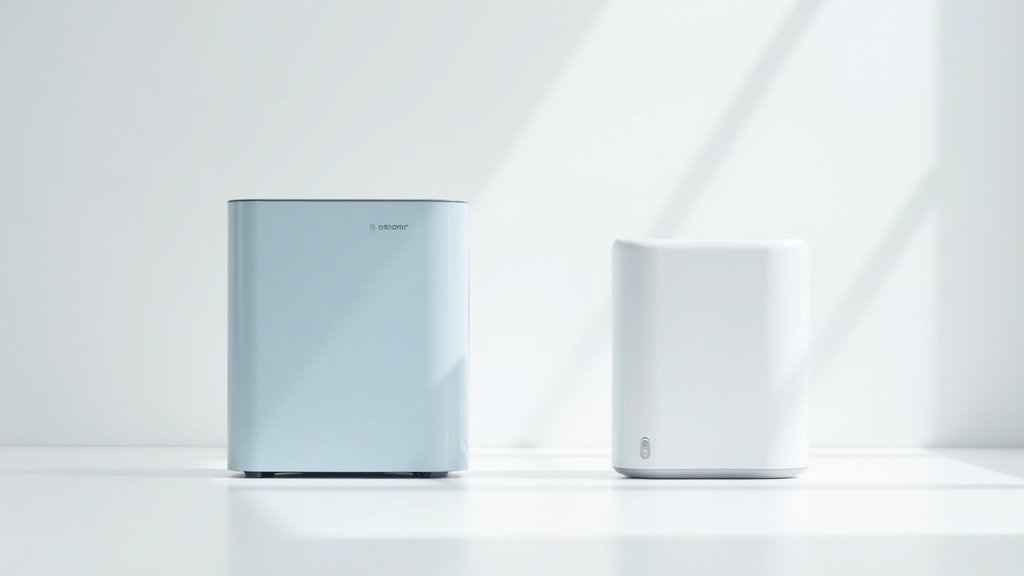
Blueair vs Coway: Two of the Best Air Purifier Brands Compared
If you have been shopping for an air purifier, two brand names keep appearing at the top of every recommendation list: Blueair and Coway. Both are established, highly regarded, and consistently produce some of the best-performing air purifiers on the market. But they approach air purification differently, and the right brand for you depends on your room size, budget, noise sensitivity, and maintenance preferences.
Blueair is a Swedish company founded in 1996 that built its reputation on HEPASilent technology — a combination of electrostatic charging and mechanical filtration that achieves HEPA-level performance with lower air resistance and quieter operation. Their filters are simple to replace, their designs are minimalist, and their focus has always been on delivering clean air with as little noise as possible.
Coway is a South Korean company that has been making water and air purifiers since 1989. Their Airmega line has become the benchmark for value in the air purifier space, particularly the AP-1512HH, which has been the best-selling air purifier on Amazon for years. Coway emphasizes real-time air quality monitoring, energy efficiency, and filter longevity.
We selected five models — two from Blueair and three from Coway — that represent each brand’s best offerings across different price points and room sizes. We compared filtration performance, noise levels, energy efficiency, filter costs, design, and smart features. Here is the complete breakdown.
Blueair vs Coway: Head-to-Head Comparison
| Model | Coverage | CADR | Filter Type | Noise (Low) | Price |
|---|---|---|---|---|---|
| Blueair Blue Pure 211 | 540 sq ft | 350 CFM | HEPASilent | 31 dB | ~$300 |
| Blueair Classic 605 | 775 sq ft | 500 CFM | HEPASilent | 32 dB | ~$700 |
| Coway Airmega AP-1512HH | 361 sq ft | 246 CFM | True HEPA | 24.4 dB | ~$160 |
| Coway Airmega 400 | 1,560 sq ft | 416 CFM | True HEPA + Carbon | 22 dB | ~$500 |
| Coway Airmega 250 | 930 sq ft | ~261 CFM | True HEPA + Carbon | 25 dB | ~$350 |
Detailed Reviews
1. Blueair Blue Pure 211+ — Best Blueair for Most Homes
Check Blueair Blue Pure 211+ on Amazon
As an Amazon Associate, we earn from qualifying purchases.
The Blueair Blue Pure 211+ is one of the most popular air purifiers ever made, and it remains Blueair’s best all-around model for typical living spaces. Covering rooms up to 540 square feet with five air changes per hour, it handles living rooms, master bedrooms, and open-plan kitchens with ease.
The 350 CADR (Clean Air Delivery Rate) is impressive for its price point and means the 211+ can cycle a 540 square foot room five times per hour. That translates to noticeably fresher air within 15-20 minutes of turning the unit on, even in rooms with cooking odors, pet dander, or seasonal pollen.
Blueair’s HEPASilent technology combines electrostatic charging with a mechanical particle filter. Incoming air particles receive an electrical charge before passing through the filter, which allows Blueair to use a less dense filter medium while still capturing 99.97% of particles down to 0.1 microns. The practical benefit is lower air resistance, which means the fan does not need to work as hard, which means less noise. At the lowest speed, the 211+ produces just 31 dB — quieter than a whispered conversation.
Design is intentionally minimal. The 211+ is a cylindrical tower with 360-degree air intake from the bottom and sides, and clean air output from the top. There are no digital displays, no app connectivity, and no air quality sensors. You get a single dial to control fan speed and an indicator light that tells you when the filter needs replacing (roughly every six months). This simplicity is either a feature or a limitation depending on your preference.
The fabric pre-filter wraps around the bottom of the unit and is washable. It comes in multiple colors so you can match your room decor. Replacement main filters cost approximately $40-60 and last about six months, making the annual filter cost around $80-120.
Pros:
- 350 CADR covers up to 540 sq ft with excellent air turnover
- HEPASilent technology delivers HEPA-level filtration at lower noise
- 31 dB at lowest speed — barely audible in a quiet room
- 360-degree air intake maximizes coverage regardless of placement
- Washable fabric pre-filter in multiple colors
- Simple one-dial operation with no complex menus
Cons:
- No smart features, WiFi, or app connectivity
- No built-in air quality sensor or auto mode
- Filter replacement costs add up over time ($80-120/year)
- No activated carbon filter for gases and strong odors
2. Blueair Classic 605 — Best Blueair for Large Rooms
Check Blueair Classic 605 on Amazon
As an Amazon Associate, we earn from qualifying purchases.
The Blueair Classic 605 is the premium large-room model in Blueair’s lineup, designed for open-plan living spaces, large living rooms, and commercial environments up to 775 square feet. With a 500 CADR — one of the highest you will find in a residential air purifier — the Classic 605 moves a staggering amount of air through its filtration system.
The 605 uses the same HEPASilent technology as the 211+ but scaled up significantly. The larger filter surface area and more powerful fan deliver five air changes per hour in a 775 square foot room, making it effective in genuinely large spaces where smaller units would be overwhelmed. In a standard 350-400 square foot living room, the 605 achieves eight or more air changes per hour, which is ideal for allergy sufferers or homes with heavy particulate loads.
Unlike the simpler 211+, the Classic 605 includes WiFi connectivity and works with the Blueair app for remote control, scheduling, and filter life tracking. It also supports Alexa and Google Assistant voice commands. An integrated air quality sensor monitors particle levels in real time and can be set to auto mode, where the fan speed adjusts based on current air quality.
The dual-filter design uses DualProtection filters that combine HEPASilent particle filtration with activated carbon and magnesium dioxide for gas and odor removal. This makes the 605 significantly more capable against cooking odors, VOCs, formaldehyde, and cigarette smoke than the 211+, which relies primarily on particle filtration.
The design is a white steel rectangle that blends into most modern interiors. It is notably larger than the 211+ at 20 x 26 inches, and weighs about 31 pounds. The filter door swings open for easy replacement, and the unit reminds you when filters are due. Replacement DualProtection filters run approximately $70-90 each and last about six months.
Pros:
- 500 CADR is exceptional for residential air purifiers
- Covers up to 775 sq ft with five air changes per hour
- DualProtection filters handle both particles and gases/odors
- WiFi, app control, Alexa, and Google Assistant support
- Built-in air quality sensor with auto mode
- 32 dB at lowest speed despite the high CADR output
Cons:
- Premium price at approximately $700
- Replacement filters are expensive ($140-180/year)
- Large footprint at 20 x 26 inches
- Overkill for rooms under 500 square feet
3. Coway Airmega AP-1512HH — Best Value Air Purifier Overall
Check Coway Airmega AP-1512HH on Amazon
As an Amazon Associate, we earn from qualifying purchases.
The Coway Airmega AP-1512HH (also known as the Coway Mighty) is the best-selling air purifier on Amazon for good reason. At approximately $160, it delivers True HEPA filtration, a real-time air quality indicator, auto mode, and Energy Star certification in a compact, well-built package. No other air purifier at this price comes close to its combination of performance and features.
The 246 CADR and 361 square foot coverage make the AP-1512HH ideal for bedrooms, home offices, nurseries, and medium-sized living rooms. The four-stage filtration system includes a pre-filter (washable), an odor filter (activated carbon), a True HEPA filter (99.97% at 0.3 microns), and a Vital Ion ionizer that can be toggled on or off. This multi-stage approach captures particles, absorbs odors, and provides an additional ion-based air cleaning layer.
The real-time air quality indicator uses a colored LED ring on the front panel — blue for excellent air quality, purple for good, pink for fair, and red for poor. In auto mode, the fan speed adjusts based on this sensor reading. When the air quality reaches blue, the unit drops to its lowest fan speed (24.4 dB, which is essentially silent) and consumes just 4.9 watts of power. The AP-1512HH runs 24/7 for less than $10 per year in electricity.
The Eco mode takes energy savings further. When the air quality remains at the highest level for 30 minutes, the fan shuts off entirely and the unit enters standby. When the sensor detects a dip in air quality, the fan restarts automatically. This is particularly useful for bedrooms where the air quality stabilizes quickly once doors and windows are closed.
Filter replacement is straightforward and affordable. The pre-filter is washable, the True HEPA filter lasts approximately 12 months ($40-50 replacement), and the activated carbon filter lasts about 6 months ($20-25 replacement). Annual filter cost runs roughly $60-100, which is among the lowest in the industry for a True HEPA purifier.
Pros:
- Outstanding value at approximately $160 with True HEPA filtration
- 24.4 dB at lowest speed — one of the quietest purifiers tested
- Real-time air quality indicator with intuitive color coding
- Auto and Eco modes for intelligent, energy-efficient operation
- Energy Star certified — under $10/year in electricity
- Affordable filter replacements at $60-100/year
Cons:
- 361 sq ft coverage limits it to medium-sized rooms
- No WiFi or app connectivity
- 246 CADR is lower than Blueair 211+ and Airmega 400
- Design is functional but not as sleek as newer Coway models
4. Coway Airmega 400 — Best for Large Rooms and Open Spaces
Check Coway Airmega 400 on Amazon
As an Amazon Associate, we earn from qualifying purchases.
The Coway Airmega 400 is Coway’s flagship large-room air purifier, covering up to 1,560 square feet — twice the coverage of the Blueair Classic 605 and more than four times the AP-1512HH. If you have an open-concept living area, a large basement, or want a single unit that can handle an entire floor of your home, the Airmega 400 is the most capable option in this comparison.
The dual-suction design pulls air in from both sides of the unit through two separate Max2 filter sets, each combining a pre-filter, activated carbon filter, and True HEPA filter. This dual-intake approach allows the Airmega 400 to achieve a 416 CADR while keeping noise levels remarkably low. At the lowest setting, the unit produces just 22 dB — quieter than every other model in this comparison, including the smaller Coway AP-1512HH.
The Max2 filters use a proprietary combination of activated carbon and True HEPA media that removes 99.97% of particles down to 0.3 microns and reduces volatile organic compounds (VOCs) including formaldehyde, toluene, and other household chemicals. The Green True HEPA filter material is unique to Coway and maintains its efficiency for up to 12 months before replacement is needed.
Real-time air quality monitoring is displayed through a colored LED ring and a numerical PM2.5 readout on the front panel, giving you precise information about your indoor air quality at a glance. The Smart Mode automatically adjusts fan speed based on detected particle levels, and Eco Mode shuts the fan off entirely when air quality has been excellent for an extended period.
The design is a sleek black and white oval tower that has won multiple design awards. At 22.8 x 14.8 inches, it is substantial but not overwhelming in a room. The bilateral filter access makes filter changes quick and intuitive. Replacement filter sets run about $80-100 each and last approximately 12 months. With two filter sets in the unit, annual filter cost is $160-200, though many owners find the filters last closer to 14-16 months in moderate use conditions.
Pros:
- 1,560 sq ft coverage — largest in this comparison by a wide margin
- 22 dB at lowest speed — quietest model tested
- Dual-suction design with bilateral Max2 filter sets
- Real-time PM2.5 numerical readout plus LED color indicator
- Smart Mode and Eco Mode for automated energy efficiency
- Award-winning design that fits premium home interiors
Cons:
- Higher filter replacement cost at $160-200/year for two filter sets
- Price of approximately $500 is significant, though justified by coverage
- No WiFi or app connectivity (Airmega 400S variant adds WiFi)
- Large unit requires dedicated floor space
5. Coway Airmega 250 — Best Mid-Range Coway with Smart Features
Check Coway Airmega 250 on Amazon
As an Amazon Associate, we earn from qualifying purchases.
The Coway Airmega 250 fills the gap between the budget AP-1512HH and the premium Airmega 400, offering 930 square feet of coverage with WiFi connectivity and smart features that neither of those models include in their standard versions. At approximately $350, it is the most feature-complete Coway at a mid-range price.
Its CADR of roughly 261 sits a step below the Blueair Blue Pure 211+ (350) but it covers nearly double the room size (930 sq ft vs 540 sq ft). This is possible because Coway calculates coverage using two air changes per hour rather than five, but in practical terms, the Airmega 250 delivers excellent air cleaning performance in rooms up to 700 square feet with higher air change rates. For bedrooms and medium living rooms, two air changes per hour is sufficient for maintaining clean air quality throughout the day.
This is the first model in our Coway lineup with built-in WiFi and IoCare app connectivity. Through the app, you can monitor real-time air quality, control fan speed, set schedules, track filter life, and receive maintenance reminders. The unit also works with Amazon Alexa for voice control. The integration is smooth and responsive, though the app interface is more functional than beautiful.
Filtration uses Coway’s Max2 filter system with a Green True HEPA filter and activated carbon layer. Like the Airmega 400, the filter captures 99.97% of particles at 0.3 microns and reduces VOCs, odors, and household chemicals. The single filter set (compared to the 400’s dual set) lasts approximately 12 months and costs about $50-70 to replace, making annual maintenance very affordable.
The air quality indicator uses the same intuitive color-coded LED system as other Coway models, and Smart Mode adjusts fan speed automatically based on particle sensor readings. At its lowest setting, the Airmega 250 produces 25 dB, which is whisper-quiet and suitable for light sleepers.
Pros:
- 930 sq ft coverage bridges the gap between AP-1512HH and Airmega 400
- Built-in WiFi with IoCare app and Alexa support
- ~261 CADR at a similar price, with far larger room coverage
- Affordable filter replacement at $50-70/year
- 25 dB at lowest speed for quiet bedroom operation
- Smart Mode with real-time air quality monitoring
Cons:
- Coverage calculation uses 2 air changes/hour (not 5)
- Single filter set vs Airmega 400’s dual configuration
- IoCare app is functional but not the most polished interface
- Design is attractive but less distinctive than the Airmega 400
Blueair vs Coway: Category-by-Category Breakdown
Filtration Performance
Winner: Tie. Both brands deliver True HEPA-level filtration (99.97% at 0.3 microns). Blueair’s HEPASilent approach uses electrostatic charging plus mechanical filtration, while Coway uses traditional True HEPA media. In real-world air quality tests, the difference in particle removal between these technologies is negligible. Coway has a slight edge in gas and odor removal thanks to the activated carbon layer included in most models, while the Blueair 211+ relies primarily on particle filtration.
Noise Levels
Winner: Coway. The Coway Airmega 400 at 22 dB and AP-1512HH at 24.4 dB are among the quietest air purifiers on the market. Blueair is also quiet (31-32 dB at lowest speed), but Coway consistently wins the noise comparison. For bedroom use where silence matters most, Coway has a measurable advantage.
Room Coverage
Winner: Coway. The Airmega 400 covers up to 1,560 square feet — nearly double the Blueair Classic 605’s 775 square feet. The Airmega 250 at 930 square feet also exceeds the 211+ at 540 square feet. For large rooms and open floor plans, Coway offers more coverage per dollar.
Smart Features
Winner: Coway (with the Airmega 250). The Coway Airmega 250 includes WiFi, app control, and Alexa integration. The Blueair Classic 605 also offers smart features, but at a much higher price point. The AP-1512HH and Airmega 400 lack WiFi in their standard versions, which is a notable omission. Blueair’s budget 211+ has no smart features at all.
Value for Money
Winner: Coway. The AP-1512HH at $160 is the undisputed value champion in the air purifier market. Even the Airmega 250 at $350 offers more coverage and features than the similarly priced Blueair 211+. Coway also wins on filter replacement costs, with the AP-1512HH costing just $60-100/year in filters compared to $80-120/year for the 211+.
Design and Build Quality
Winner: Blueair. Blueair’s Scandinavian design philosophy produces cleaner, more distinctive-looking units. The Blue Pure 211+ with its colored fabric pre-filter is a genuine design statement, and the Classic 605’s steel construction feels premium. Coway’s designs are attractive and functional but less distinctive. This is subjective, but Blueair consistently receives higher marks for aesthetics.
Buying Guide: How to Choose Between Blueair and Coway
Choose Blueair If:
- You prioritize design aesthetics and want an air purifier that looks good in your space
- You prefer the simplest possible operation (Blue Pure 211+ with its single dial)
- You need high CADR output for a mid-to-large room (Classic 605 at 500 CADR)
- You value the HEPASilent technology’s combination of electrostatic and mechanical filtration
- You want the Blueair app ecosystem and smart features (Classic 605)
Choose Coway If:
- You want the best value per dollar — the AP-1512HH is unbeatable at $160
- You need large-room coverage without buying multiple units (Airmega 400 at 1,560 sq ft)
- Noise level is your top priority, especially for bedroom use
- You want real-time air quality monitoring with color-coded indicators
- You prefer lower long-term filter replacement costs
- You want WiFi and app control at a mid-range price (Airmega 250)
Room Size Quick Guide
Small rooms (under 400 sq ft): Coway AP-1512HH is the clear winner. No reason to spend more for a small space.
Medium rooms (400-600 sq ft): Blueair Blue Pure 211+ and Coway Airmega 250 are both excellent. Choose 211+ for simplicity and design, or Airmega 250 for smart features and wider coverage.
Large rooms (600-800 sq ft): Blueair Classic 605 or Coway Airmega 250. The 605 has higher CADR, but the 250 covers more area and costs significantly less.
Very large rooms (800+ sq ft): Coway Airmega 400 is the only choice in this comparison that truly covers spaces over 800 square feet with a single unit.
Smoke season is here. These are the purifiers we tested for wildfire particle removal →
🔍 Not sure you even need a purifier? Read air purifier vs humidifier vs dehumidifier.
Frequently Asked Questions
Q: Is Blueair or Coway better for allergies?
A: Both brands are excellent for allergies, as all models in this comparison capture 99.97% of allergens at 0.3 microns or larger. For allergy sufferers, the most important factor is coverage area relative to your room size. A purifier that delivers five air changes per hour in your specific room will outperform one that only manages two. For bedrooms under 400 sq ft, the Coway AP-1512HH is ideal. For larger living areas, choose the Blueair Classic 605 or Coway Airmega 400 based on your room size.
Q: Which brand has cheaper filters to replace?
A: Coway has lower filter costs overall. The AP-1512HH costs approximately $60-100/year in filters, and the Airmega 250 runs about $50-70/year. Blueair’s 211+ costs $80-120/year, and the Classic 605 costs $140-180/year. The Coway Airmega 400 is the most expensive at $160-200/year because it uses two filter sets, but it also covers the largest room area. When calculated as filter cost per square foot of coverage, Coway is more economical across the board.
Q: Are Blueair and Coway air purifiers safe to run 24/7?
A: Yes. Both brands design their purifiers for continuous 24/7 operation. The Coway AP-1512HH’s Eco mode is specifically designed for this — it runs continuously but shuts the fan off when air quality is excellent, saving energy while maintaining monitoring. Blueair’s HEPASilent technology runs with low energy consumption at lower speeds. Running an air purifier 24/7 is actually recommended for the best results, as it maintains consistent air quality rather than allowing pollutants to accumulate between sessions.
Q: Do these air purifiers help with pet odors?
A: Models with activated carbon filters are effective against pet odors. The Coway Airmega 400, Airmega 250, and AP-1512HH all include activated carbon filtration that absorbs pet odors, cooking smells, and VOCs. The Blueair Classic 605 with DualProtection filters also handles odors well. The Blueair Blue Pure 211+ is primarily a particle filter and is less effective against strong odors unless you add the optional carbon filter accessory.
Q: Can I use Blueair and Coway purifiers in a home with smokers?
A: Yes, but choose models with activated carbon filtration. Cigarette smoke contains both particles and gases, so you need a purifier that addresses both. The Coway Airmega 400 and Blueair Classic 605 are the best options from this comparison for smoke, thanks to their combination of True HEPA/HEPASilent particle filtration and activated carbon gas filtration. For heavy smoke, size up — choose a purifier rated for a room larger than yours to ensure adequate air changes per hour.
Our Verdict: Which Brand Should You Choose?
For most buyers, Coway offers better overall value. The Coway Airmega AP-1512HH at $160 is the best air purifier you can buy for the money, period. It delivers True HEPA filtration, real-time air quality monitoring, whisper-quiet operation, and industry-leading energy efficiency at a price that makes every competitor look expensive. For bedrooms, home offices, and medium rooms, it is our default recommendation.
Check Coway Airmega AP-1512HH on Amazon
As an Amazon Associate, we earn from qualifying purchases.
For large open spaces, The Coway Airmega 400covers up to 1,560 square feet with the quietest operation in its class. If you want smart features at a mid-range price, The Coway Airmega 250 adds WiFi and app control without breaking the budget.
Blueair wins on design and high-CADR performance. The Blueair Blue Pure 211 is the most aesthetically pleasing air purifier in this comparison and delivers excellent 350 CADR performance for rooms up to 540 square feet. The Blueair Blue Pure 211 is the CADR champion at 500 CFM and includes premium smart features for buyers who want the absolute highest air throughput.
Ultimately, you cannot go wrong with either brand. Both Blueair and Coway produce reliable, effective air purifiers backed by years of engineering expertise. Choose Coway for value and coverage, and Blueair for design and raw air-moving performance. Your lungs will thank you either way.

Home Product Expert
James is the founder and lead reviewer at The Home Picker. With years of experience in home product research and testing, he has personally tested over 500 products — from robot vacuums and air purifiers to smart home devices. His reviews are based on hands-on testing, spec analysis, and real-world performance data. Read full bio →
Disclosure: This post contains affiliate links. If you purchase through our links, we may earn a small commission at no extra cost to you. Learn more.
You May Also Like
- Levoit vs Coway Air Purifier: Which Brand Wins in 2026?
- Coway AP-1512HH vs Levoit Core 300 2026: Best Budget Air Purifier?
- Coway Airmega 400 vs Winix 5500-2: Which Air Purifier Wins in 2026?
- Dyson vs Levoit Air Purifier 2026: Which Brand Wins?
- Coway Airmega Mighty2 vs the Original Mighty (2026): Should You Upgrade the People’s Air Purifier?