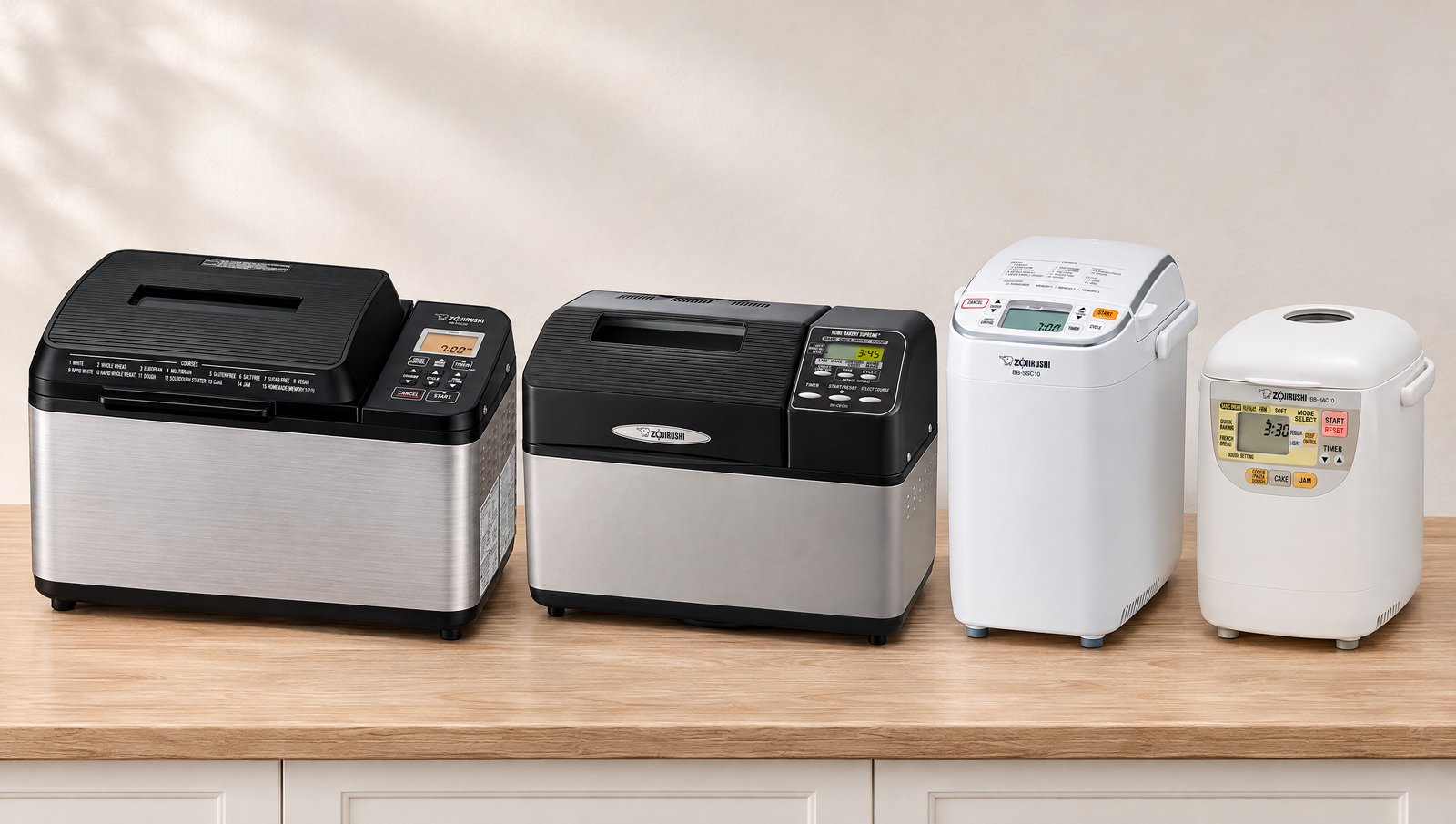
Zojirushi builds a sizing code into its model numbers. In the company’s words, a breadmaker whose number ends in “10” is the smaller one, and one ending in “20” is the larger. That neatly splits the five breadmakers its US online store lists. The Virtuoso Plus BB-PDC20, the Virtuoso Plus BB-PPC20 and the Supreme BB-CEC20 bake a 2-lb loaf in the horizontal shape of sandwich bread; the Maestro BB-SSC10 and the Mini BB-HAC10 bake a 1-lb loaf that stands upright. Settle the loaf size first, then let the menus, the counter space and Zojirushi’s PFAS-free claim for the BB-PPC20 decide within your half.
AI disclosure: The text on this page was prepared with AI assistance.
We did not test these bread makers, bake with them or measure them. This guide is built from Zojirushi’s US product pages and online store, the operating instructions for four of the five models, and Amazon’s product data, all checked on November 8, 2026. We could not find a manual for the BB-PPC20. Where Zojirushi’s own figures disagree, we show both.
Quick answer: For a loaf of about 8 sandwiches, start with the Virtuoso Plus BB-PDC20, the 2-lb model with a Gluten Free course, a sourdough starter course, custom memory settings and a lid heater. Take the BB-PPC20 instead only if its PFAS-free food-contact claim matters to you; otherwise Zojirushi lists the same size, power and menu. For about 5 sandwiches a loaf, the Maestro BB-SSC10 is the 1-lb machine with a Gluten Free course, custom memory settings and an automatic add-in dispenser; the Mini BB-HAC10 is smaller and simpler, with none of the three. The Supreme BB-CEC20 is the hardest to place: a 2-lb loaf without a Gluten Free course or lid heater, lighter than the BB-PDC20 by the two manuals, with a footprint advantage that shrinks in its own manual.
Start with how much bread you get through
Zojirushi’s online store puts numbers on the two sizes. It says the BB-PDC20 and the Supreme bake a horizontal loaf “ranging from 1-1/2 to 2 lbs” that makes approximately 8 sandwiches, with enough dough for two 12-inch pizzas, and that the Maestro and the Mini bake a vertical 1-lb loaf of approximately 5 sandwiches, with dough for one 11-inch pizza. That passage doesn’t name the BB-PPC20, whose page lists the same 2-lb capacity. Zojirushi pitches the Mini as a way for smaller households to have fresh bread “everyday without waste,” and that is the useful test: a loaf that goes stale before it is finished is the wrong size, whatever the machine.
If you are between sizes, the 2-lb half is the one that bends: there is that 1-1/2 to 2 lb range, and the Supreme’s manual prints 1.5-lb versions of several recipes. Zojirushi rates the Maestro and the Mini at a 1-lb loaf and describes no larger size.
Then check the counter, the cupboard and the outlet
| Model | Loaf | Zojirushi page, W x D x H, in | Manual, W x D x H, in |
|---|---|---|---|
| Virtuoso Plus BB-PDC20 | 2 lb, horizontal | 18 x 10-1/2 x 12-7/8 | 18 x 10-1/2 x 12-7/8 |
| Virtuoso Plus BB-PPC20 | 2 lb, horizontal | 18 x 10-1/2 x 12-7/8 | Manual not found |
| Supreme BB-CEC20 | 2 lb, horizontal | 16-7/8 x 8-1/2 x 12-1/4 | 17 x 10 x 12 |
| Maestro BB-SSC10 | 1 lb, vertical | 8-7/8 x 12-1/2 x 13-5/8 | 8-7/8 x 12-1/2 x 13-5/8 |
| Mini BB-HAC10 | 1 lb, vertical | 8-1/2 x 11-1/4 x 12-1/4 | 8 x 11 x 12 |
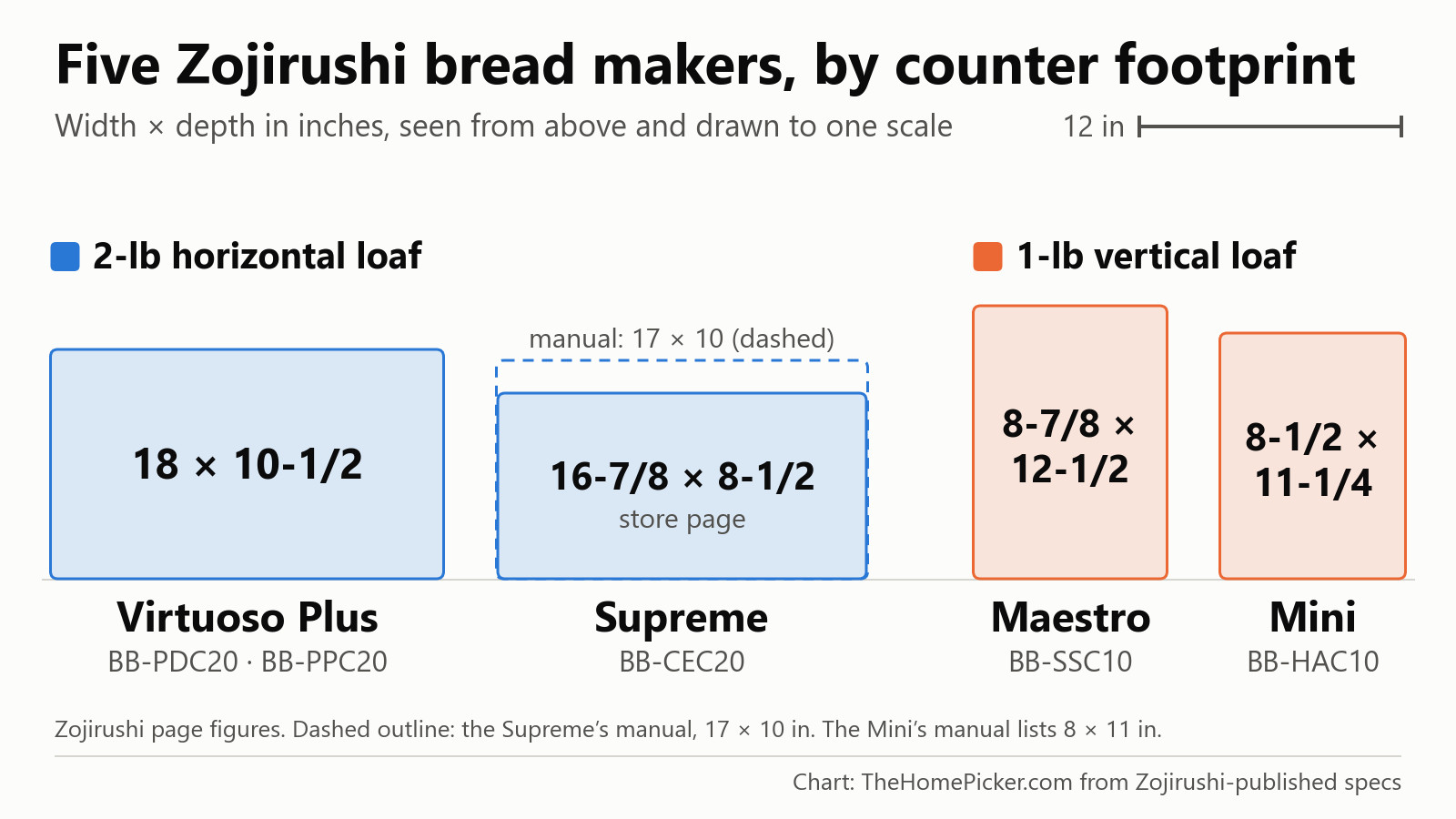
Multiply width by depth and the two halves are far apart: about 189 square inches for either Virtuoso Plus, against about 111 for the Maestro and about 96 for the Mini, on Zojirushi’s page figures. The Supreme is where the sources split. Its store page lists 16-7/8 x 8-1/2 in, about 143 square inches; its manual lists 17 x 10 in, about 170. A narrower base is the Supreme’s main spec-sheet difference from the Virtuoso Plus, and its own manual erases more than half of that difference, so measure your spot against the larger figure. Height runs the other way: the tallest of the five is the 1-lb Maestro at 13-5/8 in, against 12-7/8 in for the Virtuoso Plus.
Weight decides whether a bread maker stays out or gets put away: the manuals list about 24 lbs for the BB-PDC20, 17 for the Supreme, 16 for the Maestro and 12 for the Mini, and both 1-lb machines have a carry handle. Putting it away is not the same as baking in the cupboard. The BB-PDC20 and Maestro manuals say not to use the machine where steam or heat builds up, such as kitchen storage cabinets, to keep it at least 2 inches from walls or furniture, and to use an outlet rated at 15 amperes minimum with no other devices plugged into it. The safety sections of the Supreme and Mini manuals give no distance, say never to clog the steam vent, and ask for an outlet rated at 15 amperes or more. Power ratings follow loaf size: 700 watts for the 2-lb machines, 450 for the 1-lb ones.
The settings that actually separate them
| Model | Gluten Free course | Sourdough starter course | Custom memory settings |
|---|---|---|---|
| BB-PDC20 | Yes | Yes | 3 |
| BB-PPC20 | Yes | Yes | 3 |
| BB-CEC20 | No; gluten-free recipes in the manual | Yes | 3 |
| BB-SSC10 | Yes | No | 3 |
| BB-HAC10 | No; a gluten-free recipe in the manual | No | None |
Gluten-free splits the lineup three to two, and not along the size line. The two Virtuoso Plus models and the Maestro have a course named Gluten Free. The Supreme and the Mini don’t, although both manuals print gluten-free recipes: brown rice and raisin breads among the Supreme’s Basic/Quick recipes, and a brown rice bread among the recipes for the Mini’s basic bread course. The Maestro’s manual adds that its Homemade course can be used for making gluten free dough. Our judgement: if gluten-free loaves are a main reason to buy, pick one of the three with the course built in rather than relying on recipes run on a general basic course.
Sourdough starter does follow the size line. All three 2-lb models have the course and neither 1-lb model does. Zojirushi says the Supreme’s version prepares “a light sourdough starter in a little over 2 hours.”
Add-ins. Only the Maestro has an Auto Add Dispenser: you load it before starting, and its manual says it releases the ingredients during the knead cycle, though not on every course. The BB-PDC20, Supreme and Mini manuals describe a beep that tells you when to add them by hand. Without the BB-PPC20’s manual we could not confirm how it handles add-ins.
Crust. If you like a pale crust, the Maestro offers only medium or dark. The Mini offers light or regular, plus regular, firm or soft bread. The BB-PDC20 and the Supreme offer light, medium and dark on some courses; on the BB-PDC20 the crust can’t be changed on Whole Wheat, European, Sugar Free, Rapid Whole Wheat or Homemade.
Heat. Only the two Virtuoso Plus models are described with a heater in the lid; the BB-PDC20 manual lists a 40 W lid heater beside a 600 W main heater, and Zojirushi says the pair “promote even baking and browning.” The Maestro’s page mentions “double heaters” without placing either in the lid, and the Supreme and Mini manuals each list one heater rating. We can’t verify what the lid heater does to the crust.
Timing. All five have a 13-hour delay timer. For a faster loaf Zojirushi lists 2 hours 25 minutes on the Virtuoso Plus Rapid White and Rapid Whole Wheat courses, 2 hours 20 minutes on the Maestro’s quick course, “about 2 hours” on the Supreme and “under 2 hours” on the Mini.
The five machines
Virtuoso Plus BB-PDC20: Gluten Free, sourdough and a lid heater at 2 lb
The starting point if you want a 2-lb horizontal loaf. Its manual lists 15 courses, the last being Homemade with three memory settings, plus two kneading blades and the lid heater. The costs are space and weight: with the BB-PPC20 it has the largest base of the five, and its manual gives about 24 lbs.
Virtuoso Plus BB-PPC20: the same machine, a different pan claim
On Zojirushi’s product pages the BB-PPC20 matches the BB-PDC20 line for line in size, power, menu, blades and lid heater. What differs is the pan and the claim attached to it: a “ceramic nonstick coated baking pan,” and a statement that the model is free of PFAS (including PTFE and PFOA) and BPA wherever it touches food or beverages. The BB-PDC20’s page makes no PFAS statement either way. If that claim matters to you, this is the model; if not, nothing on the product pages separates the two. We could not read its manual, so the distance, outlet and weight details above are confirmed for the BB-PDC20 only.
Supreme BB-CEC20: the 2-lb loaf with a shorter feature list
The Supreme bakes the same kind of 2-lb horizontal loaf, with light, medium or dark crust, three Home Made memory settings, a Sour Dough Starter course and a Home Made recipe for meatloaf, but no Gluten Free course and no lid heater in its specifications. On paper its case is a lighter, smaller machine: its manual gives 17 lbs against about 24 for the BB-PDC20, and its store page lists a smaller base, though that is the very figure its own documents disagree on. If you are drawn to it, compare its current price with the Virtuoso Plus and measure against the manual’s 17 x 10 in first.
Maestro BB-SSC10: the 1-lb machine with the longer menu
The only 1-lb model with a Gluten Free course, three Homemade memory settings and an automatic add-in dispenser, and its menu adds Multigrain, Salt Free, Sugar Free and Vegan courses that the Mini lacks. The limits: medium or dark crust only, no sourdough starter course, and the most height of the five at 13-5/8 in. Its manual gives about 16 lbs, and its documents describe a single kneading blade.
Mini BB-HAC10: the smallest and simplest
The Mini takes the least counter of the five, 8-1/2 x 11-1/4 in on Zojirushi’s page, and is the lightest of the four whose manuals we read, at about 12 lbs, with a holder for the power cord. Its menu is short: basic bread in regular or firm texture, soft, French, dough, cookie/pasta dough, cake, jam and quick bread. You add raisins or nuts when it beeps. Choose it for plain 1-lb loaves in the least space; choose the Maestro for the extra courses in the same loaf size.
When none of the five fits
For a loaf larger than 2 lb or a different paddle design, look outside these five; our Virtuoso Plus vs Breville Custom Loaf comparison looks at one alternative. If you mostly want dough to shape and bake in your own oven, a stand mixer is the other route. And if even a 1-lb loaf would go stale in your house, a bread maker may not earn its counter space at all.
How to choose
- About 8 sandwiches a loaf, Gluten Free course wanted: Virtuoso Plus BB-PDC20, or the BB-PPC20 if the PFAS-free food-contact claim matters to you.
- A lighter 2-lb machine without a Gluten Free course, if its current price suits you: Supreme BB-CEC20, after measuring against its manual’s 17 x 10 in.
- About 5 sandwiches a loaf with Gluten Free, custom memory settings or automatic add-ins: Maestro BB-SSC10.
- About 5 sandwiches a loaf, plain breads, least space, or a light crust: Mini BB-HAC10.
- Sourdough starter made in the machine: one of the three 2-lb models.
Frequently asked questions
What is the difference between the Zojirushi BB-PDC20 and BB-PPC20?
On Zojirushi’s US product pages the two Virtuoso Plus models list the same 2-lb horizontal loaf, 18 x 10-1/2 x 12-7/8 in size, 700-watt rating and menu, with double kneading blades and a lid heater. The BB-PPC20 has a ceramic nonstick-coated baking pan, and Zojirushi says it is free of PFAS (including PTFE and PFOA) and BPA on all areas that come into contact with food or beverages. The BB-PDC20’s page makes no PFAS statement either way.
Which Zojirushi bread makers have a gluten-free setting?
The Virtuoso Plus BB-PDC20 and BB-PPC20 and the Maestro BB-SSC10 have a course named Gluten Free. The Supreme BB-CEC20 and the Mini BB-HAC10 don’t, although both manuals print a gluten-free brown rice bread recipe.
How much bread does a 1-lb Zojirushi bread maker make?
Zojirushi’s store says its 1-lb machines, the Maestro BB-SSC10 and the Mini BB-HAC10, bake a vertical loaf of approximately 5 sandwiches and enough dough for one 11-inch pizza. It says the 2-lb BB-PDC20 and BB-CEC20 make approximately 8 sandwiches per loaf and dough for two 12-inch pizzas.
Which Zojirushi bread maker takes up the least counter space?
The Mini BB-HAC10, at 8-1/2 x 11-1/4 in on Zojirushi’s product page, then the Maestro BB-SSC10 at 8-7/8 x 12-1/2 in. The two Virtuoso Plus models take the most, 18 x 10-1/2 in. The Supreme BB-CEC20 is listed at 16-7/8 x 8-1/2 in on Zojirushi’s store page but 17 x 10 in in its manual.
How we put this together: We compare manufacturer specifications, operating instructions and Amazon’s product data, checked on November 8, 2026; we did not test or measure these bread makers.
As an Amazon Associate, TheHomePicker.com earns from qualifying purchases.