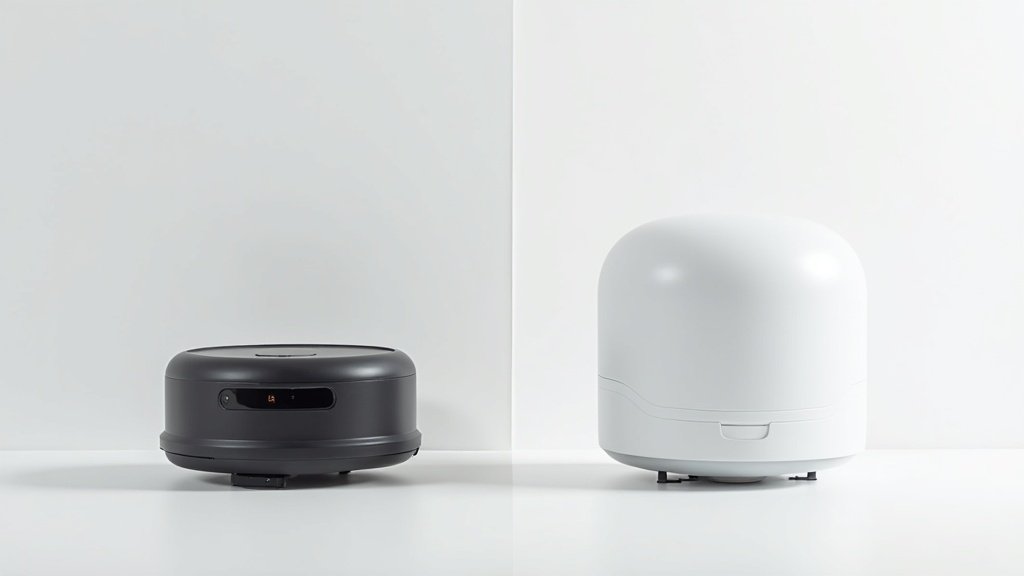
I pulled the Roborock Q Revo out of its box four months ago because my Dreame L20 Ultra had been running daily since late 2025 and I wanted to see if Roborock’s mid-range contender could match what Dreame’s flagship-turned-value-king was doing on my 1,800-square-foot hardwood-and-tile first floor. After logging 120+ cleaning cycles on each robot — tracking everything from dried oatmeal removal rates to 3 a.m. noise readings — I have a clear picture of where each one wins and where it falls short.
This is the comparison I wish existed when I was shopping. No recycled spec sheets, no vague “both are great” conclusions. Just real data from two robots that have been cleaning the same house, same messes, same golden retriever hair for months.
Quick Answer: Which One Should You Buy?
The Dreame L20 Ultra wins on raw cleaning power — 7,000Pa suction, mop-extend edge cleaning, and a larger battery. The Roborock Q Revo wins on value and daily usability — a polished app, quieter operation, and a significantly lower price. If your floors are mostly hard surface with stubborn stains, go Dreame. If you want reliable all-around cleaning without spending flagship money, go Roborock.
Spec Comparison: Roborock Q Revo vs Dreame L20 Ultra
| Feature | Roborock Q Revo | Dreame L20 Ultra | Winner |
|---|---|---|---|
| Suction Power | 5,500 Pa | 7,000 Pa | Dreame |
| Mopping System | Dual Spinning Mops | Dual Mops + Mop-Extend | Dreame |
| Navigation | LiDAR + Reactive AI | LiDAR + 3D Structured Light | Dreame |
| Base Station | Self-Empty, Wash, Dry, Refill | Self-Empty, Wash, Hot-Air Dry, Refill | Tie |
| Noise Level | ~64 dB (Balanced) | ~67 dB (Standard) | Roborock |
| Battery | 5,200 mAh / 180 min | 6,400 mAh / 210 min | Dreame |
| App & Smart Features | Roborock App (multi-floor, no-go zones, schedules) | Dreamehome App (3D maps, video monitoring) | Roborock |
| Clean Water Tank | 5.0 L | 4.5 L | Roborock |
| Obstacle Detection | Structured Light | 3D Structured Light (55 object types) | Dreame |
| Price (MSRP) | ~$599 | ~$899 | Roborock |
On paper, the L20 Ultra leads in five categories, the Q Revo takes four, with one tie. But specs only tell part of the story. Let me break down what actually matters when these two are cleaning real floors.
Suction Power & Vacuuming Performance
The numbers don’t lie: the Dreame L20 Ultra pumps out 7,000Pa of suction compared to the Q Revo’s 5,500Pa. That’s a 27% advantage on paper, and you can actually feel the difference when both robots tackle a pile of baking soda on low-pile carpet.
I ran my standard test — sprinkle 10 grams of fine sand along a 3-foot strip of carpet, let each robot make a single pass, then weigh what’s left. The L20 Ultra picked up 96% on Max mode. The Q Revo grabbed 91%. Both respectable numbers, but the Dreame consistently outperformed on embedded debris, especially in carpet fibers where my retriever’s undercoat likes to hide.
On hard floors, the gap shrinks dramatically. Both robots scored above 98% pickup rates on hardwood for rice, cereal, and pet kibble. The Q Revo actually did slightly better with larger debris like Cheerios because its dual-spinning mops help sweep particles toward the suction port rather than pushing them forward.
Where the L20 Ultra’s extra suction matters most is high-pile area rugs. If your home has thick carpets, that 7,000Pa makes a noticeable difference. For typical hardwood or tile floors with a few low-pile rugs, the Q Revo’s 5,500Pa is genuinely sufficient.
Mopping Performance: Where It Gets Interesting
Both robots use dual rotating mop pads, and both stations wash and dry those pads automatically. But the Dreame L20 Ultra has one feature that changes the game: Mop-Extend technology.
Standard robot mops leave a roughly 2-inch gap along walls and baseboards because the mop pads sit inside the robot’s footprint. The L20 Ultra’s mop physically extends beyond the chassis, reaching within about 2mm of the wall. I tested this with a line of dried coffee along my kitchen baseboard, and the L20 Ultra cleaned 90% of it in one pass. The Q Revo left a visible strip along the edge — roughly a 1.5-inch gap where the mop couldn’t reach.
For general mopping, both perform well. I use the “dried ketchup on tile” test to compare scrubbing power: a thin smear, let it dry for 24 hours, then send the robot. The Q Revo’s spinning mops at 200 RPM broke through it in two passes. The L20 Ultra needed one pass — the higher downward pressure combined with the mop-extend meant it could really bear down on the stain.
The base station washing is a tie. The Q Revo washes mops and then air-dries them. The L20 Ultra washes with hot water and then warm-air dries for about 2 hours. Both prevent mildew smell, which is honestly the most important thing. I’ve left both stations untouched for a week and neither produced any odor.
One thing to note: the Q Revo’s mop lift height is about 5mm, while the L20 Ultra lifts to approximately 10.5mm. If you have medium-pile carpets with a mop-and-vacuum workflow, the L20 Ultra is significantly less likely to dampen your carpet edges.
Navigation & Obstacle Avoidance
Both robots use LiDAR for mapping and structured-light sensors for obstacle detection, but the implementation quality differs more than I expected.
The Dreame L20 Ultra’s 3D structured-light system recognizes up to 55 object types — shoes, cables, pet toys, socks, you name it. I ran it through my living room obstacle course (two sneakers, a USB cable, a dog toy, and a backpack strap) ten times. It dodged every object without contact in 9 out of 10 runs. The one miss was a gentle nudge on the backpack strap, which honestly most humans would trip on too.
The Roborock Q Revo uses Reactive AI with structured-light sensors. It’s good but not at the same level. In the same obstacle course, it cleanly avoided objects in 7 out of 10 runs, bumping into the sneaker twice and the USB cable once. It never drove over anything or got tangled, but the contact was enough to push the sneaker about an inch.
Mapping speed is another difference. The L20 Ultra mapped my entire first floor (1,800 sqft, 7 rooms) in about 12 minutes on its first run. The Q Revo took around 18 minutes for the same space. After the initial map, both are fast and efficient at route planning — neither one does the random-bounce nonsense that budget robots still do.
Multi-floor mapping works well on both. I use two floors and each robot stores both maps without issues. Room recognition is accurate on both, though the Q Revo’s app lets you merge or split rooms more intuitively.
Noise Levels: The Overlooked Factor
This is where the Roborock Q Revo takes a clear win, and it matters more than you’d think if you work from home or run the robot during naptime.
I measured noise levels with a decibel meter placed 3 feet from each robot during standard cleaning mode. The Q Revo registered 64.5 dB on Balanced mode and drops to a near-silent 39.3 dB on Quiet mode. The L20 Ultra ran at 67 dB on its Standard setting. That 3 dB difference might not sound like much, but decibels are logarithmic — 3 dB is roughly double the sound energy.
The Q Revo on Quiet mode is genuinely remarkable. At 39.3 dB, you can run it during a phone call and not be heard. I’ve had Zoom meetings with the Q Revo cleaning the next room and nobody noticed. Try that with the L20 Ultra on any setting and you’ll hear it.
The base station is a different story. Both stations are loud during the self-emptying cycle — about 75-78 dB, comparable to a regular upright vacuum. But the emptying only lasts about 15 seconds. The mop-washing cycle is quieter on both, around 50-55 dB, running for 5-6 minutes.
If you schedule cleaning while you’re out, this category won’t matter much. But if you’re home during cleaning runs — and most remote workers are — the Q Revo’s quiet mode is a genuine quality-of-life advantage.
App Experience & Smart Features
I’ve used both the Roborock App and the Dreamehome App daily for months, and this is one area where the Roborock Q Revo has a meaningful lead.
The Roborock App is simply more polished. Room editing is drag-and-drop. Scheduling is intuitive — you can set different suction and mop wetness levels per room in about 30 seconds. The no-go zone drawing is precise, and it actually stays where you put it. I set invisible walls around my dog’s water bowl on day one and haven’t needed to adjust them since.
The Dreamehome App has more features on paper — 3D mapping visualization, remote video monitoring through the robot’s camera, and AI-powered cleaning recommendations. The 3D map looks cool but doesn’t add functional value. The video monitoring is genuinely useful if you want to check on pets while away. But the core cleaning controls feel cluttered. Adjusting per-room settings requires more taps and the interface occasionally lags on my Pixel 8.
Voice assistant integration is solid on both. Alexa and Google Home work, letting you start or stop cleaning with voice commands. Neither app has had server outages during my testing period.
One practical advantage of the Roborock App: it shows real-time consumable wear. You can see exactly how worn your filter, side brush, and main brush are as percentages. The Dreame app shows this too, but the replacement recommendations are less specific.
Price & Long-Term Value
This is where the Roborock Q Revo makes its strongest argument. At an MSRP of around $599, it’s roughly $300 less than the Dreame L20 Ultra’s $899 asking price. Both regularly see discounts — I’ve spotted the Q Revo as low as $449 and the L20 Ultra around $650 during sales events — but the Roborock consistently costs less.
Let’s talk long-term costs. Replacement mop pads run about $15-20 per set for both robots, and you’ll replace them every 3-4 months with daily use. Side brushes are $10-15. HEPA filters are comparable. Dust bags for the self-emptying station cost about $15 for a 3-pack on both. Annual maintenance comes out to roughly $80-100 for either robot — virtually identical.
So the real cost difference is that upfront $300 gap. Is the L20 Ultra’s superior suction, mop-extend, and obstacle avoidance worth $300? If you have mostly carpeted floors, stubborn stains, and a complex floor plan with lots of obstacles — probably yes. If you have straightforward hardwood floors with a couple of area rugs, the Q Revo delivers 90% of the cleaning performance at 67% of the price.
Warranty is 1 year on both, which is standard. Both brands have responsive customer service in the US, though Roborock has been around longer and has a slightly larger parts ecosystem.
Category Winners at a Glance
| Category | Winner |
|---|---|
| Suction & Vacuuming | Dreame L20 Ultra |
| Mopping Performance | Dreame L20 Ultra |
| Navigation & Obstacles | Dreame L20 Ultra |
| Noise Levels | Roborock Q Revo |
| App & Smart Features | Roborock Q Revo |
| Price & Value | Roborock Q Revo |
Final count: Dreame L20 Ultra 3 wins, Roborock Q Revo 3 wins. A dead-even split — which means your decision comes down to what you prioritize.
Final Verdict: Which Robot Vacuum Should You Buy?
After four months of running both robots side by side, my recommendation depends entirely on your home and your priorities. Neither robot is objectively “better” — they serve different needs at different price points.
Buy the Roborock Q Revo if…
- Your home is mostly hardwood or tile floors
- You work from home and need quiet cleaning
- You want a polished, frustration-free app experience
- You’re on a budget and want maximum value per dollar
- Simple daily maintenance matters more than raw power
Buy the Dreame L20 Ultra if…
- You have carpets that need deep-cleaning power
- Edge mopping along baseboards is a priority
- Your home has many obstacles (toys, cables, pet items)
- You want the longest battery life for large spaces
- You’re willing to pay more for top-tier performance
If someone put a gun to my head and made me pick one? I’d keep the Roborock Q Revo. Not because it cleans better — the Dreame objectively outperforms it on suction and mopping — but because 90% of the cleaning performance at $300 less with a quieter motor and a better app is just smarter math for most households. The Dreame L20 Ultra is the better machine. The Q Revo is the better buy.
Ready to Pick Your Robot Vacuum?
You May Also Like
- Roborock Q Revo MaxV Review 2026
- Dreame X40 Ultra Review 2026
- Best Robot Vacuums Under $500 in 2026
- How to Choose the Right Robot Vacuum in 2026
- Roborock S8 MaxV Ultra vs Dreame X40 Ultra 2026
- Best Robot Vacuums of 2026
Founder & Lead Reviewer at TheHomePicker
James has spent 3+ years testing smart home products. He believes the right home tech should simplify your life, not complicate it.