As an Amazon Associate, we earn from qualifying purchases. Full disclosure.
There is a billion-dollar industry built on making your home look like a Container Store catalog. Matching acrylic bins, bamboo drawer dividers, over-the-door racks in every shade of gray. The photography is beautiful. The promise is appealing. And about 40% of it winds up in a donation bag within six months because it never actually fit the space, the routine, or the stuff you own.
We have tested hundreds of organizers across kitchens, closets, bathrooms, garages, and every awkward corner in between. Some were genuinely life-changing — the pull-out cabinet shelf that finally made the back of a deep lower cabinet accessible, or the under-bed bins that reclaimed 15 square feet of hidden storage. Others were expensive lessons in measuring twice and buying once. This guide consolidates three years of hands-on experience into a room-by-room breakdown of what works, what does not, and exactly what to measure before you spend a dollar.
Start With a Plan, Not a Shopping Cart
The number one organization mistake is buying products before understanding what you actually need to store. That 10-piece pantry container set looks practical online, but if your pantry shelves are 10 inches deep and the containers are 12 inches, you just bought a problem, not a solution.
There are two schools of thought on home organization, and both have merit depending on your personality:
The Marie Kondo approach says declutter first, then organize. Pull everything out, decide what sparks joy (or, more practically, what you actually use), donate the rest, and only then figure out storage. This works exceptionally well if you are starting from scratch or have a serious accumulation problem. The risk is decision fatigue: four hours into sorting kitchen utensils, everything starts “sparking joy” because you just want to be done.
The practical systems approach says create structure first, then declutter gradually. Install your shelf dividers, label your bins, set up zones, and let the system naturally push out items that do not have a home. This works better for people who need momentum and visible progress to stay motivated. Our experience leans toward this method for most households.
Regardless of method, one step is non-negotiable: measure everything. Write down the width, depth, and height (in inches) of every shelf, cabinet, drawer, and closet rod before you open a browser. We keep a note on our phones with all key dimensions. Here are the measurements that catch people most often:
- Cabinet interior width (not exterior — walls eat 0.5-1 inch per side)
- Distance between shelves (adjustable shelves need clearance above)
- Closet rod height from floor (determines what fits underneath)
- Drawer interior depth (not the front panel depth — the actual usable space)
- Under-bed clearance (bed frame to floor — measure at the lowest point)
Kitchen Organization
Cabinet Organizers
Kitchen cabinets are where most organization money is well spent, because you interact with them 5-15 times daily. The problem with standard lower cabinets is depth: they are typically 24 inches deep, and anything shoved to the back becomes invisible. Upper cabinets are shallower (12 inches) but often tall enough that the top shelf is unreachable without a step stool.
A pull-out cabinet shelf is the single highest-impact kitchen organizer you can buy. It converts a dead-zone lower cabinet into fully accessible storage. Look for ball-bearing slides rated for at least 50 pounds (cheap plastic slides fail under the weight of pots and pans). Standard width options are 11, 14, 17, and 20 inches — measure your cabinet interior and subtract 1 inch for clearance. Cost: $25-$60 per shelf, and most install with just 4 screws.
Lazy Susans rescue blind corner cabinets. A 15-inch or 18-inch turntable puts every item within reach without pulling everything out. Two-tier models double usable surface area. The kidney-shaped (D-shaped) lazy Susans are designed specifically for blind corners and use the space more efficiently than round versions. Cheap ones wobble under load; look for models with steel ball bearings and a weight rating above 35 pounds.
Tiered shelf racks are the simplest upgrade for upper cabinets. A three-tier expandable rack (typically 10-23 inches wide) instantly doubles the usable layers on a single shelf. They are ideal for spice jars, canned goods, and small bottles that otherwise form a single disorganized row. Metal versions ($12-$20) last longer than bamboo or plastic, which tend to sag at wider extensions.
Under-Sink Storage
The under-sink cabinet is the most awkward space in any kitchen: pipes running through the middle, garbage disposal in the way, and a U-shaped dead zone around the plumbing. Most people just toss cleaning supplies in there and call it done.
An adjustable under-sink shelf with notches or cutouts for pipes solves the geometry problem. The best models have independently adjustable panels that slide around plumbing. Measure your pipe locations before ordering — the center drain pipe is usually 12-14 inches from the back wall, and you need at least 2 inches of clearance around it.
Tension rod trick: Install a tension rod horizontally across the upper part of the under-sink space and hang spray bottles from their triggers. This frees up the entire bottom shelf for bigger items. A 16-24 inch adjustable tension rod costs $5-$8 and holds 6-8 spray bottles easily. It is one of those “why did I not think of this sooner” solutions that costs almost nothing.
For cleaning supplies specifically, a caddy with a handle ($10-$15) lets you grab everything at once and carry it to whatever room you are cleaning, then return it under the sink when done. This beats the “pile of bottles falling over” approach that most of us default to.
Refrigerator Organizer Bins
Clear bins in the fridge serve two purposes: they group related items together (all condiments in one bin, all cheeses in another), and they make everything visible so nothing expires in the back corner. The best refrigerator organizer bins are clear, stackable, and sized to fit standard fridge shelf depths (most fridges have 17-18 inch deep shelves).
We tested dozens of bin sets, and the difference between a good set and a mediocre one comes down to three things: thickness of plastic (thin bins crack in cold temps), handle design (front-pull handles are easier than side-grip in a tight fridge), and size variety (a set with 3 sizes beats a set with 6 identical bins). A set of 6-8 bins typically runs $20-$35.
Egg holders with lids protect eggs better than the carton (which gets soggy) and stack, freeing shelf space. Can dispensers that auto-roll beverages forward are worth it if your household goes through more than a 12-pack per week; otherwise, a simple bin works fine. Avoid “soda can organizers” that hold fewer cans than the box they came in — measure the space first.
Pantry Systems
A pantry is either the most efficient room in the house or a graveyard for expired food. The difference is usually visibility and access. If you cannot see it, you will forget you own it, buy a duplicate, and find the original three months past its date.
Can racks: Gravity-feed can racks (you load from the top, cans roll to the front) genuinely reduce waste because you always grab the oldest can first. They work for any standard 14.5-15 oz can and most 28 oz cans. A 5-tier rack holds about 35 cans and costs $20-$30. Wall-mounted versions save shelf space but require stud mounting for the weight.
Label makers: A $20-$30 label maker pays for itself in reduced confusion and waste. We use the Brother P-Touch series — it is reliable, the tape lasts, and replacement cartridges are $8-$12. Label everything: bins, shelves, containers, and especially the freezer where items become unidentifiable after a week. Clear labeling also trains other household members to put things back in the right spot. A well-organized pantry starts with knowing what is in every container at a glance.
Airtight containers: Transfer dry goods (flour, sugar, rice, pasta, cereal) from bags to airtight containers. This prevents staleness, deters pantry moths, and stacks neatly. Square or rectangular containers use shelf space 30% more efficiently than round ones (circles waste the corners). OXO Good Grips POP containers are the gold standard — their one-touch lids seal reliably and pop open with one hand. A 7-piece set runs $50-$70 and covers most staples.
Closet & Bedroom Organization
Closet Systems
The closet industry wants you to believe you need a $3,000 custom closet system. For most people, a $150-$400 modular system from ClosetMaid, Rubbermaid, or IKEA does the same job. The key is matching the system to your wardrobe, not the other way around.
Modular systems (wire or laminate shelving that mounts on wall tracks) let you configure shelves, rods, drawers, and shoe racks to fit your exact space. Wire systems ($80-$200) are lighter, allow air circulation, and install faster. Laminate systems ($150-$400) look more polished and provide solid shelf surfaces. Either way, you want adjustable components that you can reconfigure as your wardrobe changes.
The most common closet mistake is allocating too much hanging space and not enough shelf or drawer space. Audit your wardrobe first: count the items you actually hang (suits, dresses, button-downs) versus fold (t-shirts, sweaters, jeans). Most people need less rod space and more shelves than they think. A well-designed closet system should leave 10-15% free space for growth — if it is packed tight on day one, it will overflow within months.
Double rod setup: If your closet has a single rod at 66-68 inches, adding a second rod at 36-38 inches doubles your hanging capacity for shirts, skirts, and folded pants. This is a $15 project with an adjustable hanging rod and takes 10 minutes. It is the single cheapest closet upgrade available.
Hat & Accessory Storage
Hats, scarves, belts, and bags are organizational nightmares because they do not fit standard storage formats. They are too bulky for drawers, too soft for shelves (they fall over), and too numerous for hooks. The best hat organizer solutions depend on your collection size:
- Small collection (1-8 hats): Over-the-door hooks or a wall-mounted hat rack. Simple, cheap ($10-$20), and keeps hats visible. Works for baseball caps and beanies. Felt hats and structured hats need a shelf to maintain their shape.
- Medium collection (8-20 hats): A dedicated hat organizer box or a rotating hat rack. Clear storage boxes designed specifically for hats ($15-$25 for a 4-pack) protect shape and prevent dust. Mount them on a closet shelf or under-bed.
- Large collection (20+): Hat walls (rows of adhesive hooks or a pegboard system) turn a collection into a display. Alternatively, a multi-tier hanging closet organizer ($15-$25) holds 10-15 caps in minimal space. Use the vertical space in a closet that is often wasted between the top shelf and the ceiling.
For belts: a pull-out belt rack ($12-$18) mounts inside a closet door or on a wall. For scarves: a multi-ring hanger ($8-$12) stores 15-20 scarves on a single hanger. For bags: shelf dividers ($10-$15 for a 4-pack) stand purses upright on shelves instead of the “pile of collapsed bags” approach.
Under-Bed Storage
The space under your bed is 15-30 square feet of storage that most people either ignore or fill with random boxes. The key spec is clearance: measure from the bottom of your bed frame (not the mattress) to the floor. Standard bed frames provide 6-8 inches of clearance. Platform beds are typically 5-6 inches. Bed risers ($15-$25 for a set of 4) add 3-5 inches and are a worthwhile investment if you need the space.
Low-profile bins (5-6 inches tall) fit under most beds without risers. Look for clear or labeled bins so you know what is inside without pulling them out. Bins with wheels ($15-$25 each) make access dramatically easier, especially if your bed is against a wall. Vacuum storage bags ($15-$20 for a 6-pack) compress bulky items like comforters, pillows, and winter coats to a third of their volume.
What to store under the bed: seasonal clothing, extra bedding, luggage, shoes you wear occasionally, and holiday decorations. What not to store: anything you need daily (you will never maintain the habit of reaching under the bed every morning), anything fragile (dust and the occasional kick from getting in and out of bed), or food and toiletries (temperature fluctuations and dust).
Bathroom & Laundry Organization
Over-Toilet Shelving
The wall space above a toilet is 2-4 square feet of unused real estate in the smallest room of the house. An over-toilet shelving unit ($30-$80) adds 2-3 shelves for towels, toiletries, and decorative items. Metal units with adjustable shelves are the most durable option and handle bathroom humidity better than particle board (which swells and warps within a year in a humid bathroom).
Installation note: most over-toilet units are freestanding (they lean against the wall with rubber feet) and do not require drilling. If you rent or prefer a non-permanent solution, these are ideal. Wall-mounted floating shelves ($20-$40 for a set of 2-3) look cleaner but require anchors in drywall, and you need to locate studs for heavier loads like stacked towels.
Avoid wood or MDF over-toilet units in bathrooms with poor ventilation. Steam from the shower will cause wood to swell, warp, and eventually mold. Stainless steel, chrome-plated metal, or coated bamboo resist moisture far better.
Shower Caddies & Towel Solutions
Shower caddies come in three types: tension pole (floor-to-ceiling spring-loaded), hanging (from the showerhead), and corner-mounted (adhesive or suction).
Tension poles ($20-$45) offer the most shelf space and stay put in most showers, but they rely on constant pressure between the floor and ceiling. Tile floors can be slippery, and the pole may slip over time. Place a small rubber pad under the base. Hanging caddies ($15-$30) are the easiest to install but add weight to the showerhead connection (which can cause dripping in older fixtures). Corner caddies ($10-$20) are the most discreet but have the smallest capacity and depend on adhesive or suction that degrades with moisture.
For towels, the simplest upgrade is a door-mounted towel bar or hook rack on the back of the bathroom door ($10-$15). This frees up wall space for other storage. Heated towel racks ($60-$150) are a luxury that dries towels between uses, preventing the musty smell that comes from damp towels hanging in a humid room. If your bathroom has a mold or mildew problem, a heated rack is a functional investment, not just a luxury.
Garage & Utility Spaces
Garage organization fails more often than any other room because the space is large, the items are heavy and irregular, and the environment (temperature swings, dust, moisture) is harsh on cheap storage solutions. Do not bring your indoor acrylic bins and bamboo shelves into the garage. They will not last.
Wall-mounted systems (slatwall panels, French cleats, or pegboard) are the backbone of a functional garage. Slatwall ($3-$6 per square foot, plus accessories) is the most versatile — hooks, baskets, shelves, and bike hangers all clip into horizontal grooves and can be repositioned in seconds. French cleats ($1-$2 per linear foot of lumber) are the cheapest and strongest option for heavy tools and custom shelving. Pegboard ($0.50-$1 per square foot) works for light tools and small items but sags under weight and looks cluttered quickly.
Ceiling storage is the most underutilized space in any garage. Overhead ceiling racks ($40-$100) bolt to ceiling joists and provide 4×8 feet of storage for seasonal items, holiday decorations, and camping gear. Weight limits range from 250-600 pounds depending on the model and installation. Hoist systems ($30-$60) use a pulley to raise and lower heavy items like kayaks and bicycles. Always bolt ceiling racks into joists, not drywall — the load will pull through drywall anchors eventually.
Tool organization: A combination of wall-mounted tool racks, a rolling tool cabinet, and labeled bins covers most workshops. Magnetic tool strips ($8-$15) hold screwdrivers, wrenches, and pliers in a visible row. Stackable parts bins ($10-$15 per row) organize screws, nails, and small hardware. If you can see the tool, you will use it; if it disappears into a junk drawer, you will buy a duplicate. We have tested this theory more times than we care to admit.
Materials & Durability — What to Look For
Organization products range from flimsy dollar-store plastic to overengineered steel. Knowing which material suits each location saves money and frustration.
| Material | Best For | Avoid In | Typical Load Capacity | Price Range |
|---|---|---|---|---|
| Bamboo | Drawers, countertops, dry shelves | Bathrooms, garages (moisture warps bamboo) | 10-25 lbs per shelf | $$ |
| Plastic (PP/HDPE) | Fridges, under-sink, kid rooms | High-heat areas, heavy tool storage | 15-40 lbs per bin | $ |
| Wire/Chrome steel | Pantries, garages, closets, heavy loads | Small items (they fall through gaps) | 50-200 lbs per shelf | $$ |
| Stainless steel | Bathrooms, kitchens, anywhere moisture is present | Budget projects (expensive for what you get) | 75-300 lbs per shelf | $$$ |
| MDF / Particle board | Closets, bedrooms, dry areas only | Bathrooms, basements, garages (swells with humidity) | 20-50 lbs per shelf | $ |
| Fabric/Canvas | Closet bins, soft goods storage, nurseries | Heavy items, damp areas | 5-15 lbs per bin | $ |
A general rule: use the lightest-weight material that can handle your load in that environment. Bamboo drawer dividers for utensils? Perfect. Bamboo shower caddy? Bad idea — use stainless steel. Wire shelving in the garage holding 80 pounds of paint cans? It was designed for exactly that. Wire shelving for small bathroom toiletries? Everything will fall through the gaps. Match the material to both the weight and the environment.
Common Organization Mistakes
After three years of testing and organizing, these are the errors we see most often, including ones we made ourselves:
- Buying before measuring. We cannot stress this enough. A beautiful 12-inch wide basket does not help when your shelf opening is 11.5 inches. Always subtract half an inch from the opening for insertion clearance. A tape measure costs $5 and prevents hundreds of dollars in returns.
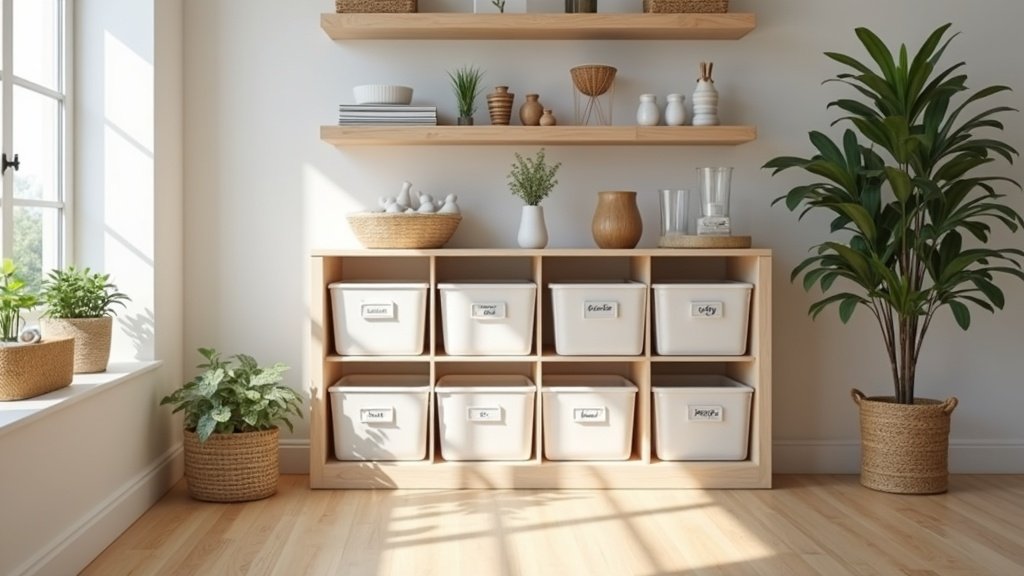
- Choosing aesthetics over function. Those woven seagrass baskets look stunning in Instagram photos and terrible after six months of actual use. They collect dust, do not stack, and the weave snags on knit fabrics. Clear bins are less photogenic but let you see contents instantly. Function always beats appearance in high-use areas.
- Overcomplicating the system. If your organization system requires 15 minutes of maintenance every evening, you will abandon it within two weeks. Good systems require zero maintenance: items go in and out of their assigned spots naturally because the placement makes sense.
- Ignoring vertical space. Most people organize horizontally (across shelves and inside drawers) and completely ignore the 4-6 feet of vertical wall space in closets, garages, and pantries. Wall-mounted hooks, pegboards, and floating shelves double your usable storage without taking up any floor space.
- Matching everything. An all-matching container set looks coordinated, but the uniform sizes rarely match what you actually need to store. Buy containers individually in the sizes that fit your specific shelves and items, even if they are different brands. Your pantry does not need to look like a magazine spread to be functional.
- Skipping labels. Every unlabeled bin becomes a mystery box within a week. You think you will remember what is inside. You will not. Label everything with a label maker or simple masking tape and marker. This is especially critical for garage storage, holiday decorations, and any multi-person household where others need to find and return items.
- Buying too many small organizers. A drawer with 12 tiny compartments is harder to use than one with 4-5 larger sections. Group similar items loosely rather than assigning every individual item its own slot. Exception: tool organizers and craft supplies, where precision matters.
- Ignoring the purge step. No amount of clever storage can fix a true accumulation problem. If you need 15 bins to organize a closet, you probably need to own fewer things, not more bins. Organize what you keep, not what you should have donated last year.
Our Testing Process
Every organization product we recommend goes through real-world testing in actual homes:
- Installation time: Measured from unboxing to fully installed, including reading instructions. Anything requiring more than 30 minutes of setup for a single component gets penalized.
- Fit accuracy: We compare the manufacturer’s stated dimensions against actual measurements. Discrepancies over 0.5 inches in any dimension are flagged as misleading.
- Load testing: Every shelf, rack, and bin is loaded to its stated weight capacity for 30 days. We check for sagging, warping, or failure. Products that fail under their rated capacity are rejected.
- Material durability: Products are tested in their intended environment (bathroom humidity, garage temperature swings, kitchen grease exposure) for a minimum of 60 days. Any degradation (rust, warping, discoloration, odor) is documented.
- Usability in daily life: The real test is whether the product stays in use after the initial excitement fades. We revisit every product at 30 and 60 days to check if it is still being used as intended or has been abandoned.
Full details on our evaluation criteria are available at How We Test.
Founder & Lead Reviewer at TheHomePicker
James has spent 3+ years testing smart home products. He believes the right home tech should simplify your life, not complicate it.
More to Explore
- The Complete Home Decluttering Guide 2026: A Room-by-Room System That Actually Sticks
- How to Choose a Closet Organization System in 2026: Wire vs Wood vs Custom (What's Actually Worth It)
- How to Organize a Small Kitchen in 2026: 15 Storage Hacks That Actually Work
- Best Under Sink Organizers in 2026: Solutions That Actually Fit
- Best Refrigerator Organizer Bins in 2026 (Clear, Stackable & BPA-Free)
- Best Kitchen Cabinet Organizers in 2026: Pull-Out Shelves, Lazy Susans & Rack Systems