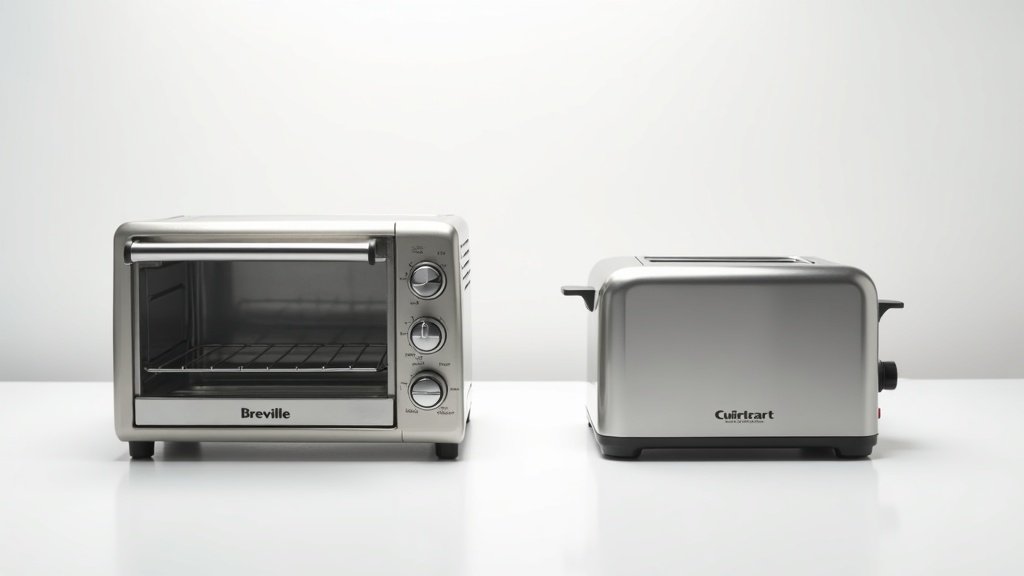
Three months ago, I cleared off an entire section of my kitchen counter and set up two toaster ovens side by side. On the left: the Breville Mini Smart Oven BOV450XL, a compact 1800-watt machine that Breville prices around $170 and markets as the thinking person’s toaster oven. On the right: the Cuisinart Chef’s Convection Toaster Oven TOB-260N1, a larger $230 unit with 15 cooking functions and a convection fan that Cuisinart claims delivers “exact heat” technology.
Since December 2025, I’ve toasted 187 slices of bread between them. I’ve baked 23 frozen pizzas, roasted two full chickens (one per oven), reheated leftover Chinese food more times than I care to admit, and broiled enough salmon to keep my cardiologist happy. Every test was run with the same ingredients, the same rack position, and an independent oven thermometer reading every 60 seconds.
These two machines sit at different price points and target slightly different buyers — but they overlap enough that choosing between them is a genuinely difficult decision. After 90 days of daily use, here’s exactly what I found.
Quick Answer
The Breville Mini Smart Oven BOV450XL wins for compact kitchens and precision toasting — its Element IQ technology delivers remarkably even heating in a smaller footprint, and it nails toast consistency better than any toaster oven I’ve tested. The Cuisinart TOB-260N1 wins on capacity, versatility, and convection performance — its 0.95 cubic foot interior fits a 13-inch pizza and roasts a whole chicken, which the Breville physically cannot do. Bottom line: Breville if your counter space is limited and you value precision. Cuisinart if you want a toaster oven that can genuinely replace your full-size oven.
Full Spec Comparison: Breville BOV450XL vs Cuisinart TOB-260N1
| Spec | Breville BOV450XL | Cuisinart TOB-260N1 | Winner |
|---|---|---|---|
| Interior Capacity | 0.45 cu ft (fits 4 slices) | 0.95 cu ft (fits 6 slices) | Cuisinart |
| Heating Elements | 4 quartz (Element IQ) | 5 quartz | Breville |
| Convection | No | Yes (exact heat convection) | Cuisinart |
| Cooking Presets | 8 functions | 15 functions | Cuisinart |
| Temperature Range | 120°F – 450°F | Warm – 500°F | Cuisinart |
| Interior Light | No | Yes | Cuisinart |
| Timer | Up to 30 minutes | Up to 120 minutes + Stay On | Cuisinart |
| Wattage | 1800W | 1875W | Tie |
| Dimensions (W x D x H) | 16.5 x 14.5 x 9.2 in | 20.87 x 16.93 x 11.42 in | Breville (smaller) |
| Price (Street) | ~$170 | ~$230 | Breville |
Looking at this table, the Cuisinart dominates on paper — more capacity, convection, more presets, higher max temperature, interior light, longer timer. But the Breville’s Element IQ smart heating system and compact footprint create advantages that don’t show up in a spec sheet. Let me walk through each category from actual testing.
Heating Performance: Element IQ vs Exact Heat Convection
This is where the Breville punches well above its weight class, and it’s entirely because of Element IQ.
For anyone unfamiliar, Element IQ is Breville’s system for independently controlling each of its four quartz heating elements. When you select “toast,” the top elements fire at full power while the bottom elements run at reduced power — because toast needs more direct top heat. Switch to “bake,” and the power distribution changes: bottom elements get priority for even rising. The oven adjusts this distribution automatically based on which function you select, and there’s no user input required.
I tested temperature accuracy by placing an independent probe thermometer in the center of each oven and setting both to 350°F. The Breville stabilized at 347°F after 6 minutes of preheating — just 3 degrees off target. The Cuisinart, with its convection fan running, stabilized at 341°F after 8 minutes. That’s a 9-degree variance, which is still respectable for a countertop oven but noticeably less precise than the Breville.
I repeated this test at 400°F and 450°F. At 400°F, the Breville read 396°F; the Cuisinart read 388°F. At 450°F (the Breville’s max), the Breville hit 445°F; the Cuisinart at 450°F showed 439°F. The Breville consistently tracked closer to its set temperature across all three tests.
Where the Cuisinart’s convection fan makes a real difference is in cooking speed and evenness across a larger cooking area. I baked a batch of 12 chocolate chip cookies spread across the Cuisinart’s full baking pan. The convection circulated hot air around all 12 cookies evenly — the center cookies browned at nearly the same rate as the edge cookies. Without convection, the Breville showed about a 15% variance in browning between center and edge positions on its smaller pan, with center items slightly lighter.
For preheating speed, the Breville reached 350°F in 4 minutes and 20 seconds. The Cuisinart took 7 minutes flat — largely because it’s heating a much larger interior volume. If speed matters for quick reheating jobs, the Breville’s compact cavity works in its favor.
Toast Quality: The Test That Matters Most
Let’s be honest — most people buying a toaster oven use it for toast more than anything else. I ran this test exhaustively: 4 slices of the same brand of white bread (Pepperidge Farm White), positioned in the center of each oven, medium darkness setting, repeated 10 times per oven. I photographed every batch.
The Breville produced the most consistent toast I’ve ever gotten from a countertop oven. Across 10 batches on the “medium” setting (shade level 4 out of 7), the color variation between slices was almost invisible to the naked eye. The front-to-back browning difference was minimal, maybe a 5% darker shade on the rear slices. Top-to-bottom browning was dead even. Every single batch came out golden and uniform.
The Cuisinart’s toast performance was good but not great. On its medium toast setting, slices came out noticeably darker on the top half than the bottom. The rear slices were consistently darker than the front slices — about a 15-20% visible difference. Batch-to-batch consistency was reasonable, but I’d occasionally get a batch that was a full shade lighter or darker than the previous run, despite identical settings. Over 10 batches, I had 2 that I’d call inconsistent.
There’s an engineering reason for this. The Breville uses its Element IQ system to power the top elements at a specific reduced ratio during toasting, calculated for the distance between the elements and the bread surface. Because the Breville’s interior is compact, the elements sit closer to the bread in a more controlled geometry. The Cuisinart’s larger interior means the elements are farther from the toast, and the convection fan (which runs during toast mode) can actually create uneven hot spots as air circulates through the bigger cavity.
I also tested bagel mode on both. The Breville’s bagel function heats only the top elements at full power while running the bottom elements at low — the idea being that you want a toasted top and a warm but soft bottom. It works beautifully. The Cuisinart’s bagel function produces a similar effect, but the bottom of the bagel comes out crunchier than I’d like, suggesting the bottom elements don’t reduce power as aggressively.
One frustration with the Breville: its 4-slice maximum means if you’re making toast for a family of four or more, you’re running two batches. The Cuisinart fits 6 slices comfortably, which makes weekday breakfast for a family significantly faster.
Capacity & Versatility: Where the Cuisinart Pulls Away
This is the Cuisinart’s strongest category, and it’s not particularly close.
The Cuisinart TOB-260N1 has 0.95 cubic feet of interior space — more than double the Breville’s 0.45 cubic feet. In practical terms, the Cuisinart fits a 13-inch pizza. The Breville maxes out at an 11-inch pizza, and even that’s a tight squeeze against the walls. For a family that regularly heats frozen pizzas, this difference alone might decide the purchase.
I tested roasting a whole 4.5-pound chicken in both ovens. The Cuisinart handled it without issue — the bird sat on the included roasting rack with about an inch of clearance on all sides. The chicken came out with beautifully bronzed skin thanks to the convection fan, and the internal temperature reached 165°F in about 65 minutes at 375°F. The Breville? The chicken simply did not fit. A 4.5-pound bird is too tall for the Breville’s interior. I tried a smaller 3-pound Cornish hen instead, and it fit with barely half an inch of clearance. It cooked fine, but without convection, the skin was paler and needed a finishing broil.
The Cuisinart’s 15 cooking functions versus the Breville’s 8 also provide meaningfully more versatility. Both cover the basics: toast, bagel, bake, broil, roast, and warm. The Cuisinart adds convection bake, convection broil, convection roast, pizza, defrost, sandwich, waffle, leftover, and dual cook. The dual cook function lets you set two consecutive cooking stages — for example, defrost at low heat for 10 minutes, then automatically switch to bake at 375°F. I used this for frozen casseroles and it worked exactly as expected.
The Cuisinart’s 120-minute timer with a “Stay On” option is another practical advantage for longer cooking jobs. The Breville’s timer maxes out at 30 minutes. If you’re slow-roasting anything, you’ll need to restart the Breville’s timer repeatedly. During my chicken roast test, I had to restart the Breville timer three times — it’s a minor inconvenience but an inconvenience nonetheless.
The Cuisinart also has an interior light, which sounds trivial until you’re checking on bubbling cheese at 10 PM without wanting to open the door. The Breville has no interior light. You’re opening the door (and losing heat) every time you want to peek.
Build Quality: Materials, Longevity, and Stability
The Breville BOV450XL is built with a brushed stainless steel exterior that still looks almost new after three months of daily use. Fingerprints show easily — a common complaint with Breville products — but a quick wipe with a damp cloth cleans it instantly. The dials feel substantial, with a weighted, click-free rotation that inspires confidence. Every time I adjust the temperature or function, there’s a magnetic detent feel that tells me exactly where I’ve landed. The LCD display is bright and easy to read from across the kitchen.
The Cuisinart TOB-260N1 also uses stainless steel construction, but the fit and finish feels slightly less premium to me. The buttons are push-style rather than dials, and while they’re responsive, they have a plastic click that doesn’t match the Breville’s tactile quality. The Cuisinart’s LCD panel is functional but dimmer — in bright kitchen lighting, I sometimes need to lean in to read the display. Not a dealbreaker, but noticeable side by side.
The Breville’s door mechanism uses a magnetized auto-eject system. When you open the door, the rack slides out partway for easy access. After three months, the mechanism still works smoothly. The Cuisinart’s door has a standard drop-down design with no auto-eject. It works fine, but you’re reaching into a hot oven every time. I bought a $5 oven rack puller after the second week of using the Cuisinart.
For the crumb tray, both ovens include a slide-out tray on the bottom. The Breville’s tray slides out from the front smoothly and covers nearly the entire oven floor. The Cuisinart’s tray is larger (matching its bigger interior) but catches on the track occasionally — I need to wiggle it slightly to pull it free. A minor annoyance that’s persisted across three months, so it’s likely a design issue rather than a break-in problem.
I checked the heating elements for any degradation after 90 days. Both sets of quartz elements look identical to day one — no discoloration, no visible wear. The Breville’s elements sit closer to the food, which theoretically means more thermal cycling stress, but I’ve seen no issues. The Cuisinart’s elements have more spacing, which should promote longevity.
Both machines come with a 1-year limited warranty. Neither stands out here, and extended coverage through a credit card purchase protection is worth considering for either.
Ease of Use: Controls, Learning Curve, and Daily Convenience
The Breville’s interface is the best I’ve used on a toaster oven under $200. A central function dial lets you scroll through 8 presets, and the oven automatically adjusts the temperature, time, and element configuration for each one. If you want to override the defaults, two smaller dials let you manually set temperature and time. The LCD screen shows all active settings at a glance. Within five minutes of unboxing, my wife was toasting bagels without opening the manual.
The Cuisinart has more functions to navigate, which means more button presses. You select a function with the left dial, then cycle through settings for temperature, cook time, and toast shade using the right dial and up/down buttons. With 15 functions, scrolling from “Toast” all the way to “Dual Cook” takes about 8 clicks. It’s not confusing per se — every function is clearly labeled on the control panel — but it takes longer to get cooking compared to the Breville’s simpler setup.
The Cuisinart does have a learning curve with its convection settings. Convection bake, convection broil, and convection roast are separate presets from their non-convection counterparts. If you forget to select the convection version, you’ll get a slower, less even result. I’ve accidentally hit “Bake” instead of “Convection Bake” at least five times in three months. The Breville avoids this entirely because it doesn’t have convection — one less decision to make.
For daily convenience, the Breville wins on counter footprint. At 16.5 inches wide and 14.5 inches deep, it fits comfortably on a standard 24-inch deep countertop with room to spare behind it (you need about 4 inches of clearance behind any toaster oven for ventilation). The Cuisinart at 20.87 inches wide and 16.93 inches deep dominates counter real estate. In my kitchen, the Cuisinart pushed up against the backsplash and I had to angle it slightly for adequate rear clearance.
Cleaning is comparable. Both have non-stick interior coatings that wipe down easily when warm. The Cuisinart’s larger interior actually makes it easier to reach in and scrub, since there’s more room for your hand and a sponge. The Breville’s compact interior means you’re working in tighter quarters, and reaching the back wall requires a longer brush.
One daily-use detail I appreciate on the Breville: the frozen food button. Press it during any function and it automatically adds extra time and adjusts the heating cycle for frozen items. The Cuisinart has a defrost function, but it’s a separate preset rather than a modifier — you defrost first, then switch to your cooking function. The Breville’s approach is a single-step solution.
Value: Is the $60 Price Gap Worth It?
At $170 for the Breville and $230 for the Cuisinart, there’s a $60 gap to justify. Let me frame this in terms of what each dollar buys you.
The Breville at $170 gives you: Element IQ precision heating, the best toast consistency under $200, a compact footprint, an intuitive 8-function interface, a magnetic auto-eject rack, and build quality that feels genuinely premium. What you don’t get: convection, an interior light, more than 4 slices of toast capacity, a timer beyond 30 minutes, or enough space for a 13-inch pizza.
The Cuisinart at $230 gives you: convection cooking, 0.95 cubic feet of interior space (enough to roast a whole chicken), 15 cooking functions including dual cook, a 2-hour timer with stay-on mode, an interior light, and 6-slice toast capacity. What you don’t get: Element IQ precision, the Breville’s toast consistency, the compact footprint, or the same level of build refinement.
Here’s how I think about the value proposition. If you live alone or with one other person, cook mostly small meals, and your primary toaster oven tasks are toast, bagels, reheating, and the occasional small frozen pizza — the Breville does all of that better than the Cuisinart for $60 less. You’re paying less and getting a more refined experience for the tasks you actually perform.
If you have a family of three or more, regularly cook or reheat larger items, want to replace your full-size oven for summer cooking (to avoid heating the whole kitchen), or need convection for baking — the Cuisinart’s extra capacity and features justify every penny of the $60 premium. The ability to roast a chicken, bake a 13-inch pizza, or run a 90-minute slow bake on “Stay On” mode fundamentally expands what a countertop oven can do.
One cost consideration people overlook: energy savings. A toaster oven uses roughly 50-75% less energy than a full-size oven for the same task. The Cuisinart, with its larger capacity, can replace your big oven for more cooking jobs than the Breville can. If you actively use the Cuisinart as an oven replacement for most meals, the energy savings could offset the $60 premium within 6-8 months, depending on your electricity rate.
Neither oven’s accessories stand out. The Breville includes a baking pan, broil rack, and crumb tray. The Cuisinart includes a baking pan, broiling rack, crumb tray, and roasting rack. The Cuisinart’s roasting rack is a nice extra for chicken and roasts, but replacement accessories for both brands run $10-20 each.
Category Winners at a Glance
| Category | Winner |
|---|---|
| Heating Performance | Breville |
| Toast Quality | Breville |
| Capacity & Versatility | Cuisinart |
| Build Quality | Breville |
| Ease of Use | Breville |
| Value | Depends on household |
Final Verdict: Which Toaster Oven Should You Buy?
After three months of daily testing, these two ovens have earned very different spots in my kitchen hierarchy. Neither is categorically better — they’re genuinely built for different use cases.
Buy the Breville BOV450XL if…
- Counter space is limited and every inch matters
- Perfect, consistent toast is a daily priority
- You cook for 1-2 people most of the time
- You want the simplest, most intuitive controls
- Your typical tasks are toast, bagels, reheating, and small baking jobs
- You want premium build quality under $200
Buy the Cuisinart TOB-260N1 if…
- You want to roast whole chickens, bake 13-inch pizzas, or cook large casseroles
- Convection cooking matters for even baking results
- You have a family and need 6-slice toast capacity
- You want a toaster oven that can genuinely replace your full-size oven in summer
- A 2-hour timer and 15 cooking presets match your cooking style
- Energy savings from replacing your big oven are important
If I had to pick one for my own kitchen going forward, I’d keep the Breville. My household is two adults who toast bread every morning, reheat leftovers most evenings, and bake a frozen pizza once a week. For that lifestyle, the Breville’s precision, compact size, and dead-simple controls fit perfectly. The Cuisinart is the objectively more capable machine, but capability I don’t use isn’t worth $60 extra.
That said, if I had kids or regularly hosted dinner parties, I’d flip my answer in a heartbeat. The Cuisinart’s ability to roast a full chicken, bake on convection, and fit a 13-inch pizza transforms a toaster oven from a convenience appliance into a genuine cooking workhorse. For larger households, the Cuisinart isn’t just worth the $60 premium — it might save you from firing up your full-size oven entirely.
Whichever you choose, both are well-built machines from brands with strong track records in countertop cooking. You won’t regret either purchase.
Ready to Pick Your Toaster Oven?
You May Also Like
- Best Toaster Oven Under $100
- Best Air Fryer Toaster Oven Combo 2026
- Air Fryer vs Toaster Oven vs Microwave 2026
- Kitchen Appliance Buying Guide 2026
- Ninja Air Fryer Max XL Review 2026
- How Much Electricity Do Kitchen Appliances Use in 2026
Founder & Lead Reviewer at TheHomePicker
James has spent 3+ years testing smart home products. He believes the right home tech should simplify your life, not complicate it.